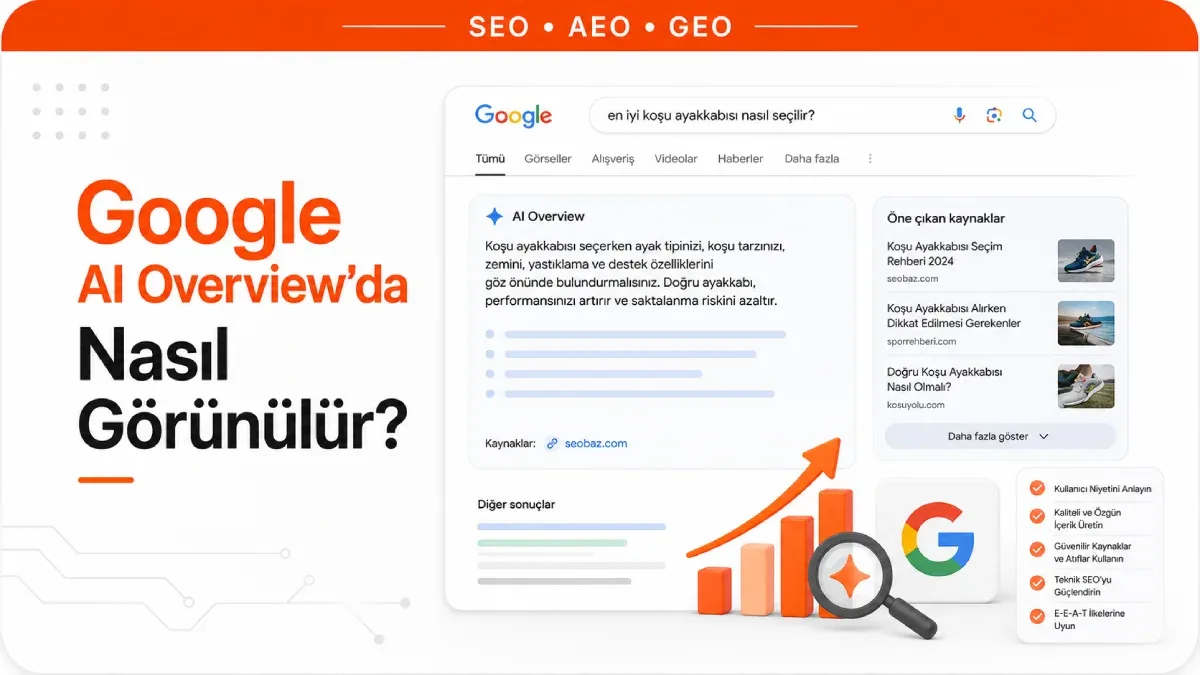
When you search for a query, the first thing you see on the results page is no longer ten blue links. At the top sits an answer a few sentences long, and next to it a few source cards that the answer is based on. User behavior splits accordingly: people either read the answer there and leave, or they click, and what they click is not necessarily the first classic result but one of those cards. So the question "how do I appear in AI Overviews" comes down in practice to a single question: is my page a candidate for those cards?
Google's own documentation ties this candidacy to two conditions. The page must be indexed, and it must be eligible to be shown with a snippet in Google Search. The sentence the documentation adds right after is missing from most guides: there are no additional technical requirements. In other words, AI Overviews are not a separate system entered through a separate door, but a display format that sits behind the eligibility gate of classic search.
When is a page eligible to appear in AI Overviews?
Eligibility passes through two filters, and both are on the classic Search side.
- Being indexed. A page that is not crawled or carries
noindexis not even in the candidate pool. The links in an AI answer come from the search index, not from a separate source store. - Being eligible to be shown with a snippet. It must be possible to extract a preview from the page's text. Any setting that restricts the preview also restricts visibility in AI Overviews at the same time.
The conclusion is simpler than most teams expect: no separate infrastructure is built for AI Overview visibility. What needs to be in place is the indexing and preview eligibility that should already be there. If a page fails these two conditions, no amount of good writing changes the outcome, because the page never reaches the evaluation stage.
In the same place, Google also sets a limit. Even a page that meets every requirement, follows best practices and does not violate policies is not guaranteed to be crawled, indexed or served. This sentence matters, because it removes the basis for approaches that describe appearing in AI Overviews as a matter of completing a checklist. Eligibility is a necessary condition, not a sufficient one.
Which controls turn visibility on and off?
The controls available to a site owner work independently, and people often confuse which one shuts off what. Because Google defines AI as an integral part of how Search works, the set of controls here is the same as the classic Search control set.
| Control | What it does | Effect in AI Overviews |
|---|---|---|
| robots.txt (Googlebot) | Manages crawling of the page for Search | A page that is not crawled cannot be a candidate |
noindex |
Keeps the page out of the index | Eligibility is removed entirely |
nosnippet |
Prevents preview text from being shown from the page | Eligibility as a supporting link is removed |
max-snippet |
Limits the length of the preview shown | The usable passage narrows |
data-nosnippet |
Keeps specific sections of the page out of the preview | The marked section is not used as a source |
| Google-Extended | Limits AI training and grounding in Google's other systems | Not a control for AI features in Search |
The last row is the most expensive misunderstanding in the field. Google-Extended is not an opt-out switch for AI Overviews in Search; it is used to limit training and grounding access in some of Google's systems outside Search. A site that wants to manage visibility on the Search side should look at preview controls instead of dealing with Google-Extended. The reverse also holds: a site that blocks Google-Extended thinking it has opted out of AI Overviews has not actually shut anything off.
For sites whose content still appears in AI features despite applying preview controls, Google's recommended order is clear: first confirm that the tag is actually present in the HTML Googlebot sees, then allow time for recrawling. Google itself says this can take anywhere from a few days to a few months. In short, the controls do not take effect instantly.
Do schema, llms.txt and FAQ markup increase visibility?
Google's documentation answers this question directly: you do not need to create new machine-readable files, AI text files or markup to appear in these features, and there is no special schema.org data you need to add.
Independent tests point the same way. In an experiment run on 1,885 pages, adding structured data did not produce a measurable difference in AI visibility. The picture is similar for llms.txt: a log analysis of 515 million bot requests found that engines did not fetch this file when generating citations. The two findings reach the same conclusion through different methods and do not contradict Google's official statement.
This does not mean structured data is useless; it just puts its role in perspective. Schema is valuable for classic Search features and the semantic consistency of a page; Google's only requirement is that the markup matches the visible text on the page. On the other hand, since FAQ rich results have been removed from general search results, old tactics that treat FAQPage markup as a visibility lever are now wasted effort.
The practical reading: markup is not a visibility lever but a clarity tool. What gets a page into an AI Overview is not a file you add but whether that page carries the answer.
How do you write a citable passage?
Once past the eligibility gate, competition moves from page level to passage level. The system does not select the whole page but the piece that corresponds to the answer. So the real question is not "is my page good" but "which paragraph on my page answers the question on its own".
A large-scale analysis of where passages used in answers are drawn from (1.2 million answers and 18,000 citations) showed that about 44 percent of citations came from the first third of the content. This is an observation about distribution, not a ranking rule. Piling information into the first third of a text does not produce citations. The usable reading of the finding is simpler: when the real answer to a question is buried deep in the page, the chance of that answer being the selected passage drops.
Similarly, there are observational studies showing that headings written as questions receive citations about twice as often. No quota such as "this percentage of headings should be questions" follows from this. A reasonable explanation of the relationship lies in the mechanics: the system works by breaking a main query into sub-questions, and when a question-form heading matches a sub-question exactly, the paragraph beneath it becomes a direct candidate passage. So what works is not phrasing the heading as a question but making it match a real sub-question. If the question is not the actual question, adding a question mark changes nothing.
That is why three things are decisive in writing passages:
- Standalone comprehensibility. When the paragraph is pulled out of the page, is its main claim still clear? If not, it is not citable.
- Position of the answer. If a section answers a real question, the answer should be at the opening of the section, not in the third sentence. Explanation and evidence come after.
- No vague references. Chains like "this method", "the system in question" and "as described above" make a paragraph dependent on context and unusable on its own.
Matching questions to answers as a writing discipline is treated as a field of its own, separate from search engine optimization. For the conceptual framework of this distinction, see our article on what AEO is.
Your own page is not your only visibility surface
No matter how well you build your own content, a large share of the sources that appear in AI answers come from outside brand websites. In an analysis of more than 25 million citations, about 84 percent of citations went to earned media, meaning news, industry publications and third-party content rather than pages the brand published itself.
This finding does not mean you should abandon your own content. Your own page is the only surface you control, and it is the only asset that carries the eligibility conditions. But on its own it is not a sufficient visibility plan either. Earned media, institutional references, community content and video surfaces are not interchangeable channels but complementary surfaces. When a brand only tries to appear on its own blog, it stays outside the pool that feeds most answers.
For the full logic of this multi-surface visibility and how it differs from classic search optimization, see the cluster's main article, what is generative engine optimization (GEO).
How do you read AI Overview visibility in Search Console?
The first thing to know on the measurement side is a limitation: pages that appear in AI features are not reported under a separate report in Search Console but within the "Web" search type of the Performance report, included in general search traffic. So the question "how many clicks came from AI Overviews" has no direct answer in Search Console.
In practice, this limitation means the following. You cannot see the effect of AI Overviews in a single metric; you need to read the relationship between impressions, average position and click-through rate together. A falling click-through rate while impressions hold steady typically points to the answer being satisfied on the results page, but this is not proof on its own and can also be explained by seasonality, a change in query mix or other changes to the results page layout.
Google says it has found that clicks from results pages with AI Overviews are higher quality, meaning users tend to stay on the site longer. It is worth noting that this is a statement based on Google's own measurement; it is not an independently verified industry finding. If you want to test it on your side, you need to track session duration and conversion rate separately in your analytics.
In Turkish-language search, the history of this measurement is short. AI Overviews and AI Mode launched in Türkiye in February 2026, and only as a gradual rollout. So it is not yet possible to read the traffic impact of AI features on a Turkish site with a long before-and-after series. The comparison windows available are narrow, and trend interpretations drawn from these windows should be treated with caution.
If you're not appearing, what do you check, in order?
The problem is usually not content quality but an early link in the eligibility chain. The order is:
- Is the page actually in the index? Verify with URL Inspection. Discussing content for a page that is not indexed is pointless.
- Is snippet eligibility on? Check whether the HTML Googlebot sees contains
nosnippet, a narrowmax-snippetvalue or adata-nosnippetcovering the section that carries the answer. These tags often come from a template or plugin and go unnoticed. - Has the change been reflected? Recrawling after you fix tags or content takes time. Do not read results before this period, which can range from a few days to a few months, has passed.
- Which question does the page answer? Is there a clear paragraph that corresponds to the query's sub-question? Text that covers the topic but does not answer the question does not produce a selectable passage.
- Does the query trigger an overview at all? Not every query triggers an AI Overview. If no overview appears for your target query, the problem is not your page.
Skipping this order and going straight to rewriting content is the most common waste of time in the field. Content work done while there is a blocker on the index or preview side does not change the outcome.
If you think auditing eligibility conditions, passage architecture and an earned media plan need to be run together, take a look at the scope of our GEO work.
Frequently Asked Questions
Are AI Overviews and featured snippets the same thing?
No. A featured snippet is a block of text taken from a single page and has a single source. An AI Overview generates an answer compiled from multiple sources and shows supporting links alongside it. The eligibility conditions overlap, because both require the page to be eligible to be shown with a snippet, but their selection logic is not the same.
If I block Google-Extended, will I stop appearing in AI Overviews?
No. Google-Extended is used to limit AI training and grounding access in some of Google's systems outside Search. To manage what is shown in AI features within Search, use the nosnippet, data-nosnippet, max-snippet and noindex controls.
If my page is indexed but never shows up as a source, is that a penalty?
No. Google states explicitly that even a page meeting all requirements and best practices is not guaranteed to be crawled, indexed or served. Not being selected as a source is not a sign of a sanction; it means other passages were judged more suitable for the same information need.