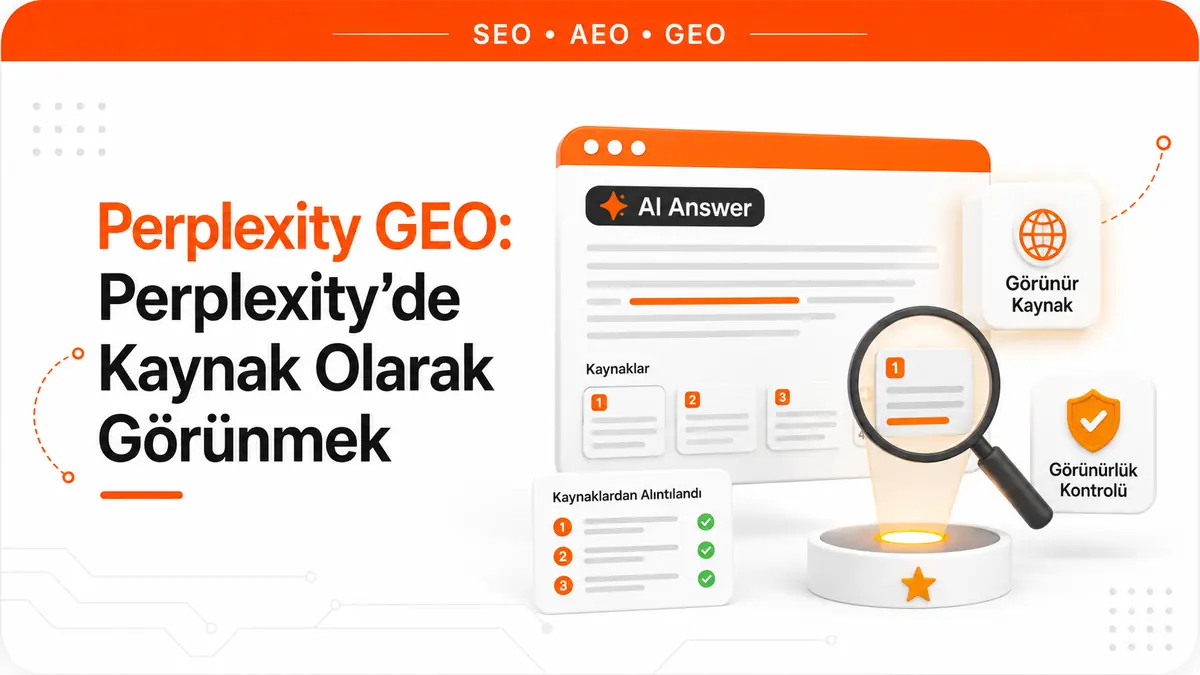
When you ask Perplexity a question, a list of the sources it used sits next to the answer, and numbered links to those sources are attached within the sentences. This behavior makes Perplexity visibility a much more concrete goal than with other AI assistants: the aim is to be a line in that list next to the answer.
The path into that list, however, does not run where most sites expect. Instead of borrowing results from an existing search engine, Perplexity operates its own crawlers, and its official documentation defines two separate user agents for this work. No matter how good the content is, if these two agents cannot reach the page, the visibility discussion never even starts. That is why the order below deliberately starts with technical access and moves toward content.
What is Perplexity, and how is it different from a classic search engine?
Perplexity is an AI search tool that takes the user's question, searches the web, reads the pages it finds, synthesizes them into a single answer and presents that answer together with the sources it used. In a classic search engine, the user makes the choice by clicking one of ten results. In Perplexity, the system makes the choice and gives the user both the result and the sources it consulted to build that result.
For a site owner, this difference has two practical consequences. First, clicks now come from the source list, not from rankings. Second, even if a page ranks well in classic search, it may not be included in the list if it is not suited to building the answer, because what the system needs is usable information, not a link. The general framework here is common to all generative search surfaces and is covered in detail in our article explaining what GEO is. What makes Perplexity a separate topic is that it adds its own crawling infrastructure on top of this framework.
Where does Perplexity find its sources?
Perplexity's own documentation defines two separate agents, and they do not do the same job. Not knowing the difference can lead to a site dropping out of Perplexity search because of a single line written in robots.txt.
| Agent | What it does | robots.txt behavior | What happens if blocked |
|---|---|---|---|
| PerplexityBot | Crawls the site to surface and link it in Perplexity search results | For a site to appear in search results, Perplexity recommends allowing this agent in robots.txt and accepting requests from its published IP ranges | The site becomes invisible on the Perplexity search side |
| Perplexity-User | Visits the page at the moment a user asks a question to build the answer accurately, and may add the page's link to the answer | Because the request is triggered by a user, this agent generally does not follow robots.txt rules | A robots.txt line does not stop this agent; blocking only happens at the server or firewall layer |
The documentation makes one more point explicitly: neither agent collects content to train AI foundation models. So the decision to block training crawlers and the decision to block the search crawler are not the same decision. Writing a blanket AI ban in robots.txt mixes the two up and can shut off the brand's visibility in Perplexity search without changing its share of training data.
Is my site open to Perplexity?
You cannot answer this question by looking at robots.txt, because access can be cut at more than one layer. The fact that Perplexity's own documentation devotes a separate section to firewall configuration suggests that this happens often in practice. Work through it in this order:
- Check robots.txt. There should be an explicit allow for PerplexityBot. Make sure it is not caught by a general disallow line.
- Check the firewall and CDN layer. Perplexity publishes separate configuration steps for Cloudflare and AWS WAF. Even with robots.txt open, a WAF rule can drop the request, and this never shows up in robots.txt.
- Verify IP ranges. A user agent string is information that can be spoofed. Perplexity provides JSON endpoints that publish the IP ranges of both agents. You should tie your allow rule not to the user agent alone but to the combination of user agent and IP range, and refresh this list regularly.
- Read your server logs. This is where real verification happens. Check whether the two agents are sending requests and which status codes those requests return. Usually only the logs reveal that a bot you think you allowed is being blocked.
- Allow time for changes. Perplexity notes that it can take up to twenty-four hours for setting changes to be reflected in its systems. Do not draw conclusions from a single test on the same day.
These steps are about eligibility, not content quality. No content written before eligibility is in place produces a measurable result, because the system has never seen that page.
I show up in ChatGPT, so why not in Perplexity?
Behind this question lies a common assumption: that content that manages to become a source on one platform will become a source on others too. In Profound's analysis of 3.25 billion citations, the overlap between the sources used by ChatGPT and Perplexity came out at about 11%. In other words, the two systems draw on largely different source pools.
This finding comes from a single study, and platform behavior can change over time, so it should not be read as a permanent law. But the direction is clear: assuming that a single AI visibility effort will spread to every platform on its own is a weak plan. The fact that Perplexity runs its own crawler also explains this divergence on the technical side. Work on the ChatGPT side is built on a separate access and source logic, and the two platforms are measured separately.
How do you write content that Perplexity cites?
In an analysis of citation behavior, about 44% of citations came from the early sections of content. How you read this finding matters a great deal. The wrong reading turns it into a mechanical rule that places certain elements in the first so-many words of a page. The right reading is about architecture: a page's most valuable answer, its strongest evidence and its decision-changing information should not be buried deep without reason.
In practice, this becomes a matter of section design. A section should still carry its own claim when detached from the rest of the text, because the system evaluates the page not as a story from start to finish but as pieces of usable information. If a heading addresses a real question, that section should answer the question first and give the explanation and examples afterward.
The second issue is classifiability. The sentence "we offer digital growth solutions" does not tell a system which category to put the brand in. The sentence "we provide technical SEO services for B2B software companies" does. Vague corporate language lowers the chance of citation regardless of content quality, because the page never becomes the clear answer to any question. This clarity should run consistently from the page title through the service description and subheadings.
Why isn't your own site enough on its own?
In Muck Rack's study of sources in AI answers, about 84% of citations go to earned media, meaning publications outside the brand's own site. This ratio does not make the brand's own pages unnecessary; your own site is where information gets verified and where the brand is defined. But the fact that most of the source pool comes from publications outside your control shows that the work cannot stop at the edge of your site.
In practice, this means industry publications, independent roundups, news stories where you appear as an expert voice, and third-party content in which the brand name comes up in a real context. The trap here is trying to fill this need by writing reviews of yourself on your own site. Content on your own blog debating your own credibility does not replace a third-party signal and tends to have the opposite effect.
Which tactics don't deliver the expected results?
Some GEO recommendations did not produce the expected results when tested. Removing them from the list lets you concentrate the work where it really makes a difference.
- Treating structured data as a citation key. In a controlled experiment run by Ahrefs, structured data could not be shown to increase AI citations. This does not mean you should remove structured data: it keeps its value for classic search features and the semantic consistency of the page. But it cannot be presented as the key to becoming a source in Perplexity.
- Treating the llms.txt file as a prerequisite. Google has stated that it does not use this file, and a review of 515 million bot requests found no evidence that AI crawlers fetch it in any meaningful way. Publishing the file does no harm, but it is not a condition for Perplexity visibility.
- Sprinkling date stamps through content. A date in the text only makes sense when it actually changes the answer. Publication and update dates inserted into sentences to look current do nothing except make the text harder to read.
- Blocking all AI bots in bulk. As explained above, this move mixes up the training crawler and the search crawler and usually produces a different outcome from the one intended.
How do you measure Perplexity visibility?
The most common measurement mistake is relying on a single test. It is normal to get different sources when you ask the same question twice, because the output of these systems varies between runs. For a meaningful reading, you need to repeat the same information need with different phrasings and at different times.
The second distinction is between citations and brand mentions. Your page may appear in the source list without your brand name appearing anywhere in the answer text. The reverse also happens: your brand name appears in the answer while other sites sit in the source list. Measure the two separately, because they point to separate problems. The first relates to how usable your content is; the second relates to how the brand is represented in third-party publications.
The third layer is the server side, and it is usually skipped. Perplexity-User requests in your logs show that the system opened your page for a real user question. This does not prove that you appear in the answer, but it is a concrete sign that you have entered the pool. Referral traffic from Perplexity shows that, beyond making the list, you are also getting clicks. A GEO program that tracks these three layers together gives a far more reliable picture than a single query test.
Frequently Asked Questions
If I block Perplexity, will my content stay out of AI training?
No, these are two separate questions. Perplexity's documentation states that neither agent collects content to train foundation models. So blocking these bots produces no result regarding training data; it only affects your visibility in Perplexity search.
Do I need to create separate pages for Perplexity?
No, and it usually does harm. Producing two pages that serve the same information need splits the signal instead of strengthening it. Perplexity visibility calls not for new pages but for making the existing page accessible and better suited to building an answer.
Can I appear in Perplexity if my Google rankings aren't good?
Because Perplexity does its own crawling, access permissions and content structure are decisive on their own. On the other hand, the two surfaces cannot be said to be completely independent either, because some of the signals that influence source selection are shared. The right approach is to track classic rankings and Perplexity citations separately, without treating them as interchangeable measures.
I made it into the source list but no traffic is coming in. What's wrong?
This may be expected. Appearing in the source list is visibility, not a guarantee of clicks. When users read the answer and their need is met, they may never touch the link. That is why the success of Perplexity work is measured not only by referral traffic but by evaluating citation frequency and the brand's representation in the answer together.