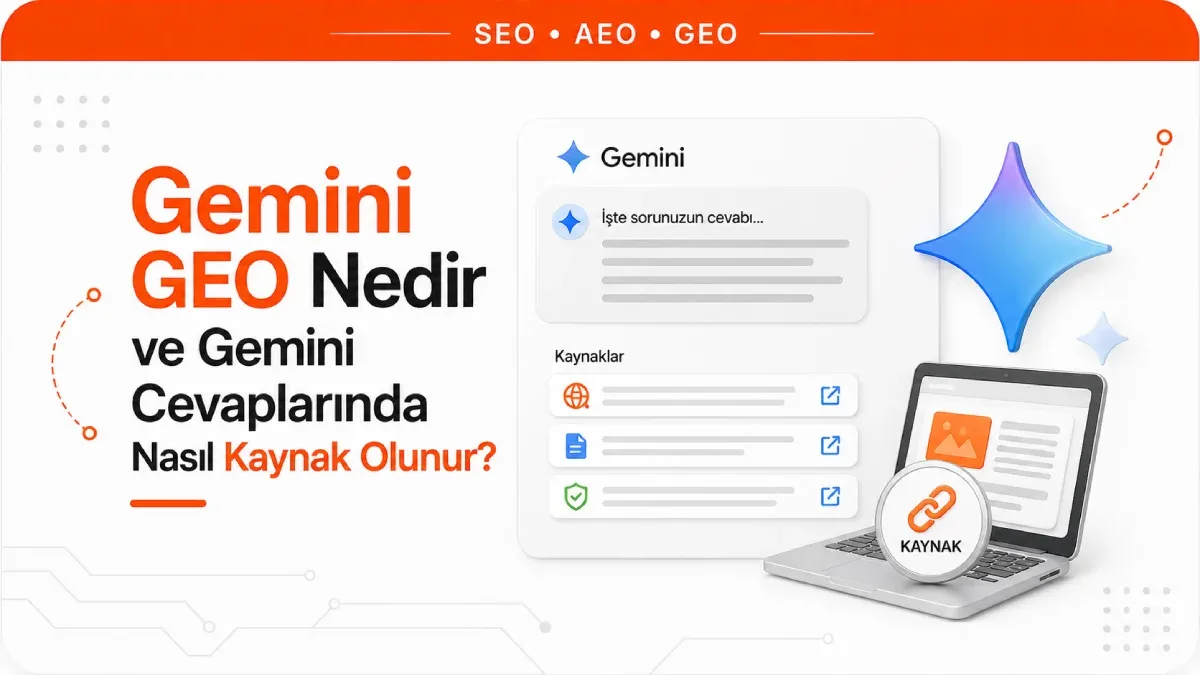
Gemini does not have a separate web index of its own. When a question requires up-to-date information, the model first decides whether searching would improve the answer; if so, it generates and runs one or more search queries, processes the results and bases its answer on them. Google calls this mechanism grounding with Google Search and states that this is how the model reaches content beyond its own knowledge cutoff.
Gemini GEO targets a single stage of this flow: making sure your page can be found as a candidate source in the queries the model writes itself, and that it can be carried into the answer. The question is not what Gemini is, but which sources Gemini reaches for when it generates an answer.
This architectural detail sets Gemini apart from other generative engines. Work done for ChatGPT or Perplexity focuses largely on that engine's own source selection behavior. With Gemini, the gateway is Google Search: a page that cannot be found in Google's index is not considered at any stage of the answer. The article what is generative engine optimization (GEO) sets out the general framework for visibility in generative engines; here we focus only on the Gemini side.
How does Gemini reach your page when answering a question?
The process does not stop at a single search query. The model analyzes the user's question, writes the queries needed to answer it on its own, may run several queries and builds the answer by synthesizing the results. Which part of the answer came from which source is indicated with inline citation markers; in other words, the system links a specific span of text, not the whole page, to a source.
This has three practical consequences. First, being strong on a single target keyword is not enough; you also need to be findable in the sub-queries around the question, because it is the model, not the user, that writes those queries. Second, the unit of selection is the passage, not the page, so what matters is not the page's average quality but how clearly a particular section answers on its own. Third, Google states that grounding works in all available languages, so content in languages such as Turkish is not outside the scope of this flow.
Where does Gemini GEO differ from classic Google SEO?
Google's documentation for site owners is clear on this point: there are no additional requirements or special optimizations needed to appear in AI Overviews or AI Mode, and classic SEO best practices still apply. That statement does not mean "there is nothing to do". The difference lies in what gets selected, and for which query.
Google explains that AI Overviews and AI Mode may use a query fan-out technique that runs multiple related searches across subtopics and data sources, that additional supporting pages are identified while the answer is being generated, and that a wider set of links can be shown than in classic web search. In other words, the pool of sources expands during answer generation, which means a new entry point for pages that cannot reach the top spot in classic rankings.
Measurements also show that the engines are not copies of one another. In Profound's analysis of 3.25 billion citations, the overlap between the sources used by ChatGPT and Perplexity was only 11%. Each engine plays on its own stage. What sets Gemini apart is that its gateway is Google Search, so classic SEO work pays off directly here.
| Comparison | Classic Google SEO | Gemini GEO |
|---|---|---|
| Entry gateway | Google index | The same Google index; grounding is fed from it |
| Target query | The query the user types | Sub-queries the model derives from the user's question |
| Unit of selection | Page and snippet | The passage carried into the answer |
| Access control | Googlebot directives and snippet controls | Additionally Google-Extended in the Gemini app |
| Measure of success | Rankings and clicks | Citations, brand mentions, information carried into the answer |
The Gemini app and AI Overviews in Google do not go through the same gate
The fact that the same model family runs on two different surfaces does not mean the access rules are shared. Google has announced that AI Mode runs on a customized version of Gemini, but whether your site is open to these two surfaces is controlled by two separate levers.
For AI Overviews and AI Mode inside Google, Google's position is this: AI is built into Search and is an integral part of how Search works, so what governs how your site is crawled is the robots.txt directives written for Googlebot. If you want to limit the information shown from your page, the tools to use are the nosnippet, data-nosnippet, max-snippet and noindex controls. For the details of this surface, the article how to appear in Google AI Overviews covers it separately.
Grounding in the Gemini app, however, is governed by a different control: Google-Extended. The upshot is that a site can appear on one of the two surfaces and disappear completely from the other, and this leaves no trace whatsoever in classic ranking reports.
How can a single line in robots.txt shut off Gemini visibility?
Google-Extended is a control token that lets publishers manage whether content Google crawls from their sites may be used for two purposes. The first is training future generations of the models that power Gemini apps. The second, and the one most often overlooked, is grounding, meaning that content from the Google Search index is provided to the model at prompt time to improve accuracy and relevance.
The trap lies in how the rule is perceived. Many sites added a block for Google-Extended to their robots.txt file because they believed it only turned off AI training. According to Google's own documentation, the same line also covers grounding in Gemini apps. On top of that, Google-Extended does not affect a site's inclusion in Google Search and is not used as a ranking signal, so the block causes no visible ranking drop and nobody notices.
A second detail makes this harder to audit: Google-Extended does not have a separate user agent string. Crawling is done with existing Google user agents, and the robots.txt token is used purely for control purposes. So you cannot detect the situation by searching your server logs for "Google-Extended"; you have to read the robots.txt file directly.
In practice, check in this order:
- Open your robots.txt file and see whether a group is defined for Google-Extended.
- If there is a block, ask whether it was a deliberate decision, because model training and Gemini grounding are turned off together by the same line.
- If you only want to limit the information shown in AI summaries within Google, this is not the lever to use; snippet controls are.
- If you want to keep a specific section, rather than the whole page, out of answers, data-nosnippet markup does this at the section level.
- After a change, allow time for the page to be recrawled and processed; do not try to measure the effect on the same day.
How do you write content that makes it into Gemini's answers?
Because the unit of selection is the passage, the real work on the content side is building sections that can be read independently. If a section still carries its main claim when lifted out of the page, it is suitable for being carried into an answer; if it relies on a chain of pronouns that depends on the previous paragraph, it is not.
Positioning also makes a difference. Muck Rack's citation analysis found that roughly 44% of citations came from the early sections of content. This is not a mechanical rule but a directional finding: do not hide your most valuable answer and evidence at the end of the article. The same study measured that about 84% of citations came from earned media sources, meaning a significant part of visibility is built outside your own site.
In a correlation analysis by Ahrefs, the factors most strongly associated with AI visibility were visibility on YouTube (0.737) and brand mentions (0.664), while the correlation for the number of backlinks remained markedly lower (0.218). These are correlation values and do not prove causation; opening a YouTube channel will not bring Gemini citations on its own. Still, they show that when working within the Google ecosystem, these two surfaces, video and brand mentions, should not be neglected.
Tactics believed to work for Gemini but with weak evidence
If the budget for visibility work is limited, the cost of time spent on weakly supported tactics is high. The items below are often recommended, but current evidence does not support treating them as prerequisites for Gemini visibility.
- Treating schema markup as a guarantee of citations. In an experiment run by Ahrefs, adding schema did not produce a measurable increase in AI citations. Schema is still useful for classic search features and semantic consistency, but it cannot be presented as the key to getting into answers.
- Treating an llms.txt file as a prerequisite. There is no evidence that search and answer systems consume this file. Creating it does no harm, but it is not a lever to build a visibility plan on.
- Looking for a secret AI-specific checklist. Google writes explicitly that there are no additional requirements or special optimizations for appearing in AI Overviews and AI Mode. The definitive formulas offered in this area are usually unproven assumptions.
- Writing to mechanical thresholds. Targets such as a specific keyword density, a fixed paragraph length or a percentage of headings that must be phrased as questions are not based on any verified selection criterion.
How do you measure Gemini visibility?
Answer generation is probabilistic, so drawing conclusions from a single attempt is misleading. Repeating the same question with different wording and on different days is the only way to tell whether a result reflects a real trend or one-off variance.
It is also important not to mix up two separate metrics. Being linked as a source and having your brand name mentioned in the answer text are different things. Your page may receive a citation while your brand name never appears in the answer, or the reverse. Recording them separately shows you where you are falling short.
There is also a diagnostic advantage specific to Gemini. Because the gateway is Google Search, you can narrow down where the problem lies using Search Console data. If your page gets no impressions at all for the sub-queries the model is likely to write, the problem is not in how you write but further upstream, at the findability stage. If there are impressions but no citations, the problem should be looked for in passage quality and the clarity of the answer. This distinction determines which step the work should start from, and it is also the first diagnostic step of the work carried out under our GEO service.
Frequently Asked Questions
If I block Google-Extended, will my Google rankings drop?
According to Google's documentation, Google-Extended does not affect a site's inclusion in Google Search and is not used as a ranking signal. No loss is expected on the ranking side. What you lose is the chance of being included in grounding in Gemini apps, and since this does not show up in classic reports, it usually goes unnoticed.
My page ranks first on Google. Why isn't it in Gemini's answer?
Ranking and citation are not the same process. The model does not search the user's question as is; it writes its own sub-queries, and the keyword you rank first for may not be among them. Selection also happens at the passage level, so what is evaluated is not the page's overall strength but the answer the relevant section gives on its own.
Does Gemini visibility require a separate strategy for Turkish-language content?
The levers are the same, because grounding works in all available languages and Google's AI Overviews are active for Turkish queries too. What changes is the sub-queries the model writes in Turkish. For that reason, the work should not be built on translations of English sources but on the way your target audience actually phrases questions in Turkish.