Ask ChatGPT and Perplexity the same question and the source lists you get back are almost completely different. In an analysis of 3.25 billion citations (Profound), the overlap between the sources the two engines cited was measured at just 11%. The practical meaning of this single number: there is no one piece of work called "AI visibility." Becoming a source in ChatGPT is a separate job with its own rules.
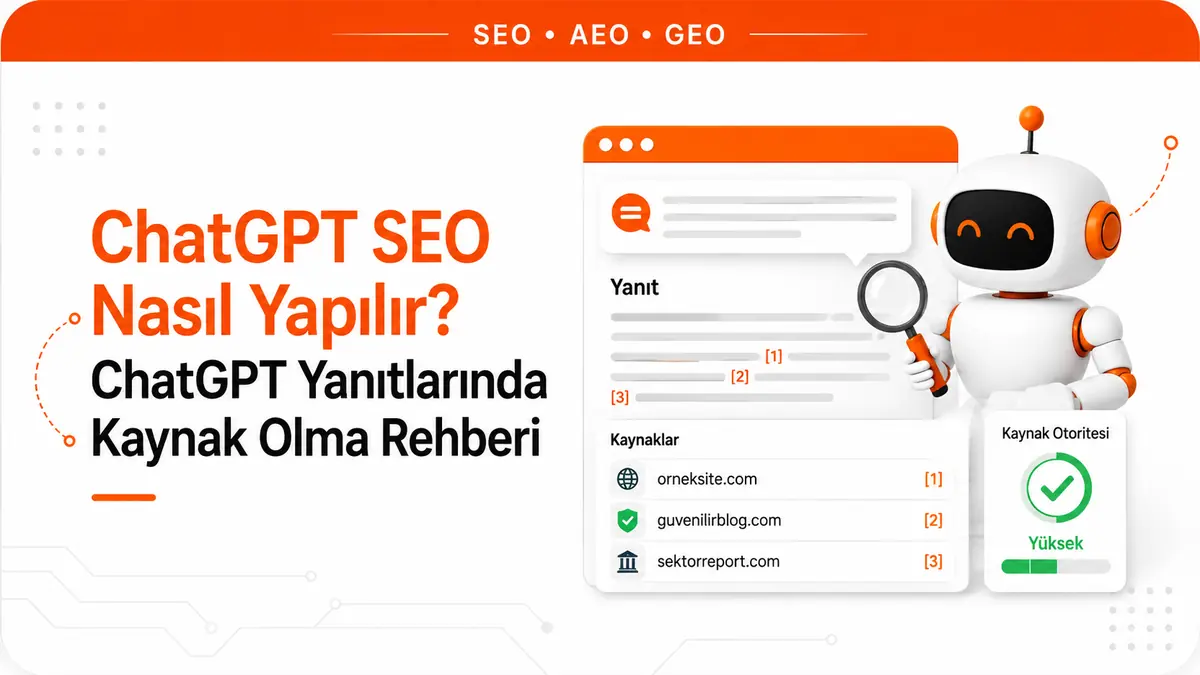
ChatGPT SEO (commonly called ChatGPT GEO) is the work of getting a site selected as a source in ChatGPT answers and getting the brand mentioned in the right context. The general framework of GEO is shared across all answer engines; on the ChatGPT side, three things make the difference: when the engine looks at the web, which crawler it sees your site with, and which passage it carries into the answer.
Why does ChatGPT's source selection differ from other engines?
The difference comes from the fact that answer engines don't share the same retrieval infrastructure. ChatGPT collects source candidates from its own crawling and search layer; Perplexity, Gemini and Google's AI Overviews work with different stacks. Being the top source in one engine doesn't even mean you are in the candidate pool of another.
Although the 11% overlap figure comes from a large sample, it is a single provider's analysis and may vary by query type. The direction is still clear: a generic AI checklist is not enough for ChatGPT. On the other hand, some of ChatGPT's behaviors don't need to be guessed at, because OpenAI spells them out in its own documentation. The next two sections rest on those documented behaviors.
When does ChatGPT look at the web to answer a question?
Not for every question. According to OpenAI, ChatGPT decides on its own whether to search the web based on the content of the question, and the user can also trigger a search manually by clicking the search icon. When search runs, a sources section opens under the answer listing the pages used.
This distinction means ChatGPT visibility lives on two separate surfaces. When the model answers without looking at the web, the answer comes from what it retained from its training data; your brand is either there or it isn't, and you can't change that directly in the short term. When the model looks at the web, live information retrieval kicks in, and this is the area you can influence through content work.
The practical consequence shows up in prioritization. For current, specific and factual questions (prices, regulations, comparisons, technical details), search is likely to kick in, because the model's memory falls short on this kind of information. These queries are where ChatGPT work produces quick results. For general recommendation queries like "which is the best brand in this space," the weight shifts to the model's brand memory, and the outcome depends less on your site than on your brand's presence across the web.
Which crawler determines ChatGPT visibility?
This is the distinction most Turkish-language sources get wrong. OpenAI uses different crawlers for different jobs, and their robots.txt settings are independent of each other. The bot that determines whether you appear in ChatGPT's search answers is OAI-SearchBot, not GPTBot.
| Crawler | Purpose | What happens if it's blocked |
|---|---|---|
| OAI-SearchBot | Surfacing sites in ChatGPT's search answers | The site isn't shown as a source in ChatGPT search answers and may only appear as a navigational link |
| GPTBot | Using content for model training | Content isn't included in training data; search visibility is unaffected |
| OAI-AdsBot | Checking pages served as ads in ChatGPT | Only concerns the ads side; doesn't determine organic source selection |
OpenAI states clearly that these settings are independent: a site can allow OAI-SearchBot and appear in search answers while blocking GPTBot to opt out of model training. Two common mistakes come straight from this table. The first is blocking all OpenAI bots wholesale over copyright concerns and unknowingly shutting off ChatGPT visibility too. The second is assuming that allowing GPTBot is enough to appear in search answers.
There are two more technical details. A change made in robots.txt can take about a day to be reflected on the search side, so testing the effect of a fix within the same hour is misleading. And even if robots.txt allows it, bot protections on the server or firewall can reject the request; OpenAI publishes the IP ranges its search bot uses and recommends allowing these requests. The most direct way to verify access is to look for OAI-SearchBot requests in your server access logs.
Which part of your content does ChatGPT carry into the answer?
What gets cited is not the page but the passage. When generating an answer, ChatGPT takes the section that answers the question, not the whole page. In a review of 1.2 million ChatGPT answers and 18,000 citations, about 44% of citations came from the first third of the content.
This finding is commonly misread. There is no rule that says "squeeze everything important into the first third"; structuring text around such a ratio hurts readability and usually produces repetition. The right takeaway is simpler: the answer to what the user asked should not be buried under a long preamble. If a section answers a real question, give the answer first and leave the explanation and evidence for afterward.
The second condition is that the passage makes sense on its own. When the cited paragraph is lifted from the page and carried into the answer, its subject should not be left ambiguous. The sentence "This method gives better results" means nothing on its own; a sentence that says which method is better and by what measure remains usable even when pulled out of context. We cover the details of this writing layer in our guide to writing content that gets cited.
What feeds ChatGPT visibility outside your site?
Whether ChatGPT recommends a brand depends less on what the brand writes on its own site than on what others write about it. In a study of more than 25 million AI citations (Muck Rack), about 84% of citations came from earned media outside the brand's own site.
Ahrefs' analysis of 75,000 brands points in a similar direction. The strongest relationships with AI visibility were found in YouTube visibility (0.737) and brand mentions across the web (0.664); the relationship with classic backlink count was noticeably lower (0.218). Caution is needed here: these are correlation coefficients, not proof of causation. Because already-large brands are more visible both on YouTube and in AI answers, part of the relationship may stem from brand size itself.
Still, it is a usable signal for setting priorities. Spending your entire budget on your own blog while your brand is never mentioned in third-party publications produces limited results for generic recommendation queries. In this picture, appearing in industry publications, producing video content and genuinely participating in relevant community platforms carry as much weight as editing your own pages.
Which ChatGPT SEO tips don't hold up?
Three tips come up again and again, and none of them holds up against the evidence:
- Adding an llms.txt file: There is no evidence that this file, recommended with the promise of a content map for AI bots, is read by the engines. A review covering 515 million bot requests found no meaningful trace of the file being fetched, and Google has stated that it doesn't use it. Adding it does no harm, but it shouldn't count as part of a visibility plan.
- Using schema markup as a citation tool: In an experiment Ahrefs ran, adding structured data produced no measurable increase in AI visibility. Schema is still valuable for classic search features and entity clarity, but it isn't the way to get selected as a source in ChatGPT.
- Following mechanical content thresholds: Rules like "make this share of your headings questions" or "include a statistic in every section" are usually derived from a single provider's observational data. Seeing a relationship in observation doesn't show that the threshold is a causal rule; forcing text into a template doesn't improve citability, it just breaks natural writing.
How do you measure ChatGPT visibility?
The first rule of measurement is not to draw conclusions from a single test. ChatGPT's answers are probabilistic; ask the same question twice and you may see different sources. "I tried the query and didn't show up" is not a finding on its own.
A usable measurement setup draws three distinctions. The first is separating citations from brand mentions: your brand can appear in the text of an answer without your site ever showing up in the source list, and vice versa. The second is recording context; the sentence your brand is mentioned in and the assessment it comes with matter as much as whether it is mentioned at all. The third is tracking the access layer separately: OAI-SearchBot requests in server logs show that your pages are being fetched, but that doesn't mean you are being cited.
Without repeating the same questions in different wordings and at different times, no trend becomes visible. A one-to-one comparison with your Google rankings is also misleading; because the two systems make their choices in separate layers, ranking first for a query and not being mentioned in the answer at all is normal. Seobaz's AI visibility service sets up this measurement cycle and runs it on a regular schedule.
In what order should you proceed?
- Verify access. Check that OAI-SearchBot is allowed in robots.txt and that server-side bot protections aren't blocking its requests. Content work done before this step is cleared won't pay off.
- Build a baseline. Record how your brand and your competitors appear for the questions people actually ask. If the starting point isn't measured, progress can't be measured either.
- Fix the pages that carry answers. On pages that correspond to the questions highlighted in measurement, move the answer up front and make passages understandable on their own.
- Expand your brand presence. Third-party publications, video and community visibility carry weight for generic recommendation queries, and since they take time to pay off, start them early.
- Repeat the measurement. Re-run the same question set at regular intervals and record citations and brand mentions separately.
Frequently Asked Questions
Can you pay OpenAI to appear in ChatGPT?
Organic source selection can't be bought; you don't get into the source list under an answer by paying. Separately, ChatGPT has an advertising surface, and OpenAI checks pages served as ads with a separate bot. Ads and organic citations are two independent channels; one doesn't replace the other.
Does ranking first on Google guarantee being a source in ChatGPT?
No. Good search visibility increases the chance of being a source candidate, because a page that isn't crawled and indexed can't make it into any engine's answer. But ChatGPT makes its source selection in its own layer; ranking first for a query and not being mentioned in the answer at all is a common situation. The two metrics are measured separately.
What can I do if my brand is mentioned with wrong information in ChatGPT answers?
First, you need to find where the wrong information comes from; the model often carries outdated or inconsistent information it found on the web. The first step is making sure the correct information is on your own site in a clear, unambiguous and easy-to-find way. The second step is consistency: details such as prices, scope of services and location should be the same in third-party profiles and publications as well. The model learns not from a single page but from information repeated across the web.