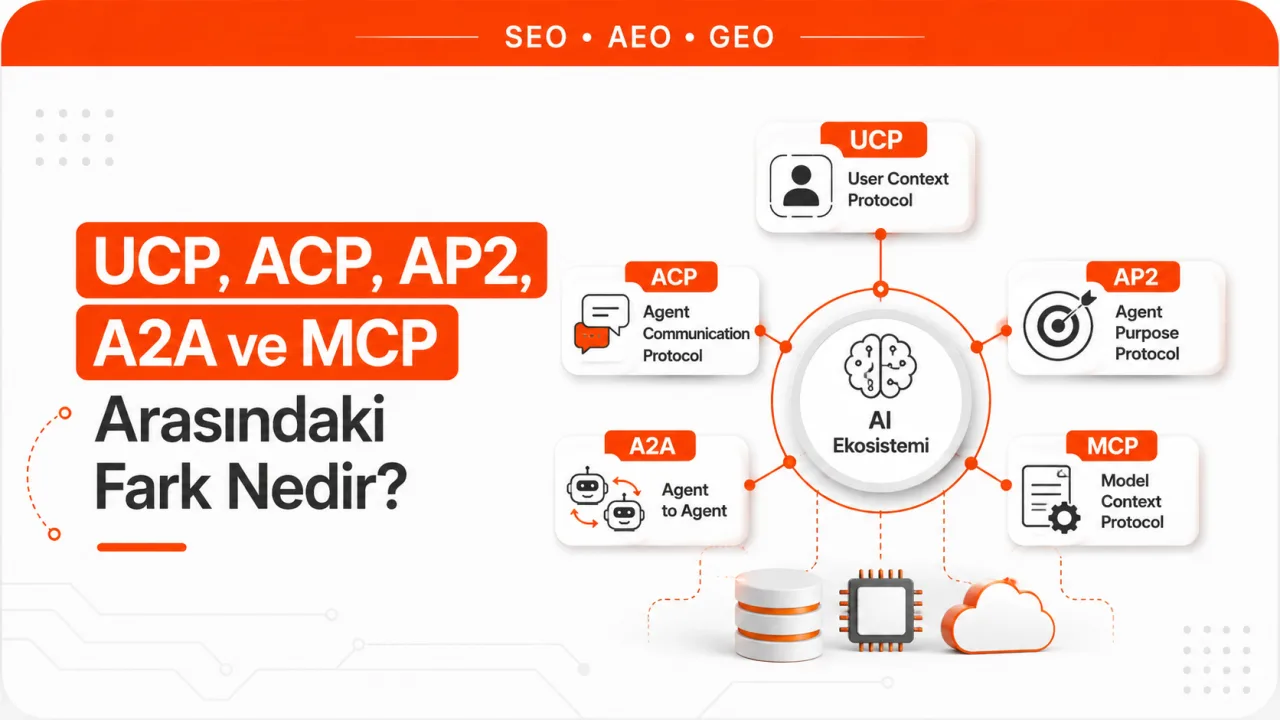
Five acronyms work on five separate layers
These five protocols do not do the same job and are not chosen as alternatives to one another. For an AI agent to complete a real purchase on a user's behalf, four independent problems have to be solved: the model needs access to tools and data in the outside world, different agents need to be able to talk to each other, there needs to be proof that the payment is genuinely made with the user's permission, and the commerce flow with the store needs a common language. MCP solves the first, A2A the second, AP2 the third, and ACP and UCP the fourth.
There are concrete reasons they get mixed up. AP2 and A2A differ by a single character. All five were announced within a short period, and largely the same companies stand behind them. More importantly, some of them really are built on top of the others: AP2 defines itself as an extension of A2A and MCP, and UCP can expose its capabilities over MCP and A2A as well as REST. So these acronyms are not options on a menu but overlapping layers. If you are looking for their individual meanings, the definitions in our AI and SEO glossary will also help.
| Protocol | Who created it | Problem it solves | Layer | Current status |
|---|---|---|---|---|
| MCP | Anthropic, later transferred to the Agentic AI Foundation | Connecting the model to external tools, data and workflows | Tool and data access | The layer with the broadest client support, widely used in practice |
| A2A | Google, later transferred to the Linux Foundation | Agents from different vendors discovering each other and dividing work | Agent-to-agent communication | Supported by more than 150 organizations, used in enterprise production |
| AP2 | Google and more than 60 payment organizations, later transferred to the FIDO Alliance | The agent proving its authority to pay on the user's behalf | Payment authorization | Reference implementation published, standardization ongoing within FIDO |
| ACP | OpenAI and Stripe | The agent handling the product feed, cart and payment step with a business | Commerce flow | Beta; the direct checkout experience inside ChatGPT has moved to the merchant side |
| UCP | Google with Shopify, Etsy, Wayfair, Target and Walmart | The entire commerce journey, from discovery to purchase and post-purchase | Commerce flow | Early access for selected merchants in the US, Canada and Australia |
MCP connects the model to tools and data
Model Context Protocol standardizes how an AI application connects to external systems. What it connects to can be a database, a file system, a search service or a ready-made set of commands. The analogy Anthropic uses is helpful: MCP is like a USB-C port for AI applications. Instead of writing a separate connection for each integration, a server is written once and every client that supports it can use it.
Of the five, this is the protocol that has been in the field the longest and has the widest support. Monthly SDK downloads have passed 97 million, and the number of public servers has passed 10,000. Independent clients such as ChatGPT, Claude, Gemini, Cursor, Microsoft Copilot and Visual Studio Code all speak the same protocol. Its governance no longer sits with a single company either: MCP was donated to the Agentic AI Foundation under the Linux Foundation umbrella. The foundation was established by Anthropic, Block and OpenAI, and is also supported by Google, Microsoft, AWS, Cloudflare and Bloomberg.
It is important to be clear that MCP is not a commerce protocol. Concepts such as payment, cart, order and return are not in MCP's vocabulary. But both ACP and UCP can expose their commerce capabilities as an MCP server. In other words, MCP is often the pipeline the others travel through.
A2A standardizes how agents work with each other
Agent2Agent defines how agents built by different companies with different frameworks discover each other and exchange tasks. The main problem it solves is this: without A2A, the only way to use another agent is to wrap it like a tool, and that limits the agent's capabilities. Agents are designed to negotiate, ask questions and carry out multi-turn work; a tool interface cannot carry that.
Technically, each agent publishes an Agent Card that introduces it. The card states what capabilities the agent has, which security scheme it uses and at which address it can be called. The other side reads this card, opens a task, and the work proceeds over multiple turns. Because cards can be signed, the agent's identity can be verified cryptographically.
The official documentation draws the distinction from MCP explicitly: A2A defines how agents communicate and transact across organizational boundaries, while MCP defines how an agent connects to its own tools and data sources. In the first, both sides can negotiate; in the second, one side calls and the other responds.
The acronym ACP has two different meanings
There is one more source of confusion that comes up in searches. The Agent Communication Protocol, which came out of IBM Research's BeeAI project, was also known as ACP and was also aimed at agent-to-agent communication. That protocol did not continue as a separate standard; it merged with A2A under the Linux Foundation umbrella, and its team moved development over to A2A. Today, when people say ACP in a commerce context, they mean OpenAI and Stripe's Agentic Commerce Protocol.
AP2 proves the payment really belongs to the user
Agent Payments Protocol targets the point where existing payment infrastructure breaks. Card payment systems assume a human is in front of the screen at the moment of the transaction. When an agent buys on a user's behalf, three questions go unanswered: did the user really authorize this agent for this purchase, does the request the agent passes to the merchant accurately reflect the user's intent, and who is responsible if the transaction goes wrong?
AP2's answer is signed documents called mandates. These are cryptographically signed, tamper-proof verifiable digital credentials. The chain has three links: what the user wants and within what limits they grant authority, approval of the cart and price the agent puts in front of them, and finally binding the payment to that approved cart. The result is a non-repudiable audit trail. When a dispute arises, the merchant can show the signed approval, and the user can check which authority they granted and with what limits.
The latest version of the protocol also covers payments where the user is not present at that moment. This was necessary for cases where the agent has to transact on its own within predefined limits. Google donated AP2 to the FIDO Alliance. On the FIDO side, a separate technical working group was set up for agent authentication, while the agentic commerce specification is progressing in the payments group chaired by Mastercard and Visa. Mastercard's Verifiable Intent framework has also been developed to work in alignment with AP2.
AP2 is not a commerce protocol on its own. It positions itself as an extension added on top of A2A and MCP, meaning it does not get involved in questions such as who built the cart or how the product was found. It is concerned only with proof of authority.
ACP and UCP: two different takes on the commerce flow
This is where the real overlap is. Both define how an agent shops with a business. The difference lies in the breadth of scope and the starting point.
ACP focused on the moment of purchase
Agentic Commerce Protocol is an open standard run by OpenAI and Stripe as founding maintainers. It is published under the Apache 2.0 license and is still in beta. It has three parts: the product feed, where products are presented in machine-readable form; the checkout interface, where the agent builds the cart and completes payment; and the delegated payment layer, where payment details are handed over securely. The token in this last part is bound to a single merchant and a single amount and expires within minutes. It cannot be used with another merchant.
There is flexibility on the implementation side: a business can offer it as a classic REST interface or as an MCP server. The protocol first powered the direct purchase experience inside ChatGPT. OpenAI later announced that it was removing that experience, moving the purchase step into merchants' own flows and ChatGPT apps, and focusing on product discovery on its side. The protocol itself has not been shut down; it continues to run underneath merchant integrations.
UCP covers the entire shopping journey
Universal Commerce Protocol is the standard Google developed together with Shopify, Etsy, Wayfair, Target and Walmart. It is supported by more than twenty organizations, including Adyen, American Express, Best Buy, Flipkart, Macy's, Mastercard, Stripe, The Home Depot, Visa and Zalando. Its scope is broader than ACP's: it describes not only the moment of payment but also product discovery, the cart, the order and post-purchase support.
Its architecture is built on the concept of capabilities. Each capability is a versioned function declared separately: checkout, cart, catalog lookup, identity linking and so on. The business declares which capabilities it supports, and the agent discovers and calls them. The same capability can be offered over REST, MCP, A2A or an embedded integration. The protocol defines four roles: the platform or agent that consumes the capability, the business that offers it and is usually the merchant of record, the credential provider that carries payment details securely, and the payment service provider that processes the payment.
Its practical impact is currently visible on Google's own surfaces. A buy button appears in AI Mode and Gemini for products from integrated merchants, payment is completed with details saved in Google Pay and Google Wallet, and the merchant remains the merchant of record. The feature is in early access and for now is available to selected merchants in the US, Canada and Australia. Participation requires current and complete product data in Merchant Center, a separate application and technical integration. With the cart, catalog and identity linking capabilities added later, the protocol has moved beyond single-item purchases.
Competitors or complements?
There is only one real rivalry among the five: ACP versus UCP. Both sit on the commerce flow layer and solve the same problem with different breadth. The other three are not in competition, because they describe different layers. This is not an interpretation but a positioning written into the protocols' own documentation: AP2 considers itself an extension of A2A and MCP, UCP states that it is compatible with A2A, AP2 and MCP, and A2A describes MCP as complementary.
Even the rivalry between ACP and UCP is not a one-time, all-or-nothing choice. Both protocols accept MCP as a valid transport, both want product data in machine-readable form, and a merchant can support both. The choice is made at the surface level, not the protocol level. You implement the protocol spoken by whichever agent surface you want to sell on.
Which one delivers real value for site owners today?
Nothing requires you to implement all five protocols at once. A sensible priority order looks like this.
- MCP is the layer with real value today. If you have data or a service agents could use, exposing it as an MCP server makes sense right now. And since both commerce protocols accept MCP, investment here is not wasted.
- UCP is the concrete channel to watch for e-commerce businesses. The purchase experience on Google surfaces runs through it. Although there are regional restrictions for now, the prerequisite is the same everywhere: Merchant Center product data must be accurate, current and complete.
- ACP requires preparation on the product feed side. The direct checkout step inside ChatGPT is gone, so there is no urgent pressure to integrate. But the investment in a machine-readable product feed is shared with UCP.
- AP2 is not directly your job. Payment authorization is on the agenda of your payment provider and the card networks. It is something to follow, not implement, until standardization on the FIDO side is complete.
- A2A is a matter of enterprise agent orchestration. Unless you have a system that connects agents from different vendors, it has no practical value for you today.
Underneath the four commerce and agent protocols lies the same thing: machine-readable, accurate and current product and service data. Price, stock, variants, delivery time and return policy no longer determine only shopping ads; they also determine which product an agent recommends and whether it can add it to the cart. This is the work to do before any protocol integration, and it is also the foundation of generative engine optimization. The agent first needs to find you, then read the information about you correctly; the payment protocol only comes into play after those two. For those who want to build this visibility layer systematically, the scope of our GEO service is defined around exactly this need.
Frequently Asked Questions
What is the difference between MCP and A2A in one sentence?
MCP defines how an agent connects to tools and data, while A2A defines how an agent talks to another agent. In the first, the calling side and the responding side are fixed; in the second, both sides can negotiate.
Are AP2 and A2A part of the same family?
Both come from Google, and AP2 positions itself as an extension of A2A. But their jobs are different: A2A handles how agents talk to each other, while AP2 handles proving that a payment is based on the user's permission. The fact that their names differ by a single character often causes confusion.
Does an e-commerce site have to choose between ACP and UCP?
No. The two are not mutually exclusive, and a merchant can support both. The decision depends on which agent surface you want to appear on. The common ground is the same on both sides: structured, up-to-date product data.
Does implementing these protocols affect search rankings?
They are not ranking signals but an eligibility layer. Implementing a protocol does not raise classic organic rankings. What it does is different: it provides the technical prerequisite for an agent to be able to transact with you. Rankings and transactability on agent surfaces are two separate measures and should be tracked separately.