On the subway, your phone shows full signal bars, the page loads halfway and then hangs. The text has arrived, the image placeholders are empty and the spinner keeps spinning. You have enough bandwidth, the server is up and the connection hasn't dropped. The culprit is usually a single lost data packet, and that packet holds up everything that comes after it.
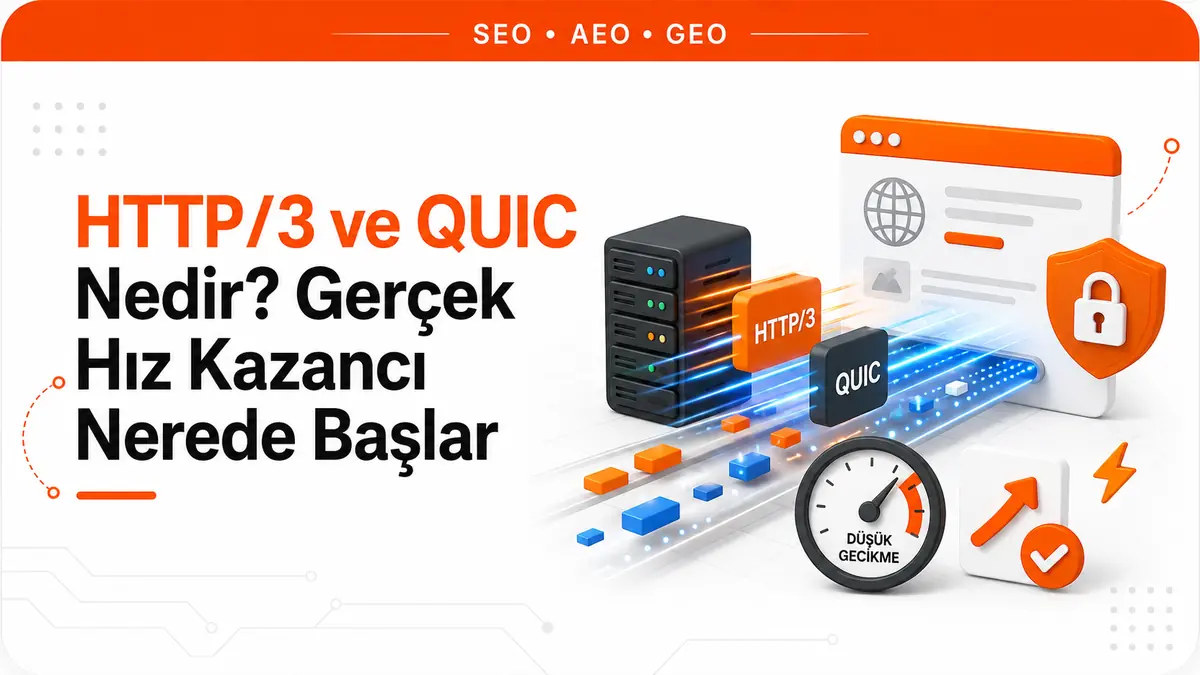
That is exactly the problem HTTP/3 tries to solve. HTTP/3 means web traffic travels over a transport protocol called QUIC instead of TCP. QUIC, in turn, is a transport protocol built on top of UDP, with encryption on by default, that carries independent data streams within the same connection. Both are defined as IETF standards: RFC 9000 for QUIC and RFC 9114 for HTTP/3.
The real reason a page stalls halfway on a bad signal
TCP delivers data as a single, ordered stream of bytes. This design has a cost: when a packet in the middle of the stream is lost, the packets that come after it are not handed to the application, even if they have already reached their destination. They wait in line until the lost packet is retransmitted and falls into place. This is called head-of-line blocking.
HTTP/2 partly solved this problem. It could carry dozens of requests in parallel over the same connection, eliminating queuing at the HTTP layer. However, HTTP/2 runs over a single TCP connection, and when packet loss happens at the TCP layer, all streams on that connection wait together. The page's CSS file and a chunk of a background image travel in the same pipe; when the image packet drops, the CSS waits too.
This is where QUIC makes the difference. QUIC carries multiple streams over UDP and handles packet loss detection and retransmission separately for each stream. When a packet from an image is lost, only that image waits; the page's text and stylesheet keep flowing. On a clean connection with no loss, the difference is almost invisible. It shows up where packets actually drop: at a crowded cell tower, on weak hotel Wi-Fi, in a moving vehicle.
The road from HTTP/1.1 to HTTP/3
To sum up the difference between the three versions in one sentence: HTTP/1.1 was limited by how many connections you could open at once, HTTP/2 solved parallelism on a single connection but remained dependent on TCP, and HTTP/3 changed the transport layer itself.
| Feature | HTTP/1.1 | HTTP/2 | HTTP/3 |
|---|---|---|---|
| Transport layer | TCP | TCP | QUIC (over UDP) |
| Parallel requests | A few separate connections per browser | Multiple streams on one connection | Multiple streams on one connection |
| Behavior on packet loss | The affected connection stalls | All streams on the connection wait together | Only the affected stream waits |
| Encryption | Added as a separate layer | Added as a separate layer | Built into the protocol |
| When the network changes | The connection drops | The connection drops | The connection can continue |
HTTP/2 brought gains such as the move from a text-based to a binary protocol, header compression and multiplexing. HTTP/3 takes none of these back; it keeps the same HTTP semantics and only changes the kind of pipe that carries them.
Why QUIC was built on UDP instead of TCP
There is a misconception often repeated in Turkish-language sources: "UDP is fast because it doesn't verify packets." For QUIC, this explanation is wrong. QUIC does not give up reliable delivery, ordering, retransmission or congestion control; it rebuilds them internally. So a page delivered over QUIC does not get faster "because no verification is done".
UDP was chosen for other reasons, and they come down to two points. First, changing TCP is close to impossible in practice. TCP lives in the operating system kernel, and the firewalls, NAT devices and carrier equipment in between are built around its behavior. A new TCP feature takes years to spread around the world. QUIC, on the other hand, runs at the application level, so it can be updated along with browser and server software. Second, UDP is a thin datagram layer, and devices in between tend to pass it through without interfering with its contents.
In addition, encryption is not optional in QUIC. The transport handshake and the TLS handshake are not run separately; they happen as a single combined step. This structure is best considered alongside related transport-layer topics; for the certificate and header checklist, our article on checking SSL, TLS and HSTS headers covers the same ground.
Where the real gain starts and ends
HTTP/3 delivers three concrete gains, and each one has its limits.
Fewer round trips when setting up a connection
In a classic setup, the browser first completes the TCP handshake and then starts the TLS handshake. QUIC combines the two, reducing the number of round trips before the first data arrives. When you return to a server you have connected to before, a shortcut called 0-RTT is also possible, but this shortcut has a known cost: data sent with 0-RTT is vulnerable to replay attacks, so it should not be used for requests that could have side effects. In practice, many setups either keep 0-RTT disabled or restrict it to safe requests. So the statement "HTTP/3 connects with zero latency" oversimplifies the reality.
The size of this gain depends directly on latency. If your server is geographically close to your visitors, the savings are measured in milliseconds. If your visitors are on another continent, the same savings become noticeable.
Independent streams during packet loss
This is the main gain described above, and it scales directly with the loss rate. On a fiber connection where loss is close to zero, you will struggle to measure the difference between HTTP/2 and HTTP/3. On a mobile network where loss is measured in percentages, it can mean the difference between a page loading and a page hanging.
The connection surviving a network change
QUIC connections are tied not to an IP address and port but to a connection ID. This allows the connection to stay up when an endpoint's address changes. When a user leaves home and switches from Wi-Fi to mobile data, a TCP connection drops and everything has to be set up again from scratch; with QUIC, the same session can continue. This behavior pays off for long downloads and on-the-move use.
Is HTTP/3 a ranking factor?
No. HTTP/3 is not a documented ranking signal, and content that presents it as one has no source to back it up.
Google's page experience documentation states two things clearly: there is no single "page experience signal", and the measures used by ranking systems are the Core Web Vitals metrics. No protocol version appears on that list. In other words, what Google looks at is not whether your site speaks HTTP/3, but what happens on the user's screen.
This is where the link lies: if HTTP/3 improves LCP or INP in your real users' field data, what counts is that metric, not the protocol's name. If it doesn't, there is no SEO effect. So the right order is: measure first, then enable, then measure again. For work that targets the metric itself, the steps in our Core Web Vitals guide are far more decisive than HTTP/3.
A similar correction is needed on the crawling side. Google's crawl capacity documentation says capacity goes up or down depending on the server's response time, latency and stability. What is measured is response behavior, not protocol version. If HTTP/3 really does lower your server's response times, an indirect effect may follow; the claim "we turned on HTTP/3, so our crawl budget will grow" is not defensible on its own.
How to tell whether your site uses HTTP/3
The fastest way is to use the browser's own developer tools. You don't need a third-party testing service.
- Open your site in Chrome and launch the developer tools.
- Switch to the Network tab.
- Right-click the header row of the request table and make the Protocol column visible.
- Reload the page and look at the values in the column:
h3means HTTP/3,h2means HTTP/2 andhttp/1.1means the older version.
Here is a detail that trips up most people. You may not see h3 on the first load, and that is not an error. A browser usually learns that a server speaks HTTP/3 from the Alt-Svc response header that arrives over TCP first. So the first connection uses HTTP/2, the server says "you can also reach me over QUIC", and subsequent visits switch to HTTP/3. That is why you should run the test after reloading the page once.
If you want to see the server side directly, look for the Alt-Svc line in the response headers. You should see a value similar to this:
Alt-Svc: h3=":443"; ma=86400How to enable it
Through a CDN: the right path for most sites
If your site is behind a CDN, HTTP/3 is not a server project for you but a toggle. In Cloudflare's case, the path is: log in to the dashboard, select your account and domain, go to Speed > Settings and turn on the HTTP/3 toggle under Protocol Optimization. The setting is available on all plans and requires a valid SSL certificate at the edge.
There is a critical limit here that is easy to miss: this setting only covers the connection between the user and the CDN. Cloudflare states in its own documentation that connecting to the origin server over HTTP/3 is not supported. So the link between the CDN and your own server still runs over TCP. For the visitor experience, the first leg is what matters most anyway, but don't work on the assumption that it's "HTTP/3 everywhere". How to set up the CDN layer as a whole is a separate topic, covered in our article on CDN and aggressive caching settings.
On your own server
In Nginx, HTTP/3 support comes from a separate module, and your build must include it. The configuration has two parts: opening the QUIC listener and announcing to the browser that HTTP/3 is available.
server {
    # HTTP/3 and HTTPS are kept on the same port for compatibility
    listen 443 quic reuseport;
    listen 443 ssl;

    ssl_certificate     /etc/ssl/example.com.crt;
    ssl_certificate_key /etc/ssl/example.com.key;

    location / {
        # announces HTTP/3 support to the browser
        add_header Alt-Svc 'h3=":443"; ma=86400';
    }
}
If you use shared hosting or a ready-made control panel, this is usually not your job. In LiteSpeed-based setups, HTTP/3 support comes with the server software and is generally managed through the panel; the question to put directly to your hosting provider is: "Is the QUIC listener enabled on my server, and is UDP 443 blocked externally?"
The step no one should skip: UDP 443
This is the most common reason HTTP/3 setups silently fail. People habitually think of HTTPS traffic as TCP 443 and write firewall rules accordingly. QUIC, however, runs over UDP. If UDP 443 is not open in your server's firewall, no browser can switch to HTTP/3 even if the configuration is correct; it silently stays on TCP. This rule is the first thing to check after setup.
ERR_QUIC_PROTOCOL_ERROR and cases where QUIC is blocked
In Türkiye, most of the search demand related to QUIC comes not from people who want to learn about the protocol but from people who have run into an error screen. This error means the browser tried to connect over QUIC and the connection failed. The source is often not the site being visited.
Typical causes are:
- UDP 443 traffic being filtered or dropped by a corporate network, campus network or carrier.
- Security software, a corporate proxy or a VPN client in between decrypting and repackaging encrypted traffic.
- An intermediate network device that does not fully recognize QUIC corrupting the packets.
- A half-finished configuration on the server or CDN side; for example, cases where the
Alt-Svcheader announces HTTP/3 but the listener is not actually reachable.
For a visitor seeing the error, turning off the QUIC setting in the browser may help, but it should be seen as a diagnostic tool rather than a solution. If the page opens with the setting turned off, the problem is clearly on the QUIC path; the real fix lies in the network in between or on the server.
For site owners, the order of checks is clear. First determine whether the error is widespread or specific to one network: open the same page from a different connection. If it is not widespread, the problem is most likely in that organization's network and cannot be fixed from your side. If it is widespread, check your Alt-Svc header, your UDP 443 rule and whether your QUIC listener actually responds. In a healthy setup, when the browser cannot reach QUIC it silently falls back to TCP; if users see a bare error screen, that fallback is broken somewhere.
Who really needs to care
To be honest, HTTP/3 does not pay off equally for every site.
Worth prioritizing: sites where most visitors come in over mobile data, projects that serve different countries and deal with high-latency connections, media-heavy sites that make many resource requests per page, and high-traffic e-commerce and news sites. In these profiles, packet loss and latency are an everyday reality, so the problem QUIC solves is one they actually face.
Should not be at the top of your priority list: small sites serving a local area, where most visitors come in over good connections. On a site like that, what hurts LCP is usually not the protocol but a 3 MB uncompressed hero image, an overly heavy theme, third-party scripts that delay loading or a 1.5-second initial response time from shared hosting. HTTP/3 fixes none of these. Switching protocols while these problems remain means spending time with no measurable gain.
On the cost side, the distinction is this. If you use a CDN, enabling HTTP/3 is a single toggle, the risk is low and it is just as easy to switch off if needed; in that case, turn it on unless you have a specific reason not to. If you manage your own server, it is a configuration job, it requires testing and there are things that can break on the firewall side; in that case, answer the profile question above before putting it on the list.
Frequently Asked Questions
Does HTTP/3 completely replace HTTP/2?
No, it runs alongside it. Because HTTP/3's availability is announced through a header that arrives over TCP in the first place, the old path has to stay open. Clients that cannot speak QUIC and networks where QUIC is blocked continue to be served over HTTP/2 or HTTP/1.1. The right setup is not a "migration" but keeping both paths open.
Do I need a new SSL certificate for HTTP/3?
No. QUIC uses TLS for encryption, and your existing certificate remains valid. You don't need to buy a new certificate; you only need a valid, correctly installed certificate at the endpoint.
Can enabling HTTP/3 harm my site?
In a correctly configured system, if the browser cannot reach QUIC it falls back to TCP, so the expected behavior is a fallback, not a breakage. In practice, problems arise with half-finished configurations and on networks where UDP 443 is filtered. That is why running a few checks from different networks after enabling it is the only sensible step before leaving the setting on.
Will my Core Web Vitals scores improve on their own once I enable HTTP/3?
Improvement is not guaranteed. Field data is collected from your visitors' real connections, and the gain depends on how lossy and high-latency those connections are. The right method is to note your field data before enabling it and compare the same metrics a few weeks later. If there is no difference, your problem was not the protocol, and you should shift your energy to images, scripts and server response time.
What you can do this week
Opening the Protocol column in the developer tools and checking which protocol your site speaks today takes five minutes. If you use a CDN, enabling the setting takes one more minute, and then you verify your UDP 443 rule. The real work starts after that: monitoring whether LCP and INP values actually move in your field data. If you treat the protocol change not as an SEO win but as extra tolerance for users on bad networks, both your expectations and your results will land in the right place.