What is an AEO agency?
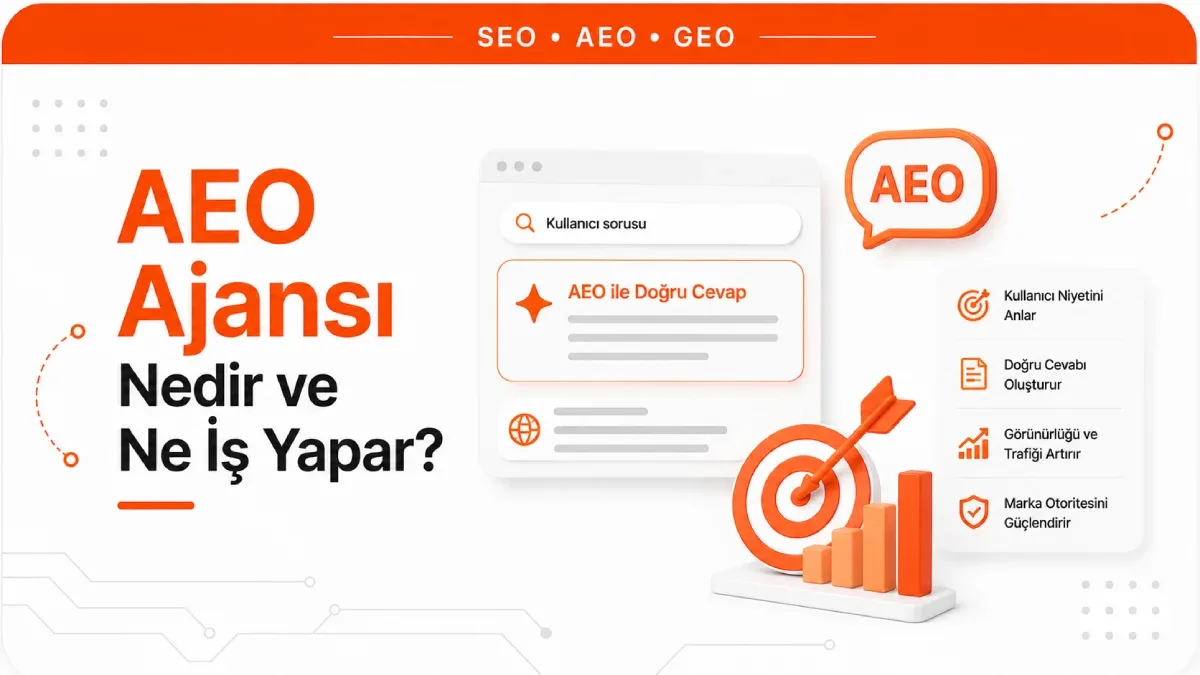
An AEO agency is a digital marketing agency that makes a brand's content understandable to, and citable by, systems that generate direct answers, such as Google AI Overviews, ChatGPT, Gemini, Perplexity and voice assistants. In these systems, the user sees a ready-made answer rather than a list of results, and only a handful of sources are cited beneath it. The featured snippet box and the "People also ask" list are answer surfaces of the same kind. The AEO agency's job is to get the brand among those sources and to measure this on a regular basis.
AEO stands for Answer Engine Optimization. Unlike our What Is AEO article, which covers the concept itself, the question here is: what exactly are you getting when you buy this work from an agency? The term's origin affects the answer. GEO has a defined source, an academic study published in 2023; AEO has no comparable canonical source. The label spread within the industry as a name for featured snippet and voice assistant work. That is why an "AEO agency" sign on its own doesn't tell you what service is behind it.
What does the abbreviation AEO mean in Turkish search?
In Turkish search data, the abbreviation AEO is mostly not about marketing. In Semrush's Türkiye database, the term aeo gets 33,100 searches a month, but most of that volume belongs to two different meanings. The first is the Ankara Chamber of Pharmacists (Ankara Eczacı Odası): aeo nöbet (on-duty pharmacy) and aeo ilan (announcements) each get 1,600 searches a month, aeo ilan panosu (notice board) 390 and aeo nöbetçi eczane (on-duty pharmacy) 320. The second is the customs status of Authorized Economic Operator; searches such as aeo belgesi and aeo sertifikası (AEO certificate) fall into this cluster.
On the commercial side, there is no measurable demand. None of the Turkish queries for "AEO agency" (AEO ajansı), "AEO service" (AEO hizmeti), "answer engine optimization agency" (answer engine optimization ajansı) or its fully Turkish equivalent (cevap motoru optimizasyonu ajansı) returns measurable volume in the Türkiye database. The only signal pointing directly to the marketing meaning is aeo seo, with 20 searches a month. For comparison: seo ajansı (SEO agency) gets 8,100 searches a month.
For buyers, this has two practical consequences. First, choosing an agency based on the abbreviation on its home page makes no sense; in the Turkish market, the label doesn't carry demand yet, so it doesn't differentiate either. Second, building a content strategy on your own site around the term "AEO" means investing in volume that doesn't exist in Turkish. Because the term arrived through translations of English sources, it circulates within the industry, not among buyers.
What does an AEO agency do?
Whatever the label, the work behind visibility on answer surfaces breaks down into six items. The table below summarizes them and how you will see the result of each. The right-hand column matters: if a proposal can't show the result of an item, that item can't be measured.
| Work item | What the agency does | How you see the result |
|---|---|---|
| Question map | Identifying the questions the brand can genuinely answer and who currently owns the answer to each | A query list and the current source owner for each query |
| Content editing | Reworking pages so they answer the question directly and in a way that stands on its own | A before-and-after comparison per page |
| Technical accessibility | Crawlability, indexing and making sure the main content is readable in the raw HTML | Search Console index status and the page source |
| Structured data | Setting up schema markup without errors and keeping it consistent with page content | Rich Results Test output and the Search Console error count |
| Brand presence | Planning off-site publication, video and community visibility | Number of brand mentions and the variety of sources they appear in |
| Measurement | Running a fixed query set across multiple engines, repeatedly | Mention and citation rates broken down by platform |
Of these six items, the first four happen on the site and the fifth happens entirely off it. That is also where most differences in scope between agencies show up: some sell only the four on-site items and treat brand presence as the client's own business.
Do AEO agencies and GEO agencies do the same work?
In practice, largely yes. The distinction between the two labels is real in origin: the AEO side traditionally focused on short answer surfaces such as snippets, the "People also ask" box and voice assistants, while the GEO side focused on the long answers of generative engines. But these surfaces have blended. The same query can now produce both a featured snippet and an AI Overview, and the preparation that feeds both is the same: content that answers the question clearly, an accessible technical foundation and the brand's presence off the site.
That is why buying the two labels as separate services with separate budgets produces needless duplication for most brands. The right question when choosing an agency is not which abbreviation it uses but how many of the six items above it covers. Our companion piece, What Is a GEO Agency and What Does It Do, looks at the same work from the angle of agency selection criteria.
What determines visibility on answer surfaces?
Here, the story the industry sells and the available evidence don't fully match, and the gap works against the buyer. According to a Muck Rack study that examined more than 25 million citation links, about 84% of AI citations come from earned media outside the brand's own site. In other words, work confined to your own site addresses only the smaller half of the problem. Ahrefs' correlation analysis of 75,000 brands points the same way: brand mentions on YouTube and across the web showed the strongest relationship with AI visibility. This is a correlation, not causation, but the direction is clear.
The second point is platform difference. In Profound's citation analysis, only 11% of the sources cited by ChatGPT and Perplexity overlapped. Being cited in one engine doesn't guarantee visibility in another, so a report from a single platform doesn't show the full picture.
Third, the evidence behind the two most commonly sold technical promises is weak. Schema markup is useful technical hygiene for classic search features and semantic consistency, but a difference-in-differences study Ahrefs ran on 1,885 pages showed that schema made no measurable contribution to AI visibility. The llms.txt file is in a similar position: Google has stated that it doesn't use it. On top of that, FAQPage and HowTo markup, standard advice in older AEO guides, no longer work as they used to; Google restricted FAQ rich results to a narrow group of government and health sites and removed HowTo rich results altogether. Schema is still set up, because faulty markup causes problems, but it can't be the main promise of an AEO proposal.
How do you measure the results of AEO work?
The first rule of measurement is to separate two different things: being cited as a source and having your brand name appear in the answer are not the same metric. Your page can appear in the source list without your brand name ever appearing in the answer, or vice versa. If the two aren't counted separately, the report looks optimistic.
The second rule is repetition. Answer engines can cite different sources for the same question at different times, so drawing conclusions from a single run is misleading. Meaningful measurement repeats a fixed query set across multiple engines at regular intervals and reports results broken down by platform.
The third is accepting the limits of measurement from the start. On answer surfaces, users often never visit the site, so this visibility doesn't show up directly in classic traffic and conversion reports. An agency that says so honestly is more trustworthy than one that draws a one-to-one line between citations and sales. There is an additional difficulty on the Turkish side: AI Overviews are much newer in Turkish than in English, so there is also less historical data to compare against.
Who benefits from an AEO agency?
This service makes sense in categories where buyers ask questions before deciding: enterprise software, consulting, professional services outside healthcare, technical products and comparison-heavy categories. What they have in common is that users ask "what is," "which one" and "how to choose" type questions before buying. A prerequisite is that the site is already indexed properly and has a content foundation to build on.
In some cases, on the other hand, AEO work should not jump the queue. For neighborhood-scale businesses whose demand comes from map results, the priority is local visibility. In transaction-driven ecommerce categories, users go straight to the product without asking questions. For brands with unresolved indexing or accessibility problems on their site, answer engine work is wasted, because a page that doesn't make it into the candidate pool can't be chosen for an answer. Nor will this service meet the expectations of brands that want direct sales in the short term and won't allocate any budget to earned media.
Hiring an agency isn't the only way. You can build the measurement layer in-house and handle content editing with your existing team. If you already have a classic SEO agency, adding answer engine tracking to its current scope is often more efficient than buying a separate service. Getting a one-time audit and carrying out the implementation yourself is also a valid option. The earned media half of the work, by its nature, sits close to public relations. Seobaz doesn't package this work separately as AEO and GEO; within our GEO service, content, technical accessibility and multi-platform measurement run in a single workflow.
What drives the cost of an AEO agency?
There is no single going price range in the market, because very different scopes are sold under the same name. What makes proposals comparable is not the price itself but which variables the price is tied to. These are the factors that determine cost:
- Size of the query set: as the number of questions tracked regularly increases, measurement cost grows linearly.
- Number of platforms and languages: measuring on four engines instead of one, in two languages instead of one, multiplies the work.
- Measurement frequency: the difference between monthly and weekly tracking is reflected directly in cost.
- Whether content production is included: editing existing pages and producing content from scratch are two very different items.
- Earned media scope: if off-site visibility work is included, publication costs form a separate line item.
- Who implements the technical work: if the agency makes recommendations but your own development team implements them, scope and timeline change.
- Audit or ongoing work: a one-time audit and monthly management are priced differently and produce different results.
When evaluating a proposal, check how many of these seven factors are defined with a clear number. If none of them are, the prices can't be compared.
Which promises in a proposal don't match the evidence?
The evidence above points to a few concrete warning signs. Proposals that present schema setup or an llms.txt file as the main lever for AI visibility don't match the current evidence; these items get done, but they aren't what brings results. Proposals that guarantee citations within a set period aren't realistic either, because source selection is the engine's own decision and varies even for the same question.
A visibility report from a single platform is the third sign: in an environment where source overlap is low, one engine's data is not the whole picture. Finally, a scope that confines all the work to the site contradicts the finding that most citations come from off-site publications. The answers you get when you ask about these four points quickly show whether an agency works from evidence or from habit.
Frequently Asked Questions
On which platforms does an AEO agency build visibility?
AEO work targets surfaces that generate direct answers, such as Google AI Overviews and AI Mode, ChatGPT, Gemini, Perplexity, Microsoft Copilot and voice assistants. The featured snippet box and the "People also ask" list in classic search also fall within this scope. Because each platform weighs different signals when choosing sources, measurement is done separately for each platform.
Does an AEO agency replace an SEO agency?
No, it builds on top of one. Answer engines find their candidate sources largely through search infrastructure; a page that isn't indexed or never appears in search can't be chosen for an answer either. The right setup is to protect search visibility and add a citability and measurement layer on top of it.
When do the results of AEO work show up?
There is no one-size-fits-all timeline. Three things determine it: how quickly the page is re-indexed, how strong the competition is for the target query and how present the brand is off the site. If the earned media side is weak, the change from content editing alone stays limited. In practice, the first period is mostly spent establishing a measurement baseline, because without a baseline to compare against, no later report means anything.
Does a small company need an AEO agency?
Small sites can find opportunities on narrow topics, because answer engines give strong weight to topical relevance when choosing sources. But you don't need an agency for that: defining the query set yourself and making your existing pages answer more clearly covers most of the first step. An agency starts to make sense when the query set grows and measurement becomes a regular process across multiple platforms.