Buyers no longer search for your product; they ask about it. Instead of typing keywords into a search box, they type "which company should I work with for this" into an assistant, and three names come back. Yours is not one of them. You call your agency, they put a rankings report in front of you, and the report actually looks good: you are on the first page for the same keyword. The report is not wrong; it is measuring something else. Being at the top of a results list and being chosen by a language model as a source worth using when it builds an answer are not the same race.
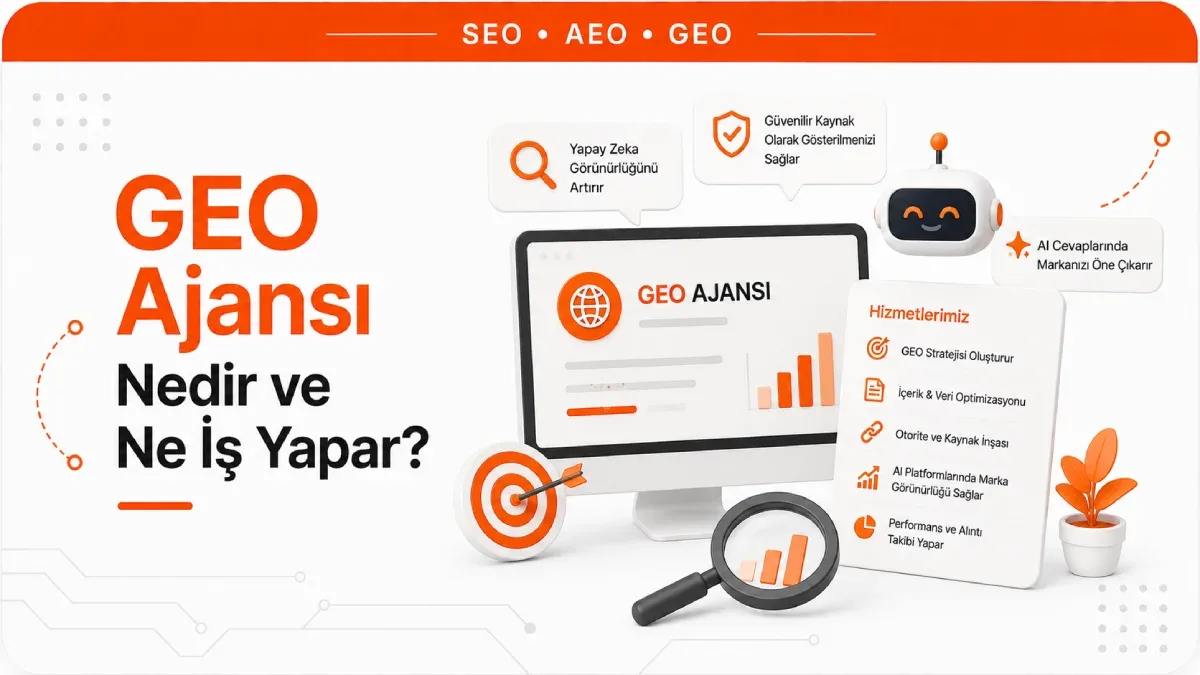
A GEO agency is the service provider that deals with this second race. GEO, short for generative engine optimization, is the work of managing a brand's chances of being present in generative search systems, being selected as a source and being mentioned in the right context within the answer. We explained the concept itself and how engines select sources in detail in our GEO guide. The question here is narrower: what does such an agency do day to day, who does this service help, and what should you look at when you are comparing proposals.
What exactly does a GEO agency do?
A GEO contract covers four work streams. If a proposal does not address one of these four at all, it is incomplete.
Measuring current visibility. The first job is to establish where the brand stands today: in which engines and for which queries it appears, where in the answer it shows up, and whether it is shown as a source or only mentioned by name. These are different things, and when they are mixed together the picture looks better than it really is. A brand can be named in the answer yet be missing from the source list entirely; the reverse also happens, where a page is used as a source but the brand name never makes it into the answer.
Making content citable. Engines do not use a page as a whole; they pull the passage they need. So a significant part of the work is not rewriting existing pages but bringing the answer inside them to the surface in a form that can stand on its own: giving the answer to the question without burying it, writing a figure together with its context, not leaving a definition dependent on another paragraph.
Off-site brand presence. This is the work stream most often skipped. Muck Rack's study of more than 25 million citations reported that about 84% of citations in AI answers came from earned media rather than the brand's own website. Because this is data from a single provider with a limited spread of languages and industries, it should not be read as a universal ratio. The direction it points to is still clear: work that only edits the brand's own site may not touch the surface that feeds most answers at all. That makes GEO work not pure technical SEO but a mix of content and PR.
Repeat measurement and reporting. Ask the same engine the same question twice and you may get different answers. This is not a malfunction; it is how these systems work. So a single measurement is an observation, not a result. The continuity of the work comes from repeating the measurement with a fixed query set, at set intervals and with the same method.
Is a GEO agency the same as an SEO agency?
It is not the same job, but it is not a separate channel either. GEO work sits on top of your existing search infrastructure: a site that cannot be crawled, cannot be indexed or lacks a basic information architecture will not be a candidate source for generative engines either. The difference lies in what is measured and where the work's center of gravity sits.
| Criterion | Classic SEO work | GEO work |
|---|---|---|
| Unit of measurement | Rankings, clicks and impressions per keyword | Being selected as a source, citations, mentions within the answer |
| Stability of results | The same query generally returns similar results | The same query can return different results at different times |
| Main work surface | The brand's own site and technical infrastructure | The brand's own site together with off-site brand presence |
| How it is verified | Search Console and rank tracking | Separate query tests per engine and repeat measurement |
| Reporting risk | Personalization of position data | A single measurement turning out to be random |
The same distinction comes up for answer engines. The work streams of an AEO agency, which focuses on surfaces that generate direct answers to questions, overlap heavily with those of a GEO agency; rather than looking for a sharp line between the two, it is more useful to check which engines and which output a proposal covers.
Who does this service help, and who doesn't it help?
GEO work does not deliver the same return for every business model. Most of the decision comes down to whether your buyers actually research before they buy.
It makes sense when:
- Buyers compare options and draw up a shortlist before buying, and can now have an assistant build that list for them. High-ticket services, technical products and enterprise sales fit this description.
- Category questions are asked without a brand name. In questions like "which companies offer this", a brand that is never mentioned is eliminated before it can make the shortlist.
- The site already has organic visibility but no presence in AI answers. This is the classic case where the infrastructure works but the content is not built to be citable.
- Incorrect information is circulating. If incomplete or wrong answers are being generated about the brand, fixing that is often more urgent than gaining new visibility.
It is premature or unnecessary when:
- Demand is immediate and location-dependent. For an emergency locksmith, the nearest pharmacy or a car that broke down on the road, proximity and map results decide.
- The site lacks basic search eligibility. Adding a GEO layer to a site that is not indexed is like hanging a sign on a building with no door. In that case the budget should go to the foundation first.
- Purchases are impulsive and visually driven. For products sold through social discovery, the decision chain runs through visibility, not research.
- The budget only covers a measurement tool. Measuring without changing anything is spending money to pile up reports.
What determines the price of a GEO agency?
There is no published, verifiable price range for the Turkish market. Filling that gap with an invented figure would mislead you, because the scope of proposals varies so much that two prices are often not even comparable. Asking about scope before asking about price is the better order. The items that create the difference between proposals are:
- Query coverage. How many queries are tracked? A set of fifteen queries and a set of several hundred are not the same amount of work.
- Number of platforms. Is measurement done on one engine, or separately on four? This item increases cost almost linearly.
- Measurement frequency. The difference between a set checked once a month and a set repeated weekly shows up in both cost and reliability.
- Content volume. How many pages are being reworked, and how many new pages are being produced?
- PR and earned media component. The difference between proposals usually comes from here, because off-site work carries both labor and publication costs. A cheap proposal that leaves this item out entirely is usually cheap for exactly that reason.
- Reporting depth. Are you handed raw screenshots, or a comparable series broken down by query?
A practical rule: if there is a big price gap between two proposals, look for the difference first in the off-site work and measurement frequency items. It is almost always there.
Questions to ask in your first meeting with an agency
Because much of what is sold in this service is invisible, what sets an agency apart is not its promise but its measurement discipline. The questions below are short and answerable; how clearly they are answered often says more than the answer itself.
- Which engines do you measure? Measurement on one engine says little about the others. Profound's comparison reported that ChatGPT and Perplexity overlap on only 11% of the sources they use for the same queries. Since it is a single provider's measurement, it should not be taken as a fixed constant, but it is enough to show that the platforms are not interchangeable.
- Do you report citations and brand mentions separately? A report that merges the two into one metric looks better than reality. A solid answer counts them separately and says which one is growing.
- How many times and how often do you run the same query? Because answers vary, a single run does not produce a result. You want to hear that the query set is kept fixed and repeated regularly.
- Do you take a baseline measurement before starting work? Without a baseline snapshot, whether the picture three months later is good or bad remains open to debate.
- How much of the work is on-site and how much off-site? If the answer is entirely on-site, the surface that a large share of citations comes from may not be touched at all.
- Who decides the query set? If the queries are not chosen from questions your customers actually ask, the measurement will be internally consistent but irrelevant to your business.
- What do you do if answers contain incorrect information about the brand? Alongside visibility, accuracy is also an output, and there should be a process for it.
- If the contract ends, who keeps the measurement history and the content produced? The value of a measurement series comes from continuity; if you cannot take the data with you, you start from scratch every time you change agencies.
Which promises in a proposal are warning signs?
Because the field is new, promises that are hard to measure are easy to sell. The following statements do not prove bad intent on their own, but they call for an explanation:
- "We'll get you to number one in AI answers." A generated answer has no ranking list. Promising a position means selling something unmeasurable as if it were measurable.
- Schema and llms.txt at the center of the promise. An experiment run by Ahrefs reported that adding schema markup did not produce a measurable increase in AI citations. Google, for its part, has stated that it does not use the llms.txt file. Structured data can still be useful for classic search features and semantic consistency, but a proposal that presents these two files as the main deliverable is very likely hollow.
- Selling a one-off visibility report. In systems that produce variable output, a single snapshot is not a basis for decisions. A one-off test can be a diagnostic tool; it cannot be the service itself.
- A guarantee of a specific number of citations. Source selection is the decision of a system the agency does not control. What can be guaranteed is the work itself, not its result.
- Scope set without measurement. A plan prepared without knowing where the brand stands today was written for a template, not for you.
Alternatives to consider before hiring an agency
An agency is not the only route. Looking at the options in order of cost leads to a better decision for most businesses.
- Measuring manually yourself. It costs nothing. Pick fifteen questions your customers might ask, ask them in the same engines every month, and note the answer and the sources. This gives you a real baseline snapshot and a foundation for testing what any agency tells you.
- Adding scope to your current SEO agency. This is usually a low-cost start, since they already handle the site side. The only thing to ask is how they will set up measurement; if you buy the scope without the measurement, it will not make a difference.
- Running PR and content separately. Earned media is already a communications effort. For businesses that have this muscle, the missing piece is usually measurement and content structure, not media access.
- Waiting for now. If your buyers purchase without researching, this is a defensible decision. But the decision to wait should also be based on measurement: asking your own category questions and seeing that no one mentions you makes the cost of waiting concrete.
When do results show up?
Anyone who gives a fixed timeframe for this is claiming to know something they don't. What can be said about how visibility progresses concerns sequence: first you enter the source pool for narrow, specific queries, then citations start to appear for those queries, and finally the brand gets mentioned in broad, unbranded category questions. These three stages do not move at the same speed; being mentioned in broad category questions usually comes last.
That is why, in the first months, it is more informative to look at three things instead of asking "did we show up in the answer": whether the number of times you are seen as a source in the tracked query set is increasing, whether the context is correct when the brand is mentioned, and whether results are becoming stable across repeats of the same query. If none of the three is moving, you need to ask which work stream is missing.
Seobaz runs this measurement and improvement cycle as part of its GEO service: baseline measurement, citability work on content structure, off-site brand presence and repeat measurement per platform.
Frequently Asked Questions
Will GEO work hurt my Google rankings?
When the work is set up properly, no such conflict arises, because most of what is done for citability (clear definitions, answers that aren't buried, data given with its context) also works in classic search. The risk appears when pages are chopped up purely for machine readability and lose their flow for human readers. If a proposal says it will reduce your pages to question-and-answer blocks, question it.
Can I just buy the agency's measurement tool myself?
A tool gives you data, not decisions. The real work is telling whether a drop the tool shows comes from fluctuations in model behavior or from a gap on the content side, building the query set around your business, and turning the findings into content and PR work. If you have a small, focused query set, starting on your own with a tool is reasonable; the real cost is not the tool itself but continuously interpreting and acting on the data.
If no one in my industry is doing this, does it make sense to wait?
The absence of competitors can mean two different things. If your category questions are never asked of assistants, waiting is the right decision. If the questions are asked but no brand from your industry appears in the answers, the gap is being filled by sources outside the industry (forums, generic lists, news sites), and the cost of entry is low until that gap closes. To find out which it is, don't guess: ask your own questions and look at the answers.