What are the study's key findings?
An AI Overview is the AI-powered answer Google shows above the results for some searches. It appeared in roughly 23 out of every 100 Turkish-language searches we analyzed. But the main finding of the study was not how often AI Overviews appear; it was where they draw their sources from.
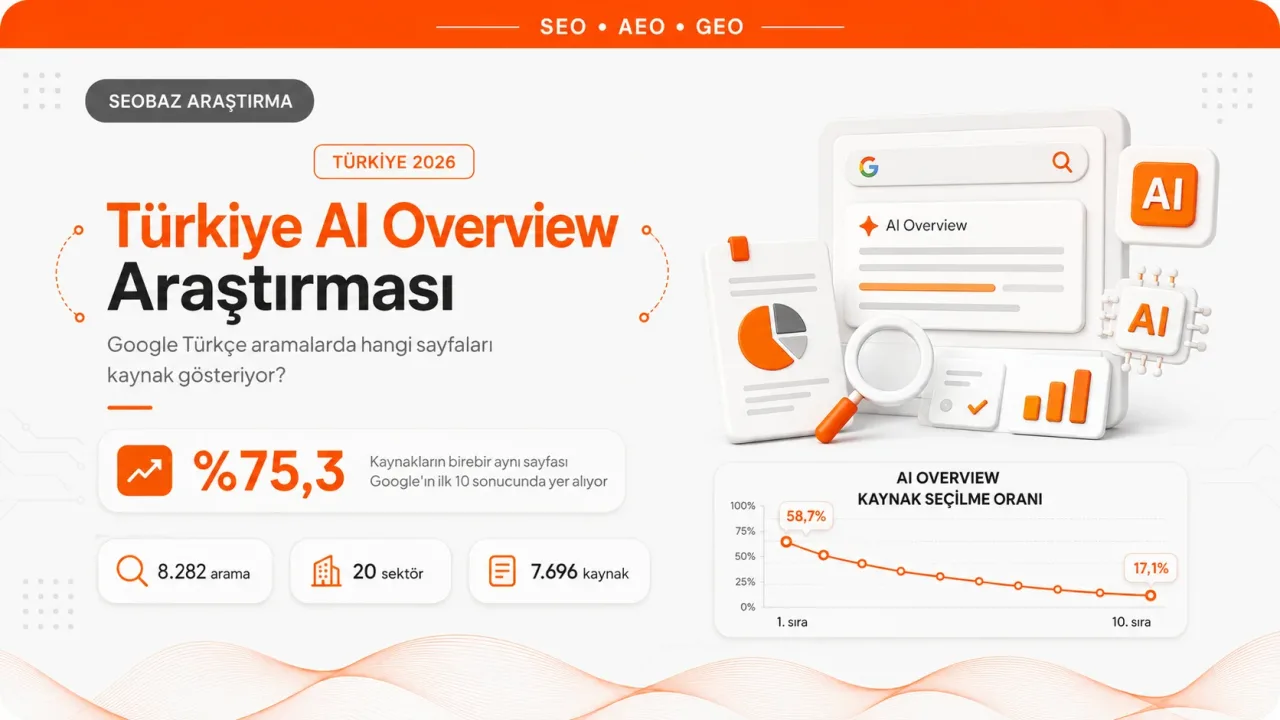
- 75.3% of sources are an exact page match with a top 10 result. When minor URL differences are cleaned up, the figure rises to 82.0%, and to 86.3% when any page from the same site counts.
- The first position has a strong advantage. The page in first position was selected as an exact-match source in 53.4% of searches with an AI Overview.
- Content readable on first load has an advantage. In the raw data, pages whose main content was present in the initial HTML response became sources 37.0% of the time, versus 26.5% for pages where it was not.
- Social media and forums are selected less than expected in Türkiye. This group made up 13.8% of top 10 results but only 8.9% of AI Overview sources.
- No simple content hack was found. Longer content, more lists or tables and specific schema types did not, on their own, explain source selection in any strong way.
The top 10 overlap is stronger in Türkiye
Share of AI Overview sources that appear as the exact same page in the top 10 for the same search.
More common in comparison searches
AI Overview appearance rate by user intent.
How did Seobaz conduct the study?
Looking only at source pages is not enough to understand why a page is selected as a source. The same feature may also be present on pages that are not sources. That is why, for each AI Overview result, we built two groups: pages linked within the AI Overview, and pages that appeared in the top 10 for the same search but were not linked.
We wrote the hypotheses before looking at the results and stored them with a timestamp. Even if no feature had made a meaningful difference, the study would still have been published. This pre-registration makes it harder to rewrite the story after the fact to fit the results.
Study population
| Measure | Scope |
|---|---|
| Valid, unique searches | 8,282 |
| Searches showing an AI Overview | 1,933 |
| AI Overview source links | 7,696 |
| Average sources per search | 4.0 |
| Industry labels | 20 |
| Features analyzed per page | 56 |
| Measurement environment | Türkiye, Turkish language, Google mobile results |
| Measurement window | August 16, 2026, 14:56–18:35 UTC |
How common are AI Overviews in Türkiye?
An AI Overview appeared in 1,933 of the 8,282 valid searches. The overall rate was 23.3%. In other words, roughly one in every four searches in the study sample had an AI Overview.
| User intent | Showing an AI Overview | Total searches | Rate |
|---|---|---|---|
| Comparing a product or service | 260 | 890 | 29.2% |
| Getting information | 1,328 | 4,915 | 27.0% |
| Completing a transaction or purchase | 250 | 1,547 | 16.2% |
| Going to a specific site | 95 | 930 | 10.2% |
The highest rate came from comparison and research searches. This means AI Overview work should not be limited to informational blog posts; commercial comparison searches are an important area of visibility too.
Rates vary sevenfold across industries
AI Overview appearance rate
Industry labels are meant for spotting opportunities. Check the queries manually before making budget decisions.
The difference between technology and food is roughly sevenfold. However, the automatically assigned industry labels may include some ambiguous queries. Read the table as an opportunity map showing which areas deserve closer query research, not as a definitive industry ranking.
Do AI Overview sources come from Google's top 10 results?
Yes. This is the strongest finding in the Türkiye data. We compared the 7,696 source links used in AI Overviews with the top 10 organic results for the same search in three different ways.
| Comparison | Matching sources | Rate | Plain explanation |
|---|---|---|---|
| Exact same page URL | 5,798 | 75.3% | The source and the Google result are the same page |
| Minor URL differences cleaned up | 6,307 | 82.0% | Trailing slashes and similar differences were ignored |
| Same website | 6,645 | 86.3% | The same site, even if the exact page differs |
The lower the position, the lower the source selection rate
The three lines show how the result changes depending on how strictly a page match is defined.
| Google position | Exact same page | URL differences cleaned up | Same site |
|---|---|---|---|
| 1 | 53.4% | 57.0% | 60.1% |
| 2 | 44.0% | 48.1% | 51.2% |
| 3 | 38.7% | 42.1% | 45.8% |
| 4 | 35.8% | 39.0% | 42.5% |
| 5 | 30.1% | 33.8% | 37.1% |
| 6 | 28.9% | 31.6% | 34.7% |
| 7 | 26.6% | 29.4% | 32.2% |
| 8 | 21.5% | 23.8% | 27.9% |
| 9 | 14.1% | 16.2% | 20.4% |
| 10 | 10.7% | 12.1% | 16.7% |
For Türkiye, the practical order of priorities is clear: first get into the top 10 for the relevant query, then raise the rate at which that visibility turns into AI Overview citations. AI Overview work should not be run as a channel separate from traditional SEO.
Which types of sites are cited as sources?
| Site type | Share of AI Overview sources | Share of top 10 results | Rate at which a top 10 page becomes a source |
|---|---|---|---|
| Social media and forums | 8.9% | 13.8% | 13.1% |
| Encyclopedias | 3.2% | 2.1% | 50.4% |
| Government | 7.6% | 8.4% | 29.5% |
| Academic | 0.3% | 0.2% | 43.2% |
| News | 8.8% | 7.9% | 38.3% |
| Marketplaces | 2.5% | 2.9% | 28.8% |
| Other sites | 68.6% | 64.8% | 33.3% |
Encyclopedia pages rarely appear in the top 10, yet they are often selected as sources. Social media and forums show the opposite: they take up more space in regular results but are selected less often as sources.
Lower positions don't fully explain the gap
Exact-match source rate for social and forum pages versus other pages at similar Google positions.
This result does not mean social media is worthless. Instagram tops the domain list with 277 source links in total. But it also appeared 699 times in the top 10. Total citations and the success rate per opportunity are not the same thing.
Do pages that are readable on first load have an advantage?
Some pages deliver their core content in the initial HTML. Others wait for the browser to run JavaScript before the content appears. Among the top 10 results we were able to analyze technically, we saw a clear difference.
Readable pages lead at every position
Pages whose main content is visible without waiting for JavaScript, versus pages where it is not.
The right reading is this: having content in the initial HTML response does not guarantee source selection, but it is associated with a measurable advantage among pages at similar positions and of similar types. Core text, headings and links should be in the page's initial HTML response. This also helps crawlability, accessibility and the user experience on slow devices.
Which page features actually make a difference?
For every page, we extracted 56 measures, including word count, paragraph structure, headings, lists, tables, dates, authors, links, schema markup and language features. After correcting for chance, a statistical difference remained for 33 features. But only five showed a difference large enough to matter from a business perspective.
| Feature | Direction on source pages | Correct interpretation |
|---|---|---|
| Content overlap with the AI Overview text | Higher | An expected confirmation, not an independent tactic you can apply in advance |
| Number of definitions | Somewhat higher | A small difference; should not be turned into a recipe on its own |
| Average word length | Very slightly higher | A very small difference |
| Passive voice density | Somewhat higher | Not evidence of causation; should not become writing advice |
| Number density | Somewhat lower | May be influenced by industry and page type |
These results do not mean you should use longer words or write in the passive voice. Other features that vary alongside them may explain these differences. In particular, a site's brand recognition and trustworthiness were not fully captured by these 56 features.
Popular recommendations that explain little on their own
- Writing longer articles
- Using more paragraphs or keeping paragraphs at a certain length
- Adding more lists, tables or images
- Always putting the query in the main heading
- Always placing the answer in the first 100 words
- Adding FAQ or Article schema
These features may still help the user experience. The study only says that, in the Türkiye data, adding them does not on its own reliably explain AI Overview source selection.
Which sites are cited most often?
| Site | Source links | Distinct searches cited in | Top 10 appearances |
|---|---|---|---|
| instagram.com | 277 | 226 | 699 |
| tr.wikipedia.org | 245 | 222 | 396 |
| memorial.com.tr | 230 | 228 | 290 |
| hurriyet.com.tr | 183 | 182 | 344 |
| acibadem.com.tr | 150 | 150 | 221 |
| eksisozluk.com | 133 | 120 | 437 |
| medicalpark.com.tr | 132 | 132 | 209 |
| medicana.com.tr | 123 | 122 | 206 |
| youtube.com | 120 | 105 | 760 |
| milliyet.com.tr | 115 | 115 | 251 |
| sabah.com.tr | 97 | 97 | 196 |
| trendyol.com | 87 | 81 | 219 |
| turkiye.gov.tr | 81 | 65 | 264 |
| alifesaglikgrubu.com.tr | 75 | 74 | 106 |
| facebook.com | 66 | 65 | 370 |
The heavy presence of healthcare providers on the list should be read alongside the high AI Overview rate for health queries. The total number of citations alone does not prove that a site is more successful. You also need to know how many searches the site had the opportunity to appear in.
What should you do in the Turkish market?
Fix top 10 visibility first
75.3% of sources in Türkiye appear in the top 10 as the exact same page. That is why AI Overview visibility should not be treated as a project separate from traditional SEO.
- Identify the target query and the user's real intent.
- Create or strengthen the page best placed to reach the top 10 for that query.
- Verify that the page's main content is present in the initial HTML response.
- Provide clear, verifiable and citable information.
- Track top 10 visibility and the AI Overview source rate together.
Measure success per opportunity instead of total citations
A site can rack up a high citation count simply because it appears in many searches. The question to track is how many target searches the page reaches the top 10 for, and in how many of those opportunities it becomes an AI Overview source.
Reduce JavaScript dependency
The page's main content should be in the initial HTML. With JavaScript turned off, the heading, core text and important links should still be visible. Using server-side rendering or prebuilt HTML reduces this risk.
Don't copy US social media playbooks directly
In US studies, Reddit and user-generated content can come up as a strong theme. In Seobaz's Türkiye data, social media and forums were cited below their share of regular results. These channels can be valuable for brand visibility, but the data does not show them to be the shortest route to a direct share of AI Overview citations in Türkiye.
Test content templates with controlled experiments
Don't roll out changes such as lists, tables, short answers or schema across the whole site at once. Set up test and control groups from similar pages. After the change, track both Google position and the AI Overview source rate.
| Period | What to do | Success metric |
|---|---|---|
| First 30 days | Map out target queries, current top 10 visibility and AI Overview sources. | A measurable baseline table |
| Days 31–60 | Fix templates whose content is not visible in the initial HTML and strengthen high-opportunity pages. | Share of readable pages and top 10 visibility |
| Days 61–90 | Test selected content changes in controlled groups. | Source selection rate per opportunity |
To run this analysis on your own query set and measure your brand's share of AI Overview citations, take a look at Seobaz's GEO services.
What are the study's limitations?
Every measurement has a scope, and research that doesn't state its scope clearly cannot defend its findings either. Each item below states not only the limitation but also what we did to address it.
- A one-day snapshot. All searches were measured on August 16, 2026, in a single window of about four hours. This protects the results from intraday fluctuation, but it is not a time series; AI Overview behavior changes over time. The same query panel will be re-crawled at regular intervals and the changes reported separately.
- The scope is deliberately narrow: Turkish, mobile, Google. The findings apply to this scope and do not generalize to desktop or other markets. The choice of mobile is not arbitrary: in Türkiye, the bulk of search happens on mobile devices.
- The sample was selected by design, not by market share. The 8,282 queries were balanced with a volume threshold and intent quotas; this makes the groups comparable but does not mirror national search volume one to one. Industry labels were generated automatically and include overlap; the industry table is therefore for spotting opportunities, and target queries should be verified manually before budget decisions.
- Inaccessible pages were excluded from the analysis. Pages that could not be downloaded or whose body could not be extracted were left out of the page feature analysis, which underrepresents large, JavaScript-heavy corporate sites. Because the initial HTML readability finding measures exactly this group, it is not affected by this bias; the page feature tables, however, should be read with this caveat.
- We measured correlation, not causation, and brand recognition was not fully controlled for. A feature seen more often on source pages may not be the cause, and the advantage of large brands may go hand in hand with certain features. That is exactly why we did not present any single feature as a recipe; we framed our recommendations as a call for controlled experiments.
- International comparisons indicate direction; they are not a league table. US studies use different periods, devices and query sets. In this report, only rates measured with the same definition were placed side by side; even so, the difference may come from sampling as much as from behavior.
These limitations do not invalidate the findings; they separate which decisions can be made today from which ones require new experiments. Knowing what the reader can rely on is as important as the finding itself.
Technical evidence summary and sources
The summary below is for readers who want to audit the calculations behind the plain-language narrative of the main report.
| Finding | Control used | Technical result | Plain interpretation |
|---|---|---|---|
| Search intent changes the rate | Four intent groups were compared | χ²(3)=188.46, Cramér's V=0.151 | The difference is real; its size is between small and moderate |
| Industry labels differ | 20 labels were compared | χ²(19)=701.11, Cramér's V=0.291 | The industry difference is clear; labels should be checked manually |
| Initial HTML readability is an advantage | Same search, position and site type were controlled | Adjusted odds ratio 1.244, 95% confidence interval 1.112–1.390 | The advantage is smaller than in the raw result, but robust |
| Social and forum pages are selected less | Same search and organic position were controlled | Odds ratio 0.316, 95% confidence interval 0.275–0.362 | Selected markedly less often than other pages at similar positions |
| 56 page features | Multiple testing correction and effect size | 33 features passed the correction, only 5 crossed the effect threshold | Most statistical differences are small from a business perspective |
Sources for the international comparison
- Ahrefs, overlap between AI Overview citations and the top 10
- Ahrefs, search rankings and AI citations
- TripleDart, which pages does AI Overview cite?
- Kevin Indig, analysis of 546,000 AI Overviews
- Semrush, AI Mode comparison study
- SE Ranking, AI Overview comparison across US states
You may cite the charts and findings as long as you link to Seobaz.
Turan Doğan. “Türkiye AI Overview Study 2026: Which Pages Does Google Cite as Sources?” Seobaz, August 17, 2026.
Conclusion
The strongest finding of the Seobaz Türkiye AI Overview Study is this: the main path to becoming a source is first being a strong organic result for the relevant search.
Getting into the top 10 does not guarantee being selected as a source, but three quarters of sources come from there. Serving content that is readable on first load adds a further advantage. US playbooks built on social media and forums, meanwhile, do not deliver the same result in Türkiye.
The data does not point to an easy AI Overview hack. What it offers is a more reliable order of work: the right query, strong organic visibility, a technically readable page, clear and citable information, and then controlled experiments.