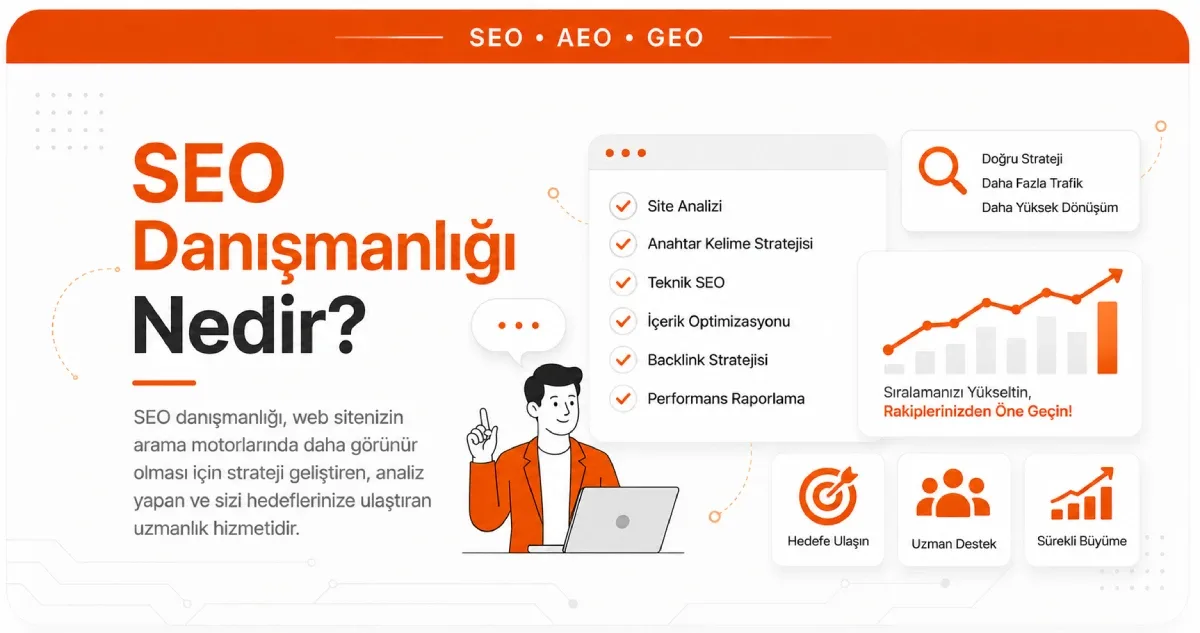
SEO consulting is a service that designs a website's search engine optimization process (the work of ranking higher on engines such as Google) under expert guidance. The consultant analyzes the site's current state, prepares a roadmap and leaves the implementation to the business's own team. This model differs from an agency service that takes on the whole job from start to finish: in consulting, decisions and strategy come from outside, while implementation comes from inside.
The scope of the service is defined in three layers: technical infrastructure, content and authority. The consultant first measures these three areas, then prioritizes them. In Türkiye, SEO consulting is offered in two forms: project-based work run by a single specialist, and ongoing consulting within an agency. The project-based model produces a one-off audit and plan; the ongoing model works in a monthly cycle. A sound consulting engagement does not start without measurable goals: it defines KPIs (key performance indicators) from the first month, using initial conversion and traffic data as the baseline.
What does an SEO consultant do?
An SEO consultant audits every area that affects the site's search performance and produces an improvement plan. The work begins with a technical SEO audit (a check of how well the site's infrastructure suits search engines). The audit covers page speed, indexing (whether pages make it into Google's index), site architecture and mobile friendliness. Findings are ranked by importance, and the highest-impact fixes are moved to the front. The output on this side is a concrete list of fixes handed to the development team.
After the audit, the consultant builds the keyword strategy: choosing the keywords the site will target based on volume, competition and intent. This strategy turns into an on-page content plan and an internal linking architecture. For each target page, title, content and linking recommendations are clarified. The consultant also sets the direction for link building and digital PR as part of off-page work (building authority outside the site). Implementation steps are handed over to the business's team in writing; the consultant reviews the implementation but does not press the buttons themselves.
What is the difference between SEO consulting and an SEO agency?
SEO consulting and agency services differ on where responsibility lies. Consulting provides strategy and guidance; implementation stays with the client's team. An agency takes on implementation as well as strategy (content production, technical fixes, link building). The distinction between the two models is summarized in the table below.
| Dimension | SEO consulting | SEO agency |
|---|---|---|
| Strategy | Set by the consultant | Set by the agency |
| Implementation | Carried out by the client's team | Carried out by the agency |
| Content production | Plan provided, production by the client | Produced by the agency |
| Technical fixes | Instructions for the development team | Applied by the agency |
| In-house team needed | Yes | No |
| Best suited to | Businesses with a team | Businesses without a team |
Consulting works well for businesses that have their own developers and content team. In a business without a team, implementation is left hanging; in that case a model that includes implementation, such as SEO packages, is a better fit.
How does SEO consulting work?
SEO consulting runs as a repeating cycle and is usually planned in 3–6 month periods. The process moves through four stages:
- Audit: the site is measured for technical health, content and authority, and the starting point is recorded.
- Strategy: target keywords, priority pages and a monthly action plan are defined.
- Guidance: implementation steps are passed to the business's team as written instructions, and questions are answered.
- Measurement: at the end of the period, ranking, traffic and conversion data are compared with the starting point.
The cycle repeats every period; the measurement from the previous period sets the priorities for the next. Tools such as on-page SEO analysis feed the measurement side of the process with rank tracking and traffic analysis.
When is SEO consulting needed?
Businesses need SEO consulting when they have the capacity to implement but lack the expertise to set direction. The need arises from the gap between the business's internal resources and the external knowledge it is missing. These five situations make consulting the right choice:
- The business has its own development and content team but no SEO expertise.
- Site traffic has dropped and the cause cannot be diagnosed internally.
- A new site is being built and the architectural decisions need to be right from the start.
- An independent audit is wanted to check whether current work is on the right track.
- The team needs training and the company wants to build an SEO culture.
In a business with no team to carry out the work, consulting alone produces no results; the plan simply goes unimplemented. This distinction is the deciding question when choosing a service.
How is SEO consulting priced?
SEO consulting fees are not tied to a fixed rate card; they are shaped by four variables: the size of the site, the level of competition in the sector, the consultant's experience and the scope of work. An e-commerce site with hundreds of pages and a one-page corporate site do not require the same effort, and analysis goes deeper in highly competitive sectors. A one-off audit and ongoing monthly consulting are priced differently; the ongoing model costs more but covers more.
What the fee really buys is the prioritization the consultant produces: correctly deciding which work comes first multiplies the value of the effort spent. Even the right tasks done in the wrong order delay results; the real value of consulting is in setting that order. The relationship between scope and price is defined on the SEO consulting service page. Fees should always be evaluated together with the expected output and timeline.
What to watch out for in SEO consulting
The most common mistakes in choosing SEO consulting come from wrong expectations and unmeasured work. You can tell how trustworthy a consultant is from the language they use: a consultant who speaks the language of measurement rather than guarantees is more reliable. Here are five points to watch:
- A guaranteed number one ranking is not realistic; no consultant can guarantee Google rankings.
- Work without a baseline measurement cannot prove improvement at the end; baseline data must be captured on day one.
- Consulting that only produces reports and recommends no actions has no value; the output must be instructions.
- Work that starts without clarifying who is responsible for implementation leaves a gap between plan and practice.
- Expecting lasting results in a short time is a mistake; the impact of SEO builds up cumulatively over 3–6 months.
How do you get started with SEO consulting?
SEO consulting starts with measuring the current state: baseline traffic, rankings and technical health are recorded. The second step is clarifying the goals; consulting only produces results when it is tied to a measurable target. The third step is dividing up implementation responsibility: who will do which task is written down from the start.
The choice between consulting and an agency depends on the business's team capacity; a business with a team benefits from consulting, one without benefits from a full-service model. The fee is evaluated together with the expected output and timeline, and a promise of guaranteed rankings is a warning sign. Baseline measurement, interim tracking and end-of-period comparison are the three fixed steps that prove the value of consulting. Once these three steps are in place, consulting makes the return on the budget spent visible through organic traffic and ranking data.
Note: This content is for informational purposes; service scope and fees vary by provider, so verify current details on the relevant service page before making a decision.
Frequently Asked Questions
Is SEO consulting the same as an SEO specialist?
SEO consulting is a service model, while an SEO specialist is the person who provides it. Consulting is the way of working that packages the specialist's knowledge as strategy and guidance. The same specialist can work as a consultant on one project and as an implementer on another; the distinction lies in the working model, not the person. The specialist's role and qualifications are a separate topic, covered in detail in the SEO specialist guide.
How long does SEO consulting take to deliver results?
The impact of SEO is cumulative and usually becomes clear within 3–6 months. Technical fixes and strategy are put in place in the first months; ranking movement becomes visible in the following period. The timeline is shorter for low-competition keywords and longer for highly competitive ones. Building authority takes longer on a new site; on an established, technically healthy site the first gains can come sooner. The exact timeline depends on the site and the goal.
Does SEO consulting make sense for small businesses?
For a small business, consulting makes sense when there is at least one person to carry out the implementation. Without a team, the plan goes unimplemented; in that case packages that include implementation are a better fit. The deciding factor is internal capacity rather than budget: the key question is whether you need direction, or both direction and implementation.
Can an SEO consultant guarantee rankings?
No SEO consultant can guarantee Google rankings; ranking is an algorithm decision that depends on hundreds of factors. A guaranteed top spot is a well-known warning sign in the industry and often relies on short-lived, risky methods. A consultant commits to verifiable deliverables: an audit, a strategy and a measurable improvement target. A consultant who speaks the language of measurement rather than guarantees is the more reliable choice in the long run.
What work does SEO consulting cover?
SEO consulting covers three main areas: technical auditing, content and keyword strategy, and an authority and link plan. Measurement and reporting accompany these areas; a target is set at the start of each period and a comparison is made at the end. The scope narrows or widens depending on whether the engagement is ongoing or project-based. In every scope, the output is the same: a concrete, prioritized roadmap the business's team can implement.