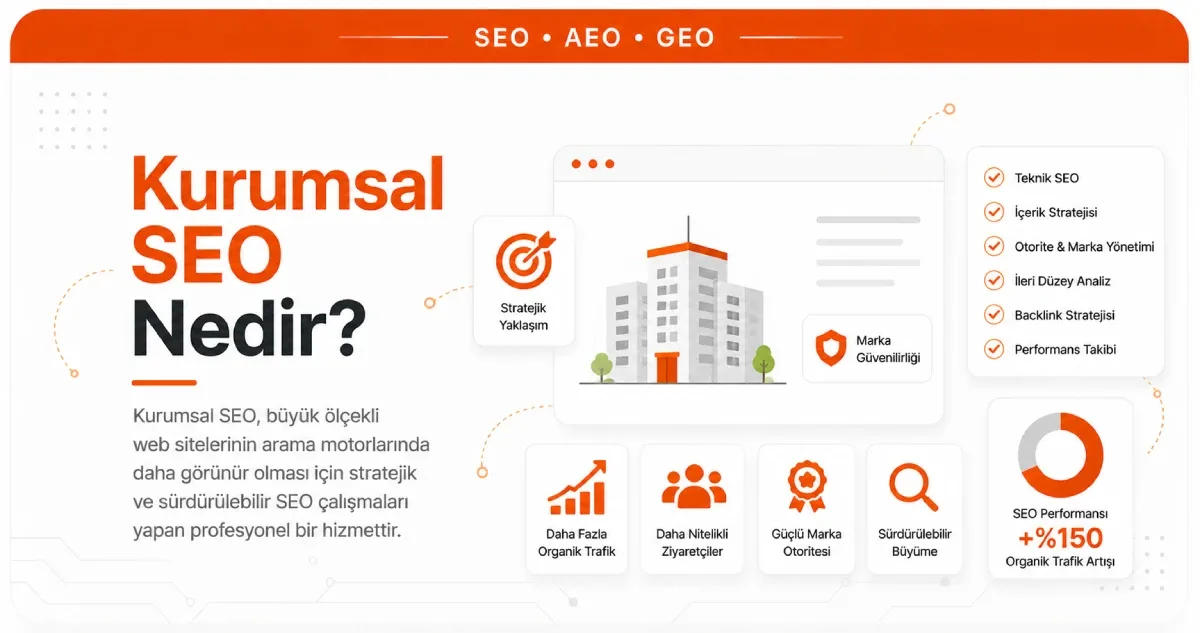
Enterprise SEO is the practice of applying search engine optimization (the work of getting a website to rank higher on engines like Google) to large-scale websites made up of thousands or even tens of thousands of URLs. It rests on the same principles as standard SEO, but scale, complexity and internal processes mean it requires a different kind of management. The working model relies not on a single specialist's handiwork but on repeatable, automatable systems: on a 10,000-page site, you can't write every title by hand; titles are managed with templates and rule sets. The concept emerged as a distinct area of expertise as enterprise-scale e-commerce, news and service sites grew. It covers three pillars: technical infrastructure, content at scale and site authority.
The key variable that sets enterprise SEO apart is page count: sites with more than roughly 1,000 URLs generally fall within its scope. At this scale, crawl budget (the limit on resources Google allocates to crawling a site) becomes a critical resource. On a small site, Google crawls every page without issue; on a large site, which pages get crawled and indexed becomes a management decision. Another distinction is internal structure: decisions aren't made by one person but coordinated across engineering, content, product and marketing teams. This coordination turns enterprise SEO into a governance effort as much as a technical one.
What is the difference between enterprise SEO and standard SEO?
Enterprise SEO and standard SEO share the same principles; they differ in scale and method. Standard SEO optimizes sites of a few dozen to 500 pages one page at a time; enterprise SEO manages thousands of pages with rules and templates. The difference shows up in three dimensions: technical scalability, process complexity and crawl budget management. The table below summarizes the core differences between the two approaches.
| Dimension | Standard SEO | Enterprise SEO |
|---|---|---|
| Site size | Dozens to hundreds of pages | Thousands to tens of thousands of pages |
| Optimization method | Manually, page by page | Template and rule based |
| Crawl budget | Rarely an issue | A central priority |
| Team structure | A single specialist or small team | Coordination across multiple teams |
| Technical debt risk | Limited | Grows exponentially |
| Approval process | Fast | Dependent on stakeholder sign-off |
The difference is felt most in technical debt (accumulated unresolved technical issues): on a small site, a single faulty template affects a few pages; on a large site, the same error spreads to thousands. That's why in enterprise SEO every change is first evaluated for its impact at scale. For integrated work that includes implementation, full-service models such as SEO packages are the usual route.
Which businesses need enterprise SEO?
Businesses need enterprise SEO once their page count and technical complexity pass a certain threshold. The need is a management problem born of scale: too many pages to manage by hand, too many topics to group under a single heading. These five types of business naturally fall within the scope of enterprise SEO:
- E-commerce sites with thousands of product, category and filter pages.
- News and publishing sites that publish hundreds of pieces of content a day.
- Multi-location businesses with many city or branch pages.
- Multilingual sites offering versions in several languages and countries.
- Large service or software platforms with extensive documentation and blog archives.
The common denominator is scale: on these sites, even a small technical improvement makes a big difference in traffic. Our e-commerce SEO guide covers the layers and priorities specific to e-commerce in detail. For small sites below the threshold, standard SEO methods remain sufficient.
How does enterprise SEO work?
Enterprise SEO works as a repeating, scalable cycle. It optimizes page groups and patterns rather than individual pages. The work proceeds in five stages:
- Audit: the site is measured for technical health, indexing (whether pages make it into Google's index) and crawl efficiency.
- Architecture: URL structure, internal linking (links between pages on the same site) and crawl budget are reorganized at scale.
- Content at scale: template-based pages and topic clusters are produced and improved with rule sets.
- Authority: site-wide strength is built through digital PR (off-site promotion and press work) and link building.
- Monitoring: rankings, traffic and indexing are tracked continuously, and deviations are caught early.
The most critical stage in this cycle is monitoring: on a site with thousands of pages, a single deployment error can drop hundreds of pages from the index within days. For continuous measurement and technical auditing, tools such as on-page SEO analysis feed the monitoring side of the process. Each stage produces the input for the next; when the order breaks down, effort goes to waste.
What are the components of enterprise SEO?
Enterprise SEO consists of managing three components at scale: technical infrastructure, content and authority. Each component has the same name as on a small site, but scale changes how it is implemented. For example, in a store with 50,000 products and 2,000 category pages, these three components are managed by separate teams.
Technical SEO
On large sites, technical SEO is the heaviest pillar of enterprise SEO. Its scope includes crawl budget optimization, control of faceted navigation (the URL proliferation produced by filtered listing pages), management of canonical tags (the tag that specifies the primary version among duplicate pages), server log analysis and the organization of XML sitemaps. A single category can generate 25,000 URLs through filter combinations; most of these pages are kept out of the index. The goal at this layer is to direct Google's limited crawl resources to valuable pages.
Content at scale
Content at scale is content production managed through patterns and clusters rather than individually written articles. Category and product pages are optimized with template rules; informational content is structured as topic clusters (a group of linked content built around a main topic). At this scale, the biggest risk is cannibalization, where multiple pages compete with each other for the same keyword and split their strength.
Authority and links
The authority pillar builds the site's overall credibility with search engines. On large sites, link building relies not on a single page but on an internal linking architecture that distributes strength and on site-wide digital PR. At enterprise scale, structured services such as backlink packages are used for link planning. Authority alone doesn't produce lasting results unless the technical and content pillars are solid.
What are the most common enterprise SEO mistakes?
Enterprise SEO mistakes stem from problems that look trivial at small scale but multiply at large scale. These are the five most common mistakes:
- Wasted crawl budget: thousands of unnecessary URLs produced by filtered pages delay the crawling of valuable pages.
- Cannibalization: many pages targeting the same keyword pull down each other's rankings.
- Siloed teams: disconnected work among engineering, content and marketing makes SEO decisions impossible to implement.
- Working without measurement: a project that starts without baseline data can't prove progress at the end.
- Neglecting technical debt: an accumulation of small errors turns into a mass ranking loss on a large site.
The common cause of these mistakes is scale blindness: carrying habits from small sites over to large ones. In enterprise SEO, every decision is made based on all the pages a pattern affects, not on a single page.
Why is enterprise SEO important?
On large sites, enterprise SEO lets small improvements pay off through a multiplier effect. On a site with 1 million visits a month, even a 1% increase in click-through rate means tens of thousands of additional visitors. Technical debt multiplies at the same scale: an indexing error that goes unnoticed on a small site can make thousands of pages invisible on a large one.
Its importance comes from the fact that scale cuts both ways. A large site carries both the biggest organic opportunity and the biggest technical risk. Enterprise SEO captures that opportunity systematically while keeping the risk under control. An unmanaged large site ends up unable to use a significant part of its content strength because of technical issues.
When is enterprise SEO the right choice?
Enterprise SEO becomes the right choice when site size and organizational complexity outgrow standard methods. Three signals drive the decision. The first is scale: once page count exceeds 1,000 URLs, manual management becomes inefficient and a template-based approach becomes necessary. The second is technical complexity: if there's filtered listing, multilingual content or multiple locations, crawl budget management comes to the fore.
The third signal is organization: if SEO decisions involve more than one team, the need for coordination makes an enterprise approach necessary. If none of these three signals is present, standard SEO remains faster and more economical. If there's scale and technical complexity but in-house expertise is lacking, you can start with SEO consulting to set the direction before implementation. Timed correctly, enterprise SEO is an investment that unlocks a large site's hidden traffic potential.
Note: This content is for informational purposes; the scope of enterprise SEO and the implementation process vary by site size and industry, so current information should be confirmed on the relevant service page before making a decision.
Frequently Asked Questions
How do you get started with enterprise SEO?
Enterprise SEO starts with measuring the site's current technical health and crawl efficiency. The first step is a comprehensive technical audit: indexing status, crawl budget and URL structure are examined. The second step is prioritization; on a large site, the highest-impact fixes go first. The third step is dividing responsibilities between teams. Work done without these three steps in place stays scattered and loses its effect at scale.
Are enterprise SEO and e-commerce SEO the same thing?
Enterprise SEO is an approach defined by scale, while e-commerce SEO is an industry practice. The two overlap on large e-commerce sites, because thousands of product and category pages require enterprise scale. But enterprise SEO also covers news, service and software sites, while e-commerce SEO is a sub-specialty focused on product, category and cart pages. On a large store, the two approaches work together.
How long does enterprise SEO take to deliver results?
In enterprise SEO, results show up on different timelines depending on the type of work. The effect of technical fixes can be measured within a few weeks after recrawling. Ranking gains driven by content and authority usually become clear within 3–6 months. On a large site, gains are cumulative: many small improvements make a big difference in total traffic over time. The exact timeline depends on site size, technical condition and competition.
Do small businesses need enterprise SEO?
For most small businesses, enterprise SEO is unnecessary; standard SEO methods deliver sufficient results. The need arises when page count and technical complexity exceed a certain threshold. On a site with no more than 200 pages, crawl budget is rarely an issue, so enterprise tools aren't needed. Size is the deciding factor: an enterprise approach makes sense when the site's complexity makes manual management difficult.
Does enterprise SEO require a separate team?
Enterprise SEO depends more on coordination across teams than on a single person. Technical fixes involve the engineering team, content at scale involves the editorial team, and authority work involves marketing. A separate SEO team isn't essential, but someone needs to own and manage these three sides. If in-house expertise is lacking, direction-setting can be covered by outside consulting and implementation by a full-service engagement. What matters isn't the number of teams but that decisions are coordinated.