There is a quick way to tell whether an about us page is doing its job: delete your brand name from the page and replace it with a competitor's. If the text still reads as true, the page is not describing your organization. On most corporate websites in Türkiye, this swap does not break a single sentence, because the page is nothing but adjectives: pioneering, innovative, customer-focused, solution partner.
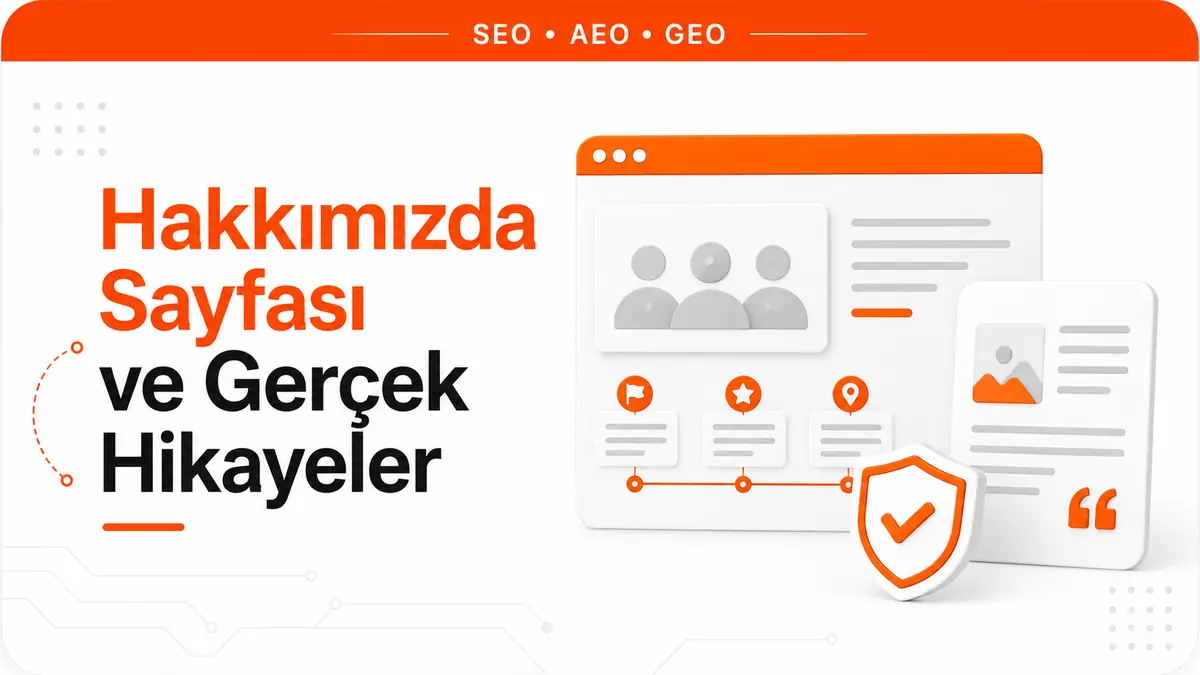
The page's real job is something else. The guidelines Google prepares for its search quality raters describe the first step in understanding a website quite plainly: find out who is responsible for the website and who created the content on the page. The guidelines note that on most websites this information can be found on the "about us" or "contact" pages. In other words, the about us page is not a promotional surface; it is the place where the identity record is expected to live.
This distinction changes how the page should be written from the outset. An identity record is built with verifiable information, not praise.
The real question the rater is asking
In the section on understanding the website, the quality rater guidelines expect two things to be clear: which person, company, organization or government body is responsible for the website, and who created the content on the page being evaluated. On forums and social media, an alias is an acceptable identifier because there is a reasonable justification for concealing identity there. A commercial website does not enjoy the same flexibility.
The guidelines' second, less discussed rule is far more decisive. Raters are asked not only to read what the site says about itself but also to look at what independent sources outside the site say. If the two conflict, the independent sources prevail. This single sentence flips the strategic role of the about us page: the page is not where trust is earned but where claims become verifiable from the outside.
A common exaggeration also needs correcting here. The ratings raters give do not directly determine rankings. Google writes that raters have no control over how pages rank and that their data is not used directly in ranking algorithms. The guidelines' value lies elsewhere: they are a plain-language description of the qualities the systems are trying to reward. Building an about us page as a "score booster" is the wrong goal; building it so that the organization can be identified is the right one.
Why a wall of mission and vision statements proves nothing
Generic corporate language fails not because it carries no information but because it cannot be disproved. There is no way to test whether the sentence "we see customer satisfaction as our priority" is true or false. A statement that cannot be tested carries zero distinctiveness, both for readers and for systems.
The guidelines contain a sharper warning on this point. If the information a site gives about itself seems exaggerated or slightly misleading, that is a sign of lower page quality. Examples include claims of experience and expertise that are overstated or added solely to impress visitors. The guidelines also state that the assessment should rest on the content itself, reputation research and verifiable documentation, not on the site's own "I am an expert" declaration.
In practice, this means that the bolder a sentence is and the weaker its means of verification, the more negative its contribution to the page. The claim "we are the industry leader" does not create trust when there is no comparative measurement behind it; on the contrary, it makes the rest of the information on the page look suspicious too.
How to tell whether a sentence counts as evidence
There are three filters you can use when writing about us copy. Sentences that do not pass all three do nothing but take up space on the page.
- The subject filter. Who is the subject of the sentence? "Our team", "we" and "our company" are not subjects; they are blanks. When there is a subject whose name, title or legal entity can be written down, the sentence starts to carry information.
- The swap filter. Replace your brand name with a competitor's. If the sentence is still true, it is not describing you. This filter strips out corporate template language in seconds.
- The external verification filter. Where can a reader go outside your site to check this claim? A trade registry record, a professional chamber or bar association listing, a university's faculty page, the verification screen of the body that issued a certificate, a news story in an independent publication, a third-party review profile. If you cannot point to a way to check it, what you have is a statement, not evidence.
The third filter is a direct application of the guidelines' independent source rule. The difference between a statement and evidence is whether the page is willing to send the visitor outside the site.
There is no fixed answer to "how much information is enough?"
About us content is usually written as if there were a single standard: an address, phone number, team, founding story and awards for every site. The guidelines do not frame it that way. They say the type and amount of contact information needed depends on the type of website. Contact and customer service information is considered critical for sites that handle money, while a humor site is not expected to offer the same set of information as an online bank.
The right question is not "have I included everything?" but "what is this page asking of the visitor?" The bigger the ask, the higher the bar for proof of identity.
| What the site asks of the visitor | Risk the visitor takes on | Expected baseline of identity evidence |
|---|---|---|
| Reading only (blog, hobby, personal site) | Time | Who created the content and at least one way to get in touch |
| Contact form or quote request | Personal data and time | Legal entity, responsible person, physical contact details |
| Signing up and creating a password | Account security, personal data | All of the above plus data processing disclosures |
| Payment and ordering | Money | All of the above, a customer service channel, payment, exchange and return terms |
| Health, financial or legal decisions | Health, financial situation, legal consequences | All of the above plus the verifiable qualifications of the person responsible for the content |
For shopping sites, the guidelines also ask raters to look for payment, exchange and return policies, noting that these are usually found under customer service. In other words, in e-commerce the about us page alone is not enough; identity information and commercial terms need to be findable together.
Why the bar moves higher for YMYL sites
Topics that can significantly affect health, financial stability, safety or the welfare of society fall under YMYL as Google defines it. Google writes that for these topics it gives more weight to content with strong signals of experience, expertise, authoritativeness and trustworthiness. The same document states that trust is the most important of the four and that the others feed into it.
The rater guidelines describe the threshold concretely. Pages that offer payment functionality or handle financial transactions receive a low rating if customer service or contact information is insufficient. Pages on YMYL topics and those requiring a high level of trust also receive a low rating if information about who is responsible for the site is insufficient. If a YMYL site handling sensitive data provides no information at all about the site or the content creator, the guidelines point straight to the lowest rating.
That is why, on YMYL sites, the about us page does not stop at describing the organization. Which expert produced the content and, where necessary, who reviewed it are also part of the identity chain. How to set up that review layer for health and finance content is a separate topic, covered in reviewer information for YMYL.
The team section is a map of responsibility, not a list of job titles
Most team sections consist of a photo, a name and a job title. This trio tells you who exists, not who is responsible for what. Yet it is the latter that shapes the assessment: whom to contact when an error is found, who makes decisions on which topics, who stands behind which piece of content.
Google recommends making it self-evident who created the content. It asks whether pages carry bylines where readers would expect them, whether those bylines lead to a page with more information about the author, and explicitly advises adding accurate author information where readers expect to find it. When the team section on the about us page is linked to the bylines on the content, the result is a navigable network of responsibility instead of a one-off introduction. How to build that link and which evidence elements biographies should contain is the subject of expert author biographies.
A warning is in order: putting people who do not exist on the team page, presenting stock photos as real employees or inventing titles that belong to no one is a far more serious problem than missing information. Deliberately providing false information about the site is listed in the guidelines among the reasons for the lowest rating.
Telling a real story means showing your process
The phrase "real story" is often understood as an emotional founding narrative. As evidence, that is usually not the valuable part. Google says that explaining to readers how content was produced builds trust, and gives the example of product reviews showing how many products were tested, what the results were, how the tests were conducted, along with concrete evidence such as photos.
The same logic carries over to introducing an organization. A section that explains step by step how the work is done carries more information than an anecdote about the founding year. If, after reading about your process, visitors know what will be discussed in the first meeting, which measurements will be taken, what the deliverable includes and what they will be left with when the work is done, the page has truly explained something. A process description is also verifiable: customers can compare what was described with what they experienced.
The founding story can be held to the same standard. Which problem you were founded to solve, what need your first customer came to you with and how your method has changed since then make a story worth telling. "We set out with passion" does not.
How much reference and client lists can prove
A client list, logo wall or thank-you note published on your own site is your own statement. The guidelines state that materials produced by the organization itself do not count as independent sources in reputation research and ask raters to look at sources outside the site. This does not mean a references section is worthless; it only means it does not stand on its own.
What moves a references section closer to evidence are threads that lead outside the site: a partnership page on the client's own website, a news story in an independent publication, a public tender or project record, a profile on a third-party review platform. How to bring an independent review layer onto the site is covered in detail in third-party review widgets.
There are also cases where a client cannot be named because of a confidentiality agreement. In that case, an anonymous case study is legitimate, but it should be used with its limits in mind: an anonymous case shows method, it does not verify reputation. If numerical results are shared, state what the measurement was based on and which periods were compared; otherwise the figure remains an unverifiable claim in the reader's eyes.
Contact information and how easy the page is to find
The guidelines do not impose a single format for contact information. Email address, phone number, physical address and contact form are all listed; they note that on some sites this information is organized by department and the names of the relevant people are given. For personal sites, not sharing a home address and phone number is considered legitimate, and aliases are accepted on platforms that host user content. What matters is not the format but how the level of access offered compares with what the site asks of the visitor.
Findability is a separate requirement. When looking for this information, raters start from the home page, look for a contact or customer service link and, if they cannot find one, have to explore the site. The same difficulty applies to real users. About us and contact pages should be reachable from the main navigation in a single step, supported by internal links and technically crawlable. Checking the site's link structure with an on-page SEO analysis is a practical starting point for confirming that the page really is linked and accessible.
Communicating the same information to machines
The identity information on the about us page can also be communicated in machine-readable form with Organization structured data. Google uses this markup to understand the organization and the site owner. It would be wrong to assume the markup produces a direct guarantee of rankings or citations; what it does is remove ambiguity from the information on the page.
{
  "@context": "https://schema.org",
  "@type": "Organization",
  "name": "Organization name",
  "legalName": "Full legal name",
  "url": "https://example.com/",
  "logo": "https://example.com/logo.png",
  "address": {
    "@type": "PostalAddress",
    "streetAddress": "Street address",
    "addressLocality": "District",
    "addressRegion": "Province",
    "postalCode": "Postal code",
    "addressCountry": "TR"
  },
  "contactPoint": {
    "@type": "ContactPoint",
    "telephone": "+90-XXX-XXX-XX-XX",
    "contactType": "customer service"
  },
  "sameAs": [
    "https://www.linkedin.com/company/organization",
    "https://en.wikipedia.org/wiki/Organization"
  ]
}
There is only one rule: every field in the markup must have a visible counterpart on the page. Writing an address that is not on the page, an employee count that does not exist or an award that was never received into structured data does not introduce the organization; it places it in the category of misleading information about the site.
Fixes that turn weak statements into evidence
The table below shows three common patterns and a version of the same information that produces evidence. The right-hand column is not a sentence to copy but a rule to apply.
| Common statement on the page | Why it produces no evidence | The form that turns it into evidence |
|---|---|---|
| We are a pioneering and innovative organization in our field | No basis for comparison, still true with a competitor's name, cannot be checked from outside | State the legal name, registry record and line of business; readers can view the record in the relevant official registry |
| We have completed hundreds of successful projects | Vague number, undefined scope, no measure of results | Give the type of service and how success is measured; for work that can be shared, point to something visible on the client's side |
| We serve you with our experienced, expert staff | Unclear who they are; the claim of expertise remains a statement | Name the people responsible, state the body that granted their qualifications and link to a verifiable record |
A question framework to fill in
An about us page does not need a template; it needs answered questions. When the questions below are answered in order, the resulting text is unique to the organization by default. A question without an answer is left blank; the moment it is filled with a generic sentence, the page stops producing evidence and starts producing noise.
- Identity. Who runs the site: an individual or a legal entity? What is the full legal name? Which record verifies this identity, and where can readers see it?
- Responsibility. Who is responsible for the content? Who makes decisions on which topics? When an error is reported, who receives the report and how quickly is it addressed?
- Competence. Which education, certificate, membership or public record verifies the claimed expertise? Does the issuing body offer a way to verify it?
- Method. How does the work proceed step by step? Which measurements are taken, what does the deliverable include, and what does the client have when the work is done?
- Access. Through which channel, during which hours and in which language can you be reached? Is there a physical address? If payment is taken, where are the payment, exchange and return terms written?
- Independent footprint. Which sources other than you mention you? Can you link to them? If not, is there a plan for how such a footprint will be built?
Not all six headings have to be filled at once. On a hobby blog, the first two may be enough; on a site that takes payments, the fifth cannot be skipped; on a YMYL site, the third becomes mandatory. What determines the quality of the page is not its length but how many questions are genuinely answered relative to what is being asked of the visitor.
Frequently Asked Questions
Should the about us and contact pages be separate?
What matters is not the number of pages but that the information can be found in one step from the home page. The rater guidelines describe starting from the home page when looking for information, looking for a contact or customer service link and exploring the site if none is found. A combined about us and contact section on a single page and two separate pages linked to each other both meet this expectation. The only structure that does not is one where the information is buried deep in the site.
I am a sole proprietor. Do I have to publish my home address?
The guidelines accept that there can be legitimate reasons for anonymity and give the example that personal sites may choose not to share personal contact details such as a home address or phone number. What matters is what the site does. On a site that only publishes content, a working contact channel and information about who created the content may be enough. If the site takes payments or provides information on YMYL topics, the bar rises; in that case a business registration and a functioning customer service channel are expected.
Will a good about us page improve rankings?
No such direct link can be drawn. Google states that experience, expertise, authoritativeness and trustworthiness as a whole are not themselves a ranking factor, and that raters have no control over rankings and their data is not used directly in the algorithms. The page has a different function: making the organization identifiable, making claims verifiable and keeping the information visitors need to make a decision within easy reach. When it does these three things, the page has done its job for both users and search systems.