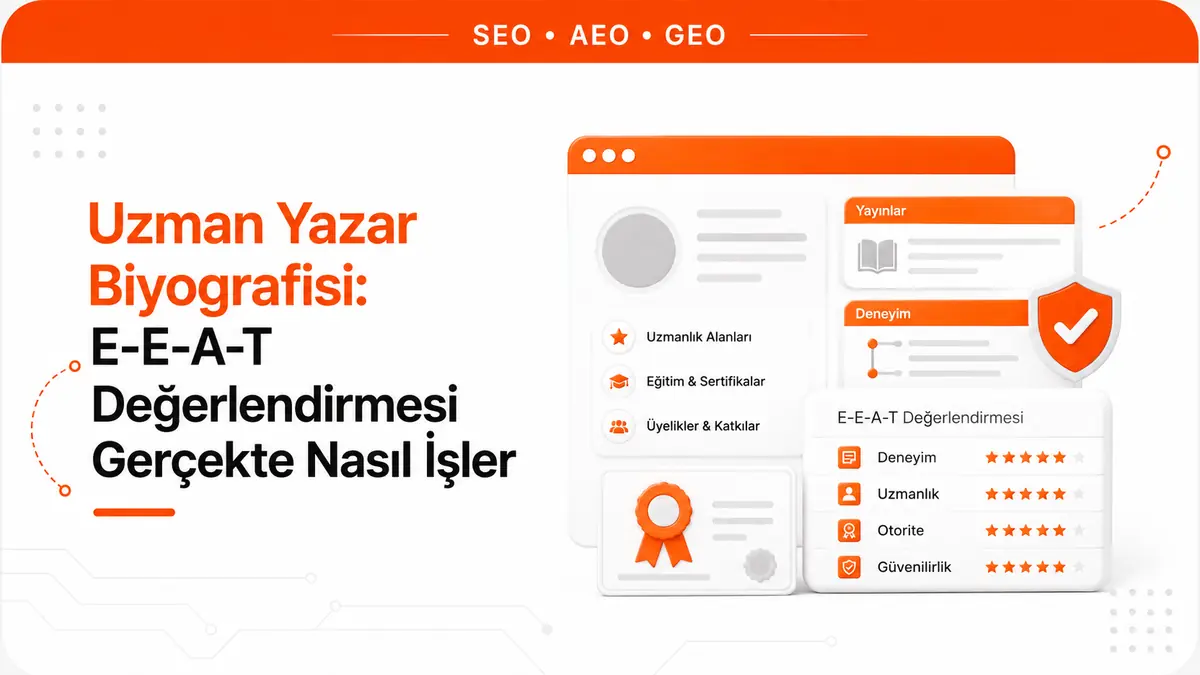
The real job of an author box is to answer the reader's question "who wrote this and why should I trust them?" without the reader having to leave the page. That question existed long before search engines. Yet Google's documentation on the topic is frequently misread, and the author box is treated as a lever for raising a score. Google rejects this clearly in its own content guidance: E-E-A-T itself is not a specific ranking factor; automated systems use a mix of signals to try to identify content that demonstrates good E-E-A-T. In other words, there is no score to buy, accumulate or calculate. There is an expectation to meet, and the guidelines Google gives its quality raters spell it out quite concretely.
What author information actually solves
Google's framework has four components: experience, expertise, authoritativeness and trust. Trust sits at the center. The quality guidelines say so directly: an untrustworthy page has low E-E-A-T no matter how experienced or expert its creator appears. The example in the guidelines is harsh but illuminating: a page about financial fraud written by the person who knows fraud best is still untrustworthy.
Experience and expertise are not the same thing either. Google added the experience component to the long-standing E-A-T acronym later and stated its reasoning openly: for some questions, what readers are looking for is not formal knowledge but an account from someone who has lived through the topic. You would want an accountant to fill in a tax return correctly, but when the question is what a particular tax software is like, accounts from people who have actually used it may be more valuable. The function of author information is to make this distinction visible to the reader: has the person behind this text lived the topic, studied it, or merely compiled it?
The authoritativeness component does not even apply to most topics. The guidelines acknowledge that for most topics there is no single official authoritative source. For passport renewal, the government's own page is uniquely authoritative, but for an ordinary technical topic no such monopoly exists. Framing the author page as "the place where I declare that I am an authority" is therefore mostly wasted effort.
What inputs do quality raters use to weigh an author?
This is the most practical part of the guidelines, and it is missing from most author page guides. Raters are required to base their E-E-A-T judgment on one or more of three separate inputs:
- What the website or content creator says about themselves. The starting point is the about us page or the content creator's profile page. The question put to the rater is: based on this information, is this source trustworthy?
- What others say about the person or website. Independent reviews, references, news articles and other credible sources of information are sought out. The critical word here is independence: is there independent, reliable evidence that the person is experienced, expert or authoritative, or, conversely, evidence that they are untrustworthy?
- What is visible on the page itself. For some types of content, expertise is evident directly from the main content. The guidelines' example is clear: someone's skill at hairstyling can be judged from a video showing them at work and the comments beneath it.
This trio also explains why an author page alone is not enough. The first input is entirely under your control, the second is not, and the third depends on the quality of the content itself. Inflating only the first input does not strengthen the assessment when the other two are empty. Telling the real story on your about us page and making expertise verifiable through external sources do not substitute for each other; they work together.
The guidelines also flag conflicts of interest as a separate warning. An account from someone who has used a product is valuable, but a manufacturer's praise of its own product or a review by a paid promoter does not carry the same trust. Hiding commercial ties in an author biography is a choice that directly undermines whatever trust has been earned.
Which questions should a good author page answer?
A decision framework is more useful than a template to copy. An author page has done its job if it answers the following questions without the reader needing to do any extra research.
- Who is this person and what is their role on this site?
- Where does their knowledge of the topic come from: from doing it, from studying it, or both?
- Is there a way to verify this claim outside the site?
- Do they have any conflict of interest related to the topic?
- What else has this person written on the site?
The last point is often skipped, but for readers it is the quickest trust test. A list of the author's other articles shows at a glance whether the claim of expertise is a one-off or an ongoing area of work.
When answering these questions, what matters is that each statement has a verifiable counterpart. To make the difference concrete:
| Unverifiable statement | Verifiable counterpart |
|---|---|
| A leading expert in their field | Holds a specific role at a specific organization, and that role can be confirmed on the organization's own website |
| Has completed countless projects | Links are provided to published work, a recorded talk or open source contributions |
| Many years of experience in the industry | The same work history appears on their professional profile and does not contradict the information on the site |
| Certified expert | A link is provided to the issuing body's verification page |
Why exaggerated claims of expertise backfire
In the quality guidelines, information about the author or website that is exaggerated or slightly misleading is defined as a reason for a low rating in its own right. The guidelines' description is direct: claims of personal experience or expertise that seem overstated or appear to have been added to impress visitors fall into this category. The same section says the assessment should rest not on someone saying "I am an expert" but on the content itself, what reputation research turns up and verifiable credentials.
One step further lies intent. Deliberately including false or misleading information about the content creators to make a site appear trustworthy is listed in the guidelines, under deception, as one of the reasons for the lowest rating. A fabricated author identity, a purchased title or an affiliation with an organization that does not exist is not "a bit of embellishment"; it belongs in this category.
The practical consequence: there is a ceiling to how far you can inflate an author box, and beyond that point every addition increases risk. An unverifiable claim leaves you in a weaker position than making no claim at all, because when the reader or rater tries to verify it, they come up empty-handed.
Where does the bar rise on YMYL pages?
Google states that for topics that could significantly affect health, financial stability, safety or the welfare of society, its systems give more weight to content aligned with strong E-E-A-T. The quality guidelines tie this to a concrete rule: pages on topics requiring a high level of user trust should be rated low if they contain insufficient information about who is responsible for the website or who created the content.
The point to note here is that the rule is not about "how long is the author bio" but about "is it clear who is responsible?" On pages that take payments or handle financial transactions, the same logic applies to customer service and contact information. If you add an extra layer to health and finance content with information stating that the content was reviewed by a subject matter expert, the reviewer's identity must pass the same verifiability test. A review label that leaves the reviewer invisible does not create trust.
Does writing under a pseudonym invalidate the author signal?
No, and this is the source of a common mistake. The quality guidelines state explicitly that on forums and social platforms people may use aliases to avoid sharing their identity, and that in such cases an alias is acceptable for identifying the content creator. The same guidelines note that a long-standing online alias can identify a content creator. For personal sites and non-YMYL forum discussions, an email address or a social media link on its own can be enough.
So there is no rule requiring a real name. What actually happens is this: an unclear identity becomes a problem when the type and topic of the page call for a high level of trust. When there is a reasonable justification for staying anonymous, expectations drop; when you enter YMYL territory, they rise.
Byline placement and sitewide consistency
In its own self-assessment questions, Google asks whether it is self-evident to visitors who created the content, whether pages carry a byline where one would be expected, and whether the byline leads to further information about the author. In the same place, it strongly recommends adding accurate authorship information to content where readers would expect it. These three elements only make sense together: the byline must be visible, it must be real and it must lead somewhere.
Consistency is a sitewide matter. If some articles show a real author name while others show a generic editor account, readers conclude that the content in the second group has no owner. Likewise, a job title on the author page that contradicts the one on the person's professional profile makes verification harder, not easier. Sites that want to surface the second input (what others say) on the page can use review widgets from third-party platforms, but this approach has its own limitations in terms of visibility and technical accessibility.
What the Person schema layer solves and what it doesn't
Structured data lets you repeat information that is already visible on the page in a form machines can read. It does not produce a score. Google's own documentation states plainly that features using structured data are not guaranteed to appear in search results. Nor is it the key to getting into the Knowledge Graph. Its function is more modest and more realistic: to state the relationship between the author and the content without ambiguity.
Google's concrete recommendations for author markup are: everyone who appears as an author on the page should also be included in the markup, multiple authors should not be merged into a single field, and each author should be listed in their own field. The author.name field should contain only the name; the publisher's name, job title, honorific or introductory words such as "posted by" should not go there. Use dedicated properties instead, such as jobTitle for the job title and honorificPrefix for honorifics. Choose the Person type for people and Organization for organizations; do not use Thing.
There is also an often-overlooked detail: Google strongly recommends using the url or sameAs properties to disambiguate the author and says it can understand both. author.url can point to a page that uniquely identifies the author; this could be a professional profile page, an about me page or a biography page. If it points to an on-site profile page, Google recommends marking that page up with ProfilePage structured data.
{
  "@context": "https://schema.org",
  "@type": "ProfilePage",
  "mainEntity": {
    "@type": "Person",
    "name": "First Last",
    "jobTitle": "Technical SEO Specialist",
    "description": "Works on site migrations and crawl budget.",
    "url": "https://example.com/author/first-last",
    "image": "https://example.com/images/first-last.jpg",
    "knowsAbout": ["Technical SEO", "Site migration", "Crawl budget"],
    "worksFor": {
      "@type": "Organization",
      "name": "Organization Name",
      "url": "https://example.com"
    },
    "sameAs": [
      "https://www.linkedin.com/in/first-last",
      "https://github.com/firstlast"
    ]
  }
}
On the article itself, the author field makes the connection:
{
  "@context": "https://schema.org",
  "@type": "BlogPosting",
  "headline": "Article title",
  "author": [
    {
      "@type": "Person",
      "name": "First Last",
      "jobTitle": "Technical SEO Specialist",
      "url": "https://example.com/author/first-last"
    }
  ],
  "publisher": {
    "@type": "Organization",
    "name": "Organization Name",
    "url": "https://example.com"
  }
}
Google itself states that Article markup has no list of required properties and that you should add the recommended properties that fit your content. Writing made-up values just to fill in fields is therefore an unnecessary risk: if the information in the markup contradicts what is visible on the page, it creates problems rather than gains.
One more correction: according to the schema.org definition, the reviewedBy property, which states that content was reviewed by an expert, is used on the WebPage type. Adding this property directly to an Article node is not a valid use of the vocabulary.
Common myths about author biographies
- "It raises your E-E-A-T score." No such score is published, and Google writes that E-E-A-T itself is not a specific ranking factor. There is no number to raise, only an expectation to meet.
- "Quality raters affect rankings." Google states clearly that raters have no control over how pages rank and that rater data is not used directly in ranking algorithms. The value of the guidelines lies in being able to assess your own content through the same lens.
- "Person schema gets you into the Knowledge Graph." Features that use structured data are not guaranteed to appear. Markup states a relationship; it does not buy an outcome.
- "The more numbers in the bio, the better." An unverifiable quantitative claim counts as an exaggerated statement in the quality guidelines and is a reason for a low rating.
- "The bio should be updated at regular intervals." No such interval has been published. An update makes sense when the information has actually changed; Google separately flags changing dates purely to look fresh in its own list of warnings.
- "A long author page is a strong author page." Google's own documentation says it has no preferred word count. What matters is not length but whether claims are backed up.
Frequently Asked Questions
Who should appear as the author of AI-assisted content?
Google recommends disclosing the use of automation or AI where how content was produced is meaningful to the reader, and includes this in its self-assessment questions: is the use clear to visitors, is information provided about how it was used, is it explained why it was considered useful? The real person or team responsible for the content continues to appear as the author; AI is not an author identity but part of the production process. Producing content with automation for the purpose of manipulating rankings is defined outright as a spam policy violation.
Is an author photo required?
No. The function of a photo is to let readers see quickly that there is a real person on the other side, so using a stock image or a generated face defeats the purpose. For authors with a reasonable justification for not revealing their identity, a consistent identity without a photo is a stronger choice than a fake photo.
How long should an author bio be?
There is no set length, and Google's own guidance notes that it has no preferred word count. The measure is this: if the bio answers the five questions above without the reader needing to do further research, it is enough. Every sentence that answers none of them adds noise to the page, not trust.
Does a one-person site need a separate author page?
It is not required. On a one-person site, the information about who is responsible can be gathered on the about us page and the byline can link there. A separate author page becomes useful when more than one person writes on the same site or when one person's area of work does not overlap with the site as a whole.