The intent of a query does not lie in the dictionary meaning of its words. Google's Search Quality Rater Guidelines show this with their own examples: the search "is egg salad healthy" wants calorie and nutrition information, not an egg salad recipe, and the guidelines say that recipe pages without nutrition information do not even count as a reasonable minority intent for this query. The same guidelines give the example of climbing pages about the Bears Ears area for the query "can bears climb mountains" and note that a result matching a few words in the query does not make it relevant. Intent is not about matching keywords; it is the task the person wants to complete with that search.
In practice, this distinction means the following: if one of two pages targeting the same keyword ranks while the other does not appear at all, the problem is usually not keyword density or link count but the type of page. The user expected a list and found promotional copy, expected a price and found a guide, expected a tool and found a historical account. This article is about choosing that type based on evidence rather than guesswork.
Intent lies in the task behind the query, not in the keyword
The rater guidelines define intent as "what the user is trying to accomplish when they search", and immediately add an important caveat: a single user can have multiple intents for a single query. So intent is not a single label stuck onto a query. The interpretation of a query and the intents under that interpretation are separate layers.
The guidelines' approach to the words in a query is also instructive. In the "lewis county non emergency number" example, they note that results ignoring the phrase "non emergency" lead the user straight to the wrong number, and they say users will be frustrated when results skip important words in the query. The lesson here is a point often missed in keyword research: reducing a query to its head term and dropping the qualifiers means dropping the intent too. "SEO consulting" and "SEO consulting fees" are not the same information need, and the two are usually not served by the same page. If you are new to the basic concepts, our introduction to what SEO is lays the groundwork this distinction rests on.
Google's own intent framework is not the same as the industry's four types
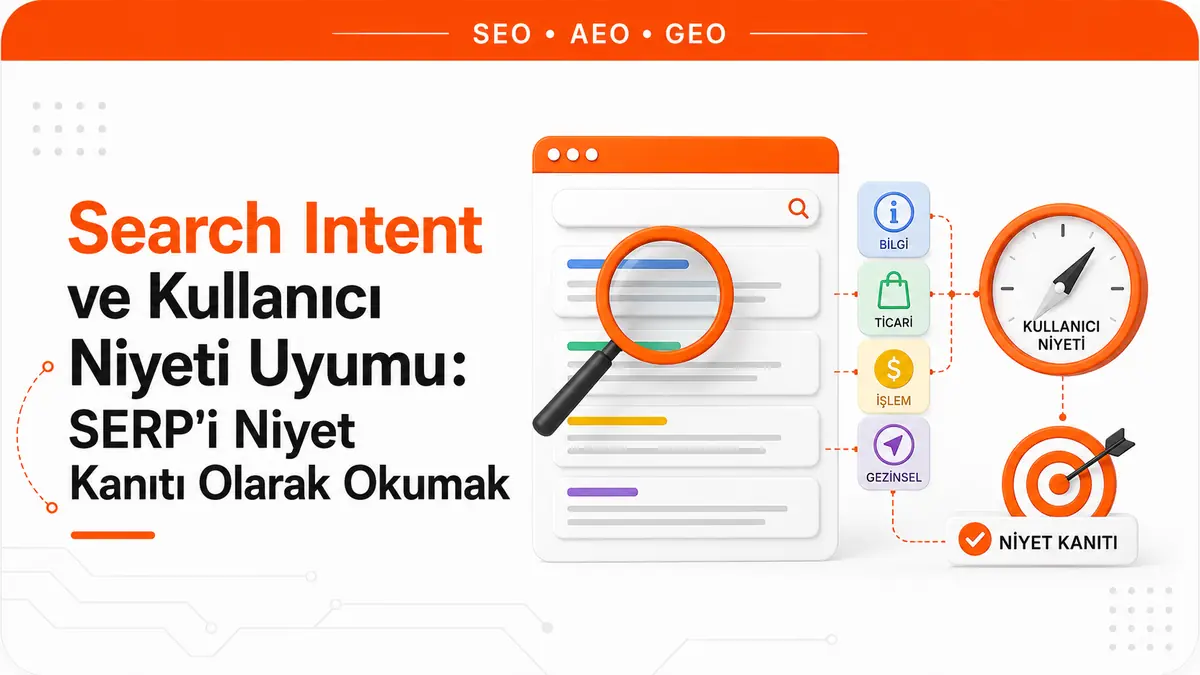
In SEO literature, intent is almost always described under four headings: informational, navigational, transactional and commercial investigation. This set is useful, but it is an industry convention. None of these four terms appear in the rater guidelines Google publishes. The guidelines' own section divides queries as follows:
- Know queries: The user wants to learn about or explore a topic. Within this, the guidelines also define a Know Simple subtype: questions with a single correct answer most people would agree on, which fits in one or two sentences or a short list.
- Do queries: The user wants to complete a task or engage in an action. Downloading, buying, calculating, watching and interacting with an app fall under this heading.
- Website queries: The user has a specific website or page in mind. The guidelines call this the target page, and they also place brand name searches in this group.
- Visit-in-person queries: The user is looking for a physical place to go. Some target a specific business, others a category of business.
The difference between the two frameworks is not cosmetic. The industry's four types try to put a query in a single box. The guidelines, on the other hand, accept from the outset that queries can carry "one or more" intents, and state explicitly that the line between Know and Do is sometimes blurry and that you should not try too hard to separate these two categories strictly. In addition, the guidelines' Know Simple distinction carries a very practical insight with no equivalent in the industry's four types: producing a long guide for questions with a short, definite answer is not a lack of information but an excess of format.
One point should not be confused either. The rater guidelines are not a ranking algorithm document. Google says that aggregated feedback from human raters helps improve how its systems distinguish information quality. So the intent framework in the guidelines is not a rule set that scores a page directly; it is the most official and most detailed written version of Google's definition of a "good result". That is where its value comes from.
Six steps for reading the SERP as evidence of intent
Intent is not guessed; it is counted. A query's results page is the most concrete and most current decision Google has made about which page types complete the task for that query. The steps below turn that decision into a readable output.
- Search the query under clean conditions. Personalization and location really do change the results. The guidelines show this with the "verbena" example in Austin: the same query points to a restaurant in Austin and to a plant in other cities. Search with your target audience's region and language fixed.
- Label the top ten organic results by page type. Labels come from the page itself, not the URL: category page, product page, service page, pricing page, step-by-step guide, definition article, comparison list, tool or calculator, forum thread, video.
- Look at what the pages do, not what they say. Does an article with "best" in its title actually compare multiple options, or is it a promotion of a single product? When this distinction is missed, intent is misread.
- Record SERP features in a separate column. The map pack, shopping results, video carousel, featured snippet and "People also ask" box carry intent information independent of the results list.
- Write down the dominant intent and the secondary intent separately. The type of the top three results gives the dominant intent. If a different type clusters between positions four and ten, there is a second intent layer there, and that layer is usually the subject of a separate page.
- Compare your own page type with these labels. If the page you plan to produce does not fall into the same box as the type of the top three results, you are producing the wrong asset for that query.
The output of this reading should not be an impression to keep in mind but a written record. A simple tally sheet does the job:
Query: technical seo audit
Region: Türkiye / Turkish

Pos.   Page type               Intent label
1      service page            Do
2      service page            Do
3      pricing page            Do
4      step-by-step guide      Know
5      tool page               Do
6      step-by-step guide      Know
7      definition article      Know
8      service page            Do
9      forum thread            Know
10     step-by-step guide      Know

SERP features: People also ask box present, no map pack,
               no video carousel, no featured snippet

Dominant intent : Do  (all of the top three are on the buying side)
Secondary intent: Know (guides cluster in positions 4-10)
Decision        : service page. Move guide content to a separate
                  article and link to it from the service page.
From result type to page decision: a reading table
The table below links the surface you see on the results page to the guidelines' intent name and the asset you need to produce. It is not a list of guesses; it turns the labels you collected in steps 2 and 4 into decisions.
| What you see on the SERP | Intent name in the guidelines | Page to produce |
|---|---|---|
| Product or category pages in the top three, shopping results | Do | Product or category page. A blog post will not earn a spot for this query. |
| Service and pricing pages in the top three, heavy ads at the top | Do | A service page covering scope, process and price range. |
| Map pack and business cards | Visit-in-person | Location page and business profile. Competing from a distant region is inefficient. |
| A single brand's own pages, login screens | Website | If it is your own brand, your own page. If it is a competitor's brand, do not target it. |
| A one- or two-sentence definitive answer in the featured snippet | Know Simple | A short, direct answer block. A long guide is an excess of format. |
| Long guides, different approaches, forum threads | Know | A comprehensive guide. A sign of a topic without a single correct answer. |
| Video carousel at the top | Know or Do | Video accompanying text content. The task is learned by watching. |
| The top three and the next seven are clearly different types | Mixed | Produce the type of the top three and split the other layer into a separate page. |
What the SERP does not tell you
The limit of using the results page as evidence of intent is not mentioned in most sources that recommend this method. Google's own rater guidelines state explicitly that you should not rely on the top-ranking results when researching a query, and they give the reason: a query may have other meanings that are not represented at all on Google's results pages. The guidelines also say a page should not be given a high rating just because it appears at the top of search.
Building this caveat into the method does not invalidate the method; it clarifies its scope. The results page reliably tells you two things: which page type is the entry ticket for that query, and what the dominant interpretation is. What it does not tell you is what everyone typing that query wants. In the guidelines' terms, the results page shows the dominant interpretation and common interpretations, but it is under no obligation to show reasonable minority interpretations to any great extent.
The practical conclusion is this: take the page type from the results page, but not the page scope. If all your competitors cover the same five headings, that does not mean users are only curious about those five things. To determine scope, you need to look at the query's own qualifiers, the "People also ask" box, autocomplete suggestions and the questions customer representatives actually get asked. Format alignment gets you onto the list; a difference in scope moves you up it.
How to handle mixed-intent queries
A separate section of the rater guidelines is devoted directly to this topic, with two examples. For the query "harvard", the user may want to go to the official homepage (Website), get directions (Visit-in-person) or learn about the application process and the school's history (Know). For the query "walmart", the user may want to visit a nearby store (Visit-in-person), go to the site to shop online (Website) or read news about the company (Know). The guidelines say that for queries like these, raters should lean toward considering the interpretations reasonable.
Mixed intent is not an ambiguity to be resolved but a structure to be accepted. In practice, three decisions get the job done.
The dominant intent determines the page type. Whatever the type of the top three results, that is the asset to produce. Producing a hybrid page that is "both a guide and a sales page" for a mixed-intent query means producing a page that satisfies half of each intent.
The secondary intent goes to an on-page module or a separate page. If the dominant intent is Do, placing a short "how it works" block inside the service page covers the secondary Know layer. But if that layer carries search volume of its own, a module is not enough and a separate article is needed.
Which query belongs to which page is written down in advance. Opening separate pages for different intents on the same topic is the right decision, but without a record, the two pages start competing with each other for the same query. Topical map planning sets up this mapping from the start, and a keyword cannibalization check cleans up overlaps that form later.
Diagnostic signatures of a mismatch
An intent mismatch does not come with a single symptom. Different types of mismatch leave different signatures in search performance data. The five signatures below narrow down where the problem is.
Impressions but no clicks, position stuck between eight and twenty. Google sees your page as a candidate for that query but does not move it to the top. This is the most common format mismatch signature. Check: are the top three results for the query the same page type as yours? If not, the problem is not content quality but asset type. If they are the same type and clicks are still low, the problem is not ranking but presentation, and you need to look at title optimization.
The page does not appear at all, but another page on your site shows up for that query. Google considers another of your pages, not the one you targeted, to be the answer to that intent. Usually the two pages are of similar types or the internal link structure points to the wrong page.
The page rises to the top and then drops back. The page type may have been chosen correctly, but the information need may not be fully met. When the format is right, the problem is on the scope side, and the solution is not to make the page longer but to genuinely answer the sub-question that was left out.
Part of a query cluster ranks and part does not appear at all. The page satisfies only some of the micro-intents in the cluster. Look at the qualifiers of the queries that do not appear: additions such as "price", "how", "how long does it take", "example" or "template" usually point to a sub-need with no counterpart on your page at all.
The results page has changed type but your page is still in the old format. This is intent drift, the topic of the section below, and the only remedy is to read the results page again.
All of these signatures are observations from your own data, and they are enough for diagnosis. Drawing firm conclusions about Google's mechanisms from them, however, is a separate claim and requires care. Google states that it uses aggregated, anonymized interaction data to assess how relevant search results are to queries, and turns this into signals that improve its systems' relevance estimates. That statement describes a query-level relevance estimate. It does not describe a pogo-sticking penalty applied to individual pages. The sentence often repeated in the industry, "if users bounce back, your page gets penalized", is a claim about a mechanism that this documented statement does not support. Bounce-back behavior is a strong diagnostic finding for you, not a proven penalty mechanism.
Commercial page or blog post?
Of all the outputs of intent analysis, this decision has the most money riding on it, and it comes down to a single question: are the top three results for the query pages that make money, or pages that provide information?
If the top three contain service, product, category or pricing pages, the query belongs to a commercial page. Writing a guide for this query means serving the right answer in the wrong container. The reverse is just as costly: pushing a service page for a query where guides hold the top three results means the page never appears for that query, and this is usually the real cause behind "we can't rank for this keyword" complaints that people try to solve on the technical side.
Three common mistakes need attention when deciding. The first is letting volume dictate the decision. Targeting a high-volume informational query with a service page does not turn volume into traffic. The second is settling for a single page for the same topic. A "technical SEO" topic cannot serve both "what is technical SEO" and "technical SEO audit service" with the same page, because the results pages for the two queries are filled with different types. The third is not recording which page owns which query after opening two pages.
There is only one legitimate reason to go against the results page when choosing a page type: having a genuinely new form of information for that query and being able to prove it. This exception is rare and should not be confused with a desire to "do something different".
How do you know when intent has drifted?
Google's own documentation states clearly that the meanings of queries change over time. The guidelines give the example of the query "iphone": a user searching in 2007 was looking for that day's first model, while most people searching today are looking for the newest model, and the dominant interpretation changes again as new models come out. In the same section, the guidelines say that unless the query states otherwise, users are assumed to be looking for current information about a topic.
The rule that follows is not a review period tied to a calendar. A fixed interval is too late for queries that drift quickly and unnecessary for queries that never drift. Instead, it is more efficient to watch for triggers that signal drift:
- The page's position has dropped noticeably without any change to the content.
- A feature that was not there before has appeared on the results page, or an existing feature has disappeared.
- A new product category, a new regulation or a new tool has entered the industry.
- The query's autocomplete suggestions or the questions in the "People also ask" box have changed.
- The query has entered a seasonal turning point.
When one of these triggers occurs, the task is to rerun the six-step reading and compare the new label table with the old one. Drift is visible only in the distribution of result types, not in traffic data. A traffic drop is a consequence of drift, not an indicator of it.
Common edge cases
The results page is entirely full of competitors' product pages, but I have no product to sell. Should I write a guide? Not for that query. The guide format does not get you in the door for this query. Instead, target informational variations of the same topic: if the type of the results page changes when qualifiers such as "how", "difference" or "when is it needed" are added to the query, that is where the real opportunity is.
Is the results page I read the same on every device and in every location? No. The guidelines note that user location is very important for understanding searches like "coffee shops near me" and not important at all for searches like "how does gravity work". If your query involves a physical place or a local service, do the reading in the target region. If it does not, a difference in location usually does not change the result.
I can't put a query into a single intent box. Am I reading it wrong? You are probably reading it right. The guidelines say the line between Do and Know is sometimes blurry, that some queries fall into both categories, and that you should not struggle to separate these categories strictly. The categories are there to show broad patterns. Base your decision not on the category name but on the page type of the top three results.
Is intent alignment the same as keyword difficulty? No. A difficulty score estimates the competitive cost of ranking for that query. Intent alignment determines whether you can enter the race at all. On a query entered with the wrong page type, rankings will not come even if the difficulty score is low, because the problem is not competition but eligibility.