What data does ChatGPT look at when recommending products?
Before ChatGPT recommends a product, it needs a structured record about that product. This record comes from three channels: the product feed the seller sends directly to OpenAI, third-party product data providers and the public product pages themselves. What a seller can influence comes down largely to the quality of these three channels.
Product feeds provided directly by the seller
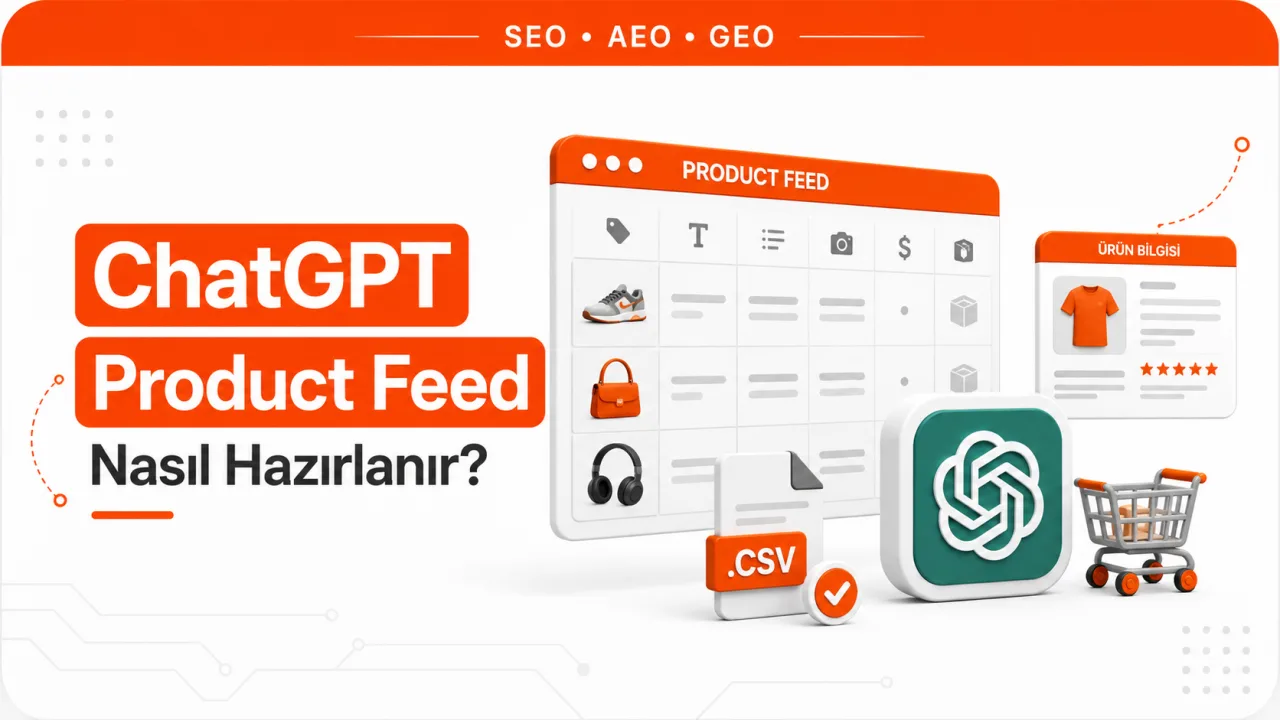
OpenAI's product feed specification defines how a seller submits its catalog in a structured format. Once the feed reaches OpenAI, the records are validated and the product data is indexed for matching and ranking inside ChatGPT. The specification states that the system accepts updates every 15 minutes. Direct feed access requires an application, which means not every seller can use this channel today.
The situation is different for stores selling on Shopify. OpenAI says that product data in Shopify catalogs is already integrated into ChatGPT and that stores do not need to do any additional work. In this case, the seller's job is not to set up a feed but to fill in the fields in its catalog correctly.
Third-party providers and public product pages
Products without a direct feed are not ignored. OpenAI explains that the prices shown in product listings are taken from third-party providers and that the merchant list is built from product and merchant data coming from these providers or obtained directly from the seller.
In ChatGPT's shopping research mode, the source is the web itself. OpenAI states that the results of this mode are organic, rely on publicly available retail sites, read product pages directly, show their sources and avoid low-quality or spam sites. In other words, the product page is a document the model actually reads; the page itself is a data source.
How does product ranking work?
Product results are not ads
OpenAI is clear on this point. Product results are selected independently by ChatGPT, are not ads and are not influenced by any OpenAI partnership. Ads are kept separate from product results.
The same statement also covers checkout. Sellers using the Instant Checkout feature pay a small commission on completed sales, but OpenAI says this commission does not affect user prices or ChatGPT's product results, and that products supporting Instant Checkout are not favored in product results. This means there is no way to pay to stand out in product results.
How merchants selling the same product are ranked
When a user clicks a product, a list of merchants selling that product appears. OpenAI explains that this list is ranked by factors such as stock availability, price, quality and whether the seller is the manufacturer or primary seller of that product. When several merchants sell the same product, this ranking also considers whether Instant Checkout is enabled.
This distinction matters. A product making it into the results and the merchants selling it being ranked against each other are two different steps. Instant Checkout gives no advantage in the first step; it is one of the conditions considered in the second. OpenAI also states that this behavior will evolve and that merchant ranking may become more personalized according to user preferences.
There is no published ranking formula
Apart from the four factors above, OpenAI has not published any weights, thresholds or scoring. So claims that filling in a particular field will earn a particular position cannot be verified. What is verifiable is this: the more accurate, complete and up to date the data, the more precisely the product is matched. Product results are only one surface of ChatGPT visibility. Being cited as a source in text answers is a separate topic, covered in the general framework for ChatGPT visibility.
Can machines read the product page?
Crawler access and bot protection
OpenAI's search crawler, OAI-SearchBot, is used to surface sites in ChatGPT's search features. Sites that block this crawler do not appear in ChatGPT's search answers. GPTBot, which is used for model training, is a separate setting; you can allow one and block the other. OpenAI also notes that changes to robots.txt can take about a day to take effect in its systems.
The layer most often overlooked is the firewall. ChatGPT's page-reading traffic signs its requests, and the site operator can verify that signature. If the CDN or bot management layer blocks this traffic without recognizing it, the product page cannot be read. OpenAI recommends allowing it by its designated bot name on common providers and making sure intermediate proxy layers forward the signature headers intact. An e-commerce site can have flawless product data, but if this layer blocks access, none of it gets read.
Having the main content available as text
If the price, stock status, variant list and specification table are rendered only by client-side scripts, they are less likely to be read. The product page's HTML output should contain the product name, brand, price, currency, stock status and core technical specifications as text. This is not a design decision but an accessibility decision.
The role of structured product data
The required fields in OpenAI's product feed specification are few and clearly defined: product ID, title, description, product URL, brand, main image URL, price, availability, target country and eligibility flags indicating whether the product can be used in search and in checkout. The title is capped at 150 characters, the description at 5,000 and the brand at 70.
Fields that are not required but directly strengthen matching form a separate group. Product identifiers make catalog matching easier and reduce the risk of being matched with the wrong product. For products with variants, a stable ID is used for the parent product and a separate ID for each purchasable option. OpenAI's merchant guidelines ask sellers to keep title, URL, description, image, stock and price values specific to each variant when they differ between variants.
There is a practical shortcut for sellers who already have a Google Shopping feed. OpenAI accepts Google-compatible product data feeds and maps the fields to its own schema. The product ID, title, description, brand, product link, image link, availability and price fields map directly. So there is no need to rebuild an existing feed from scratch; it is enough to fill in the missing required fields and clear validation errors. During validation, a faulty row is rejected on its own while the remaining valid rows are still processed.
On-page markup also plays a part, but keep expectations realistic. Structured data is useful for classic search features and semantic consistency; it is not a guarantee of citations or rankings. You can quickly check whether a page's product markup is valid with a structured data audit tool.
Why are price and stock consistency decisive?
Stock availability and price are the first two merchant ranking factors OpenAI explicitly lists. The specification makes the same point: frequent updates improve match quality and reduce out-of-stock and price mismatch issues.
OpenAI acknowledges the system's own lag as well. It states that when a merchant updates its price or shipping terms, it may take time for the change to be reflected in ChatGPT, and that the price shown in the first answer is usually the price of the first listed merchant and may not be the lowest available price. For shopping research, OpenAI states plainly that the model can make mistakes about product details such as price and stock.
For the seller, the conclusion is simple. The price in the feed, the price on the product page and the price in the cart must be the same. Writing a discount applied at checkout into the feed, or not updating the feed when a campaign ends, are the two most common mistakes that create mismatches. Showing an out-of-stock product as in stock leads to the same outcome. Users can also report products with incorrect information from the product menu in ChatGPT, so these errors do not go unnoticed.
Clarity of product names and attribute fields
ChatGPT can generate simplified product titles and descriptions based on information it receives from third-party providers. The reason is clear: sellers use different titles for the same product, and results need to be readable.
This has two practical consequences. First, campaign phrases and repeated keywords piled into the title are not carried over to the text shown to the user, so they gain you nothing. Second, for the model to classify the product correctly, the title needs to be distinctive. Brand, model, a distinguishing technical attribute and variant information do this job. OpenAI's merchant guidelines also ask for short, factual text and accept both plain text and bulleted text.
Attribute fields, meanwhile, are where most sellers leave gaps, and where the real difference is made. Users give ChatGPT queries with constraints: a specific size, a specific material, a specific price ceiling, a specific dimension. The success metric OpenAI defines for shopping research is exactly this: the percentage of products in the answer that meet the user's requirements. A product with empty material, dimension, weight, category path and condition fields cannot be evaluated against a constrained query and gets filtered out. Filling in fields here is not a formality; it is the condition for not being eliminated.
The role of reviews on independent sources
ChatGPT can show product review summaries. These summaries are generated by the model from reviews on public sites, and OpenAI states that it does not verify the reviews and ratings themselves. Labels that appear on product images, such as "budget-friendly" or "most popular", are also generated by the model, and OpenAI says they are not guaranteed or verified statements and may not reflect all market data.
The product feed includes fields for star rating and review count. Popularity score and return rate are defined as performance signals, and the specification states that these signals may be used to strengthen ranking and to surface high-performing products. The wording is conditional; it is not a definitive ranking rule.
The takeaway for sellers: reviews on your own site are not the only surface. Having the product reviewed on independent retail and review sites as well increases the number of sources the model can read. On the other hand, generating fake reviews does not work in this architecture, because the model synthesizes multiple sources and is steered away from low-quality sites.
Factors you can and cannot influence
| Factor | Seller's control |
|---|---|
| Completeness and accuracy of the fields in the product feed | Direct |
| Freshness of price and stock data | Direct |
| Crawlability of the product page and bot protection behavior | Direct |
| Clarity of the product name and attribute fields | Direct |
| How competitive the product's actual price and stock are | Within commercial limits |
| Being the manufacturer or primary seller | Depends on the business model |
| Reviews on independent sources | Indirect |
| Simplified titles and descriptions generated by ChatGPT | None |
| Product labels generated by the model | None |
| Content of review summaries | None |
| User memory and personalization | None |
| Weights of the ranking model | None |
| Paying to stand out in product results | None |
Order of implementation
- Check robots.txt to confirm that OpenAI's search crawler can crawl your product pages.
- Check that ChatGPT traffic is not blocked at the CDN and firewall layer and that the signature headers are preserved.
- Verify that the brand, price, currency, stock and core attributes appear as text in the product page's HTML output.
- Review your existing shopping feed against OpenAI's field mapping, fill in missing required fields and clear validation errors.
- Increase the frequency of price and stock synchronization, and make the feed price match the cart price.
- Make product names distinctive, and fill in the material, dimensions, weight and category fields.
- For products with variants, give each purchasable option its own ID and its own price and stock values.
You cannot judge the results of these steps from a single query. Model answers change from run to run, so the product name and store name should be tested repeatedly with different sets of constraints. This measurement is part of AI Visibility tracking. Making product pages findable and readable on the public web rests on the same technical foundation for classic search and for the sources ChatGPT reads, so it is more efficient to handle it together with e-commerce SEO work.
Frequently Asked Questions
Can I pay ChatGPT to feature my product?
No. OpenAI states that product results are selected independently by ChatGPT, are not ads and are not influenced by partnerships. The Instant Checkout commission does not affect product results either. Ads are kept separate from product results.
If I have a Google Shopping feed, do I need to prepare a new feed?
OpenAI accepts Google-compatible product data feeds and maps the fields to its own schema. So instead of building a feed from scratch, it is enough to fill in the missing required fields and fix validation errors. Keep in mind, however, that direct feed access requires an application.
If I use Shopify, do I need to do anything extra?
OpenAI says that product data in Shopify catalogs is integrated into ChatGPT and that stores do not need to do any additional work. However, filling in catalog fields correctly, keeping price and stock consistent and making sure the product page is readable remain the seller's responsibility.
If I block GPTBot, will I disappear from ChatGPT shopping results?
OpenAI defines the search crawler and the training crawler as separate settings. You can allow the search crawler so your pages appear in search results while keeping the training crawler blocked. Sites that block the search crawler, however, do not appear in ChatGPT's search answers.
Is adding structured data enough to appear in ChatGPT?
It is not enough. Markup contributes to semantic consistency, but on its own it achieves nothing if the page cannot be crawled, if price and stock data are inconsistent or if attribute fields are empty. There is no published guarantee on the ranking side either.