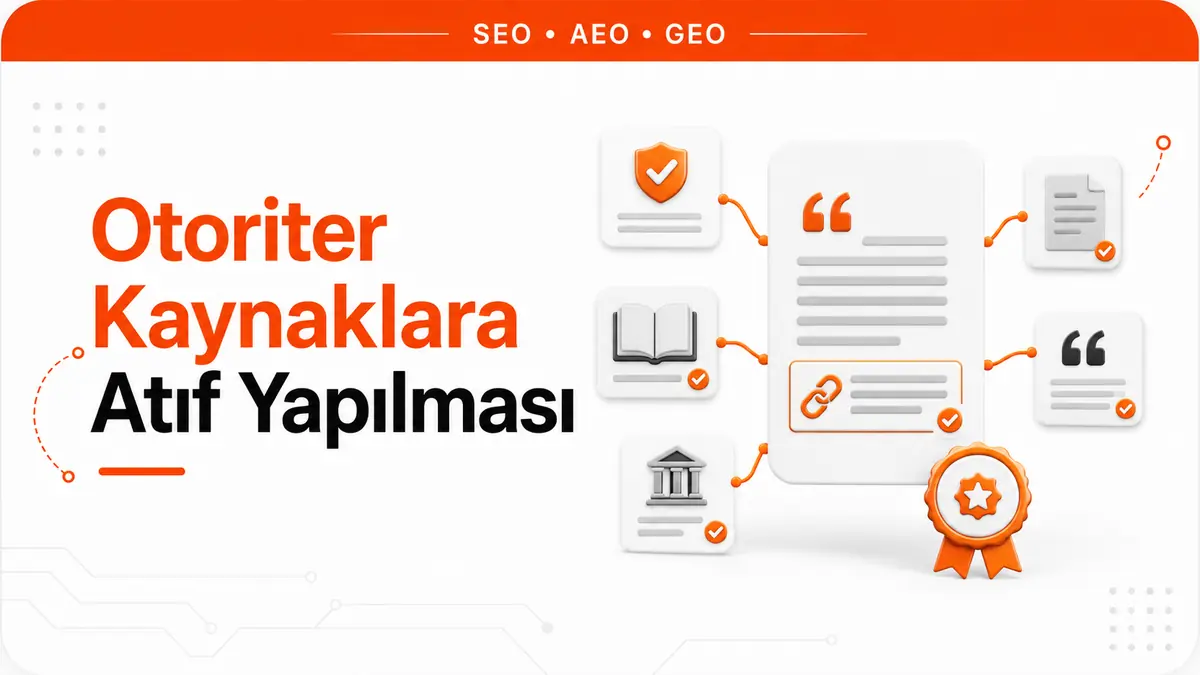
Citing authoritative sources means backing the claims and data in your content with reliable, recognized and independent sources. As of 2026, Google's E-E-A-T framework evaluates a page's trustworthiness not only by the author's expertise but also by the authority of the sources it cites. LLM-based answer engines analyze the source network of the content they quote and place pages with authoritative references in a higher trust tier.
An Algorithmic Definition of an Authoritative Source
An authoritative source is a web source that carries a high trust score in a given subject area and provides independent, verifiable information. Google's algorithm evaluates source authority through several signals: domain authority, publishing history, the presence of an editorial process, academic or institutional context, and whether the source is cited by other authoritative sources.
This evaluation is a modern interpretation of PageRank. Traditional PageRank measured the number of links, while today's authority assessment measures the quality of the link and the citation. Being cited by 100 low-authority sources produces a weaker signal than being cited by a single high-authority source. Citing authoritative sources is therefore a deliberate content engineering decision that places your own content inside this authority network.
The Conceptual Difference Between a Citation and a Link
A citation and a link are different concepts. A link is a clickable reference created with the <a href> tag in HTML and directly passes link equity. A citation is a reference to a source's name, data or conclusion within the text; whether or not it includes a link is secondary.
Google's NLP (Natural Language Processing) algorithms can detect in-text citations even without a link. A phrase such as "as stated in Google's Search Central documentation" produces an algorithmic citation signal even when no link is present. A linked citation, however, is stronger in terms of both user experience and algorithmic signal. The ideal approach is therefore to both mention authoritative sources in the text and link to them.
Source Authority Hierarchy and Tier Classification
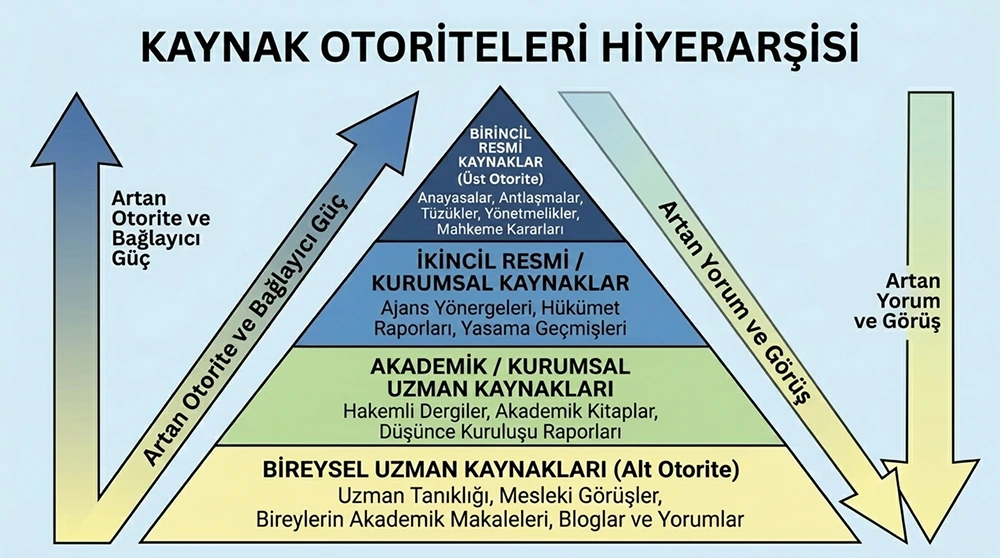
Not all sources carry equal authority. Classifying source authority into four tiers clarifies your citation strategy. The first tier is primary official sources: Google Search Central documentation, W3C standards, IETF RFC documents, web.dev guides and official API documentation. These sources are the defining authority on the subject.
The second tier is academic and research sources: peer-reviewed journals, university publications, Google Research papers and technical white papers. The third tier is industry authority sources: publications recognized by the industry, such as Moz, Search Engine Journal, the Ahrefs Blog and Smashing Magazine. The fourth tier is individual expert sources and case studies: blog posts by well-known SEO experts, conference talks and publicly available case analyses. In your citation strategy, first- and second-tier sources should take priority, while third- and fourth-tier sources should be used as supplements.
How to Cite Google's Official Documentation
Google Search Central is the most authoritative source on how Google's search engine behaves. Statements in this documentation come directly from Google engineers and are the strongest support for claims about algorithm behavior. A citation such as "as Google's official guide states, a Disallow rule in robots.txt blocks crawling, not indexing" confirms the credibility of the claim directly with a primary source.
There is, however, a nuance to keep in mind when citing Google's documentation. Google updates its documentation frequently, and older statements can lose their validity. Checking that the cited page is current and, where possible, noting its last updated date keeps the citation valid. Citing a documentation page that has been removed or changed costs you credibility.
The E-E-A-T Impact of Citing Academic and Research Sources
Academic sources sit in the highest trust tier because they have gone through peer review. In Google's E-E-A-T framework, the "Trustworthiness" component is directly related to the quality of the sources that support the content. Academic citations provide this quality at the highest level.
In SEO and web performance, the areas where you can cite academic sources are broader than you might think. Google's own research papers (research.google.com), W3C technical reports, HTTP protocol standards (RFC documents) and academic studies on web performance are all academic sources that can be used in technical SEO content. A citation such as "HTTP/3's QUIC-based architecture maintains connection continuity on mobile networks thanks to the connection migration mechanism defined in IETF RFC 9000" delivers technical depth and source credibility together.
Citing Data Sources and Statistical Credibility
Sourcing the numbers in your content is critical for credibility. The statement "60% of websites are not mobile-friendly" is an unsourced claim and carries little algorithmic trust. The statement "according to HTTP Archive's 2026 Web Almanac report, the median JavaScript size of mobile pages has reached 520 KB", on the other hand, is verifiable and backed by an authoritative source.
The preferred sources for data citations are: HTTP Archive (web technology statistics), CrUX (Chrome User Experience Report), Statista (general statistics), W3Techs (web technology distribution) and official Google blog announcements. These sources present their data methodology transparently and are open to independent verification. Using statistics with an unclear source weakens the trust signal instead of strengthening it. When no data is available, it is more honest and credible to use qualifying phrases such as "based on industry observations" rather than giving a statistic.
A Strategy for Citing Industry Authority Publications
Industry publications such as Moz, Ahrefs, Semrush, Search Engine Journal and Search Engine Land are widely accepted authority sources in SEO. Their blog articles, research reports and tool data are frequently cited in technical SEO content. However, not all of these sources carry equal authority, and you should be selective when citing them.
When citing industry sources, you need to make sure the source has no stake in the conclusion. Citing a study on an SEO tool's blog that shows the superiority of that same tool weakens the neutrality signal. Citing the same tool's article that analyzes an industry trend with independent data, on the other hand, is a credible reference. This distinction determines the quality of the citation.
Outbound Link Strategy and the Link Equity Concern
Whether external links (outbound links) to authoritative sources cause a loss of link equity is a frequently debated question. Google has stated that quality external links increase a page's credibility and produce a positive signal in algorithmic evaluation. Avoiding links to authoritative sources in order to protect link equity is therefore a mistake.
This shows that link equity is not a zero-sum game. Links to authoritative sources lead the page to be evaluated as "an authority that knows and references these sources". Just as a reference list increases an academic paper's credibility, quality outbound links in web content produce a trust signal. Linking in every sentence is unnecessary, however; the optimal approach is to link at strategic points, where supporting the claim is critical.
Building Citations into the Text Naturally
Citing authoritative sources should not be a forced "source list" bolted onto the text. The citation should be integrated into the natural flow of the sentence. Phrases such as "as documented by Google Search Central (source)" or "according to HTTP Archive data" make the citation an organic part of the sentence. References added at the end of a paragraph, such as "[Source: Google, 2026]", fit an academic format but look artificial in blog content.
This naturalness rule also matters from an SEO and GEO perspective. LLM-based systems evaluate in-text citations semantically. When a citation is integrated into the semantic structure of the sentence, the LLM scores this information as more reliable. References pushed outside the sentence weaken the semantic link between the content and the source. The citation should therefore be built as a structural component of the sentence.
Primary vs. Secondary Sources
A primary source is the original source where the information was first produced or announced. Google's official blog announcement, the original paper of a study or the official specification of a standard are primary sources. A secondary source interprets, summarizes or analyzes the primary source. An SEO blog's analysis of a Google update is a secondary source.
In your citation strategy, a primary source should always be preferred over a secondary one. Instead of saying "according to Search Engine Journal, Google released a new update", saying "as announced on the Google Search Central Blog, this update affects the passage ranking system" points the citation directly at the primary source. Going to the primary source also removes the risk of information being distorted along the way: secondary reports often leave out part of an announcement or give it a different emphasis.
Competitor Citation Analysis and Finding Missing Sources
Analyzing the sources cited by competing content that ranks for your target query is competitive intelligence that strengthens your own citation strategy. If all competitors cite the same two or three sources, citing a different and more authoritative source produces information gain. Adding an academic citation on a topic where no competitor uses academic sources creates a clear differentiation in the trust tier.
To do this analysis systematically, review the top 10 results in the SERP and extract each page's outbound links and in-text citations into a table. Sources cited by most competitors are "hygiene" sources (baseline requirements); you must use them in your own content as well. Authoritative sources that no competitor uses are "differentiator" sources; adding them provides information gain and a trust advantage.
The Risk of Outdated Citations and Source Verification
Whether the cited source is up to date directly affects the credibility of the citation. A Google documentation page published in 2020 may have been updated or removed by 2026. Presenting old data as if it were current is the fastest way to lose credibility.
In our real-world experience, on average 15–20% of the citations used in technical SEO content become outdated within 18 months. Google documentation URLs change, research reports are updated with new versions and industry blog posts are revised. Checking that cited sources are still accessible and current during the content update cycle is a mandatory step in content maintenance. Broken links and outdated data erode both user experience and algorithmic trust.
Mandatory Citations and Stricter Standards for YMYL Content
Content in the YMYL (Your Money or Your Life) category covers health, finance, law and safety. In this category, Google evaluates E-E-A-T signals against a much higher threshold. In YMYL content, citing authoritative sources is not a preference but a requirement.
Health content should cite medical research and official health organizations, finance content should cite regulators and official data sources, and legal content should cite legislation and court decisions. Outside YMYL (for example, in technical SEO), this standard is more flexible, but citation quality strengthens the trust signal in every case.
How the Citation Chain Affects Trust in LLM-Based Systems
LLM-based answer engines such as ChatGPT, Perplexity and Gemini evaluate the source network of the content they quote. If a piece of content cites authoritative sources itself, the LLM scores it as "verified and reliable". Content that contains uncited claims is placed in a lower trust tier.
This mechanism forms the citation dimension of a GEO (Generative Engine Optimization) strategy. When an LLM generates an answer on a topic, it compares multiple sources. A source that backs its claims with authoritative references is more likely to be quoted than one that does not. In the LLM era, authoritative citations are a piece of content's passport to algorithmic trust. This passport plays a decisive role both in classic SERP rankings and in being selected as a source by AI answer engines.
Structuring Citation Relationships with Schema Markup
Schema.org lets you define citation relationships as structured data. The citation property declares, in a machine-readable format, which sources a piece of content cites. The isBasedOn property specifies which source the content is based on:
{
  "@context": "https://schema.org",
  "@type": "Article",
  "headline": "Article Headline",
  "citation": [
    {
      "@type": "WebPage",
      "name": "Google Search Central - Robots.txt",
      "url": "https://developers.google.com/search/docs/crawling-indexing/robots/intro"
    },
    {
      "@type": "ScholarlyArticle",
      "name": "Passage Ranking Research Paper",
      "url": "https://research.google/pubs/pub12345/"
    }
  ]
}
This configuration helps Google understand the relationship between the content and its sources at a structural level. Citations declared through schema algorithmically confirm in-text citations and strengthen the trust signal.
Citation Density and the Optimal Reference Balance
Citing in every sentence raises questions about the originality of the content. A piece whose information all comes from other sources offers no synthesis value and is treated as a "compilation". On the other hand, citing nothing leaves claims unsupported and leads to a loss of credibility. The optimal balance is to cite critical claims and avoid citing commonly known principles.
As a practical rule, 5–8 authoritative citations is the optimal density for a 2,000-word technical SEO article. At least 2 of these citations should point to primary sources (Google documentation, W3C standards), 2–3 to data sources (HTTP Archive, CrUX) and 1–2 to industry authority publications. This distribution produces a well-rounded trust signal and prevents dependence on a single source.
Citing Your Own Authority with Internal Links
Citing authoritative sources is not limited to external sources. In-depth guides, case studies and research reports previously published on your site are proof of your own topical authority. Citing these existing resources with internal links from new content both directs the user to in-depth information and algorithmically strengthens the site's topical authority.
This approach is the citation dimension of the "hub and spoke" content architecture. The main guide page (hub) is the authority center that covers all subtopics of the subject. Subpages (spokes) cover specific topics in depth and strengthen the topic network by citing the hub page. Linking internally to relevant resources from your existing content inventory every time you produce new content speeds up the build-up of topical authority.
Negative Citations and Avoiding Unreliable Sources
Citing low-authority sources, sources containing false information or spam sources lowers the content's trust score. Forum replies, unverified blog posts, anonymous source sites and information taken from content farms are not accepted as authoritative citations.
A high domain authority alone does not guarantee that a source is reliable. "Sponsored content" on a high-DA news site or a "user reply" on a forum has not gone through editorial review and should not be used as an authoritative source. The key criteria for a source worth citing are that it has gone through an editorial process, its author is identified and it is open to independent verification.
Cross-Validation and Multi-Source Confirmation
A claim that relies on a single source inherits that source's mistakes. Applying cross-validation to critical data and contested topics increases the credibility of the citation. A phrase such as "as stated in both the Google Search Central documentation and the web.dev performance guide" shows that the same information has been confirmed by two independent authoritative sources.
This approach is especially important when Google's official statements and industry observations contradict each other. Google may state that a particular signal has a "minor effect", while industry A/B tests may show different results. Presenting both perspectives together with their sources lets readers make up their own minds and strengthens the perceived neutrality of the content.
Citation Maintenance and a Periodic Source Verification Cycle
Here is the point that looks right in theory but breaks in practice: cited sources are not timeless. URLs change, pages are removed, data is updated and official positions are revised. A citation that was correct six months ago may today point to a broken link, outdated data or a changed official statement.
Building citation maintenance into the content update cycle is essential. Every three months, check that external links in published content are still accessible. Run an outbound link crawl with Screaming Frog to find links that return 404 and replace them with current URLs. Check that data citations are up to date and replace old data with the latest versions. This maintenance cycle is the only sustainable way to protect the trust signal of your citations over the long term. A broken reference link erodes not only the user experience but also the page's algorithmic trust score.