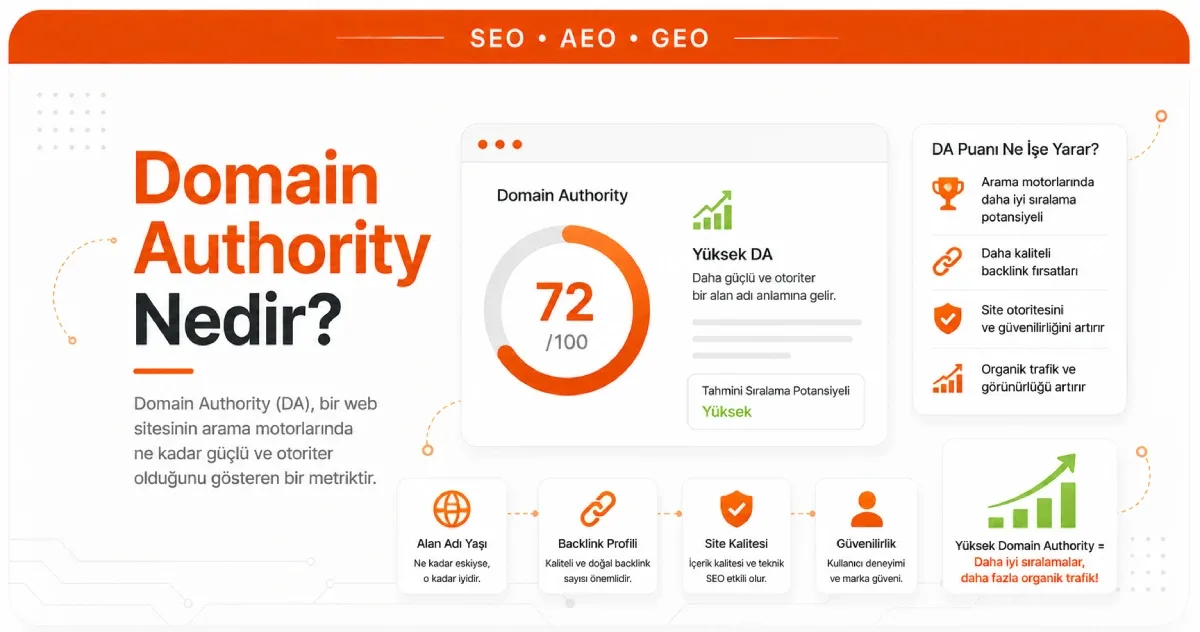
Domain Authority is a metric developed in 2008 by the search analytics company Moz that predicts how well a website is likely to rank in search results. Abbreviated as DA, the score takes a value between 1 and 100; a higher value indicates a greater likelihood that the site holds a stronger position in search engines than its competitors. Moz, the company behind the metric, is an SEO software firm founded in Seattle in 2004. Domain Authority is not a value produced by Google itself: it is an independent prediction tool that models a site's ranking potential, not its actual rankings.
Domain Authority evaluates the entire domain, not a single page. The score is based on link data collected by Moz: the number of referring domains (distinct domains linking to the site), the total volume of links and the quality of those links are the main inputs. The value is not an absolute grade but a comparative measure: a site's DA only means something alongside the DA of competitors in the same sector. In this sense, Domain Authority is a practical benchmark used in competitive analysis and in evaluating link sources.
How is Domain Authority calculated?
Domain Authority is a multivariate calculation that Moz's machine learning model converts into a score on a 1–100 scale. The model correlates a site's link profile with Google search results and produces the value that best predicts ranking strength. The main signals that go into the calculation are:
- Number of referring domains: the total number of unique domains linking to the site.
- Total link volume: the count of all links pointing to the site.
- Link quality: the authority and trustworthiness of the linking sites themselves.
- MozRank and MozTrust: Moz's sub-metrics that measure link popularity and trust.
The score's scale is logarithmic, meaning it is not linear: raising DA from 20 to 30 is much easier than raising it from 70 to 80. That is why each point in the upper bands requires many times more link strength than in the lower bands. Moz updates the model periodically; after an update, a site's DA can shift by a few points even if the site has done nothing.
What is a good Domain Authority score?
There is no universal "good" threshold for Domain Authority; a meaningful value depends on the sector and the competition. Because the score is comparative, the goal is not an absolute number but reaching the band your competitors are in. Still, these bands offer a rough frame of reference:
| DA band | General interpretation |
|---|---|
| 1–20 | New site or weak link profile |
| 20–40 | Growing, moderate authority |
| 40–60 | Established, strong site in its sector |
| 60–100 | Major brand or high-authority publisher |
In a low-competition sector a DA of 30 can be competitive, while in a highly competitive sector the same score falls short. You can check a site's DA for free with lookup tools such as the DA PA checker. The right question is not "what is my DA" but "where do I stand relative to my competitors' DA".
What is the difference between Domain Authority and Page Authority?
Domain Authority and Page Authority are two metrics produced by the same company (Moz) but with different scopes. Domain Authority measures the strength of the entire domain, while Page Authority measures the ranking strength of a single page. Both work on a 1–100 scale and rely on the same link data. The difference lies in the unit being evaluated: one scores the site, the other scores the page.
This distinction has a practical consequence: a newly published page on a strong domain (high DA) can have a low PA. Likewise, a single heavily linked page on a site with moderate authority can carry a high PA. When analyzing rankings, read DA for domain-level strength and PA for individual page performance together. Domain Authority and Page Authority are Moz-only metrics; other tools produce similar values under different names.
Is Domain Authority a Google ranking factor?
Domain Authority is not a factor used in Google's ranking algorithm. Google does not see or use Moz's DA score when determining search results; the metric is entirely a third-party estimate. Google spokespeople have stated many times that they have no ranking signal called "domain authority". DA is a model that tries to mimic Google's behavior, not an output of Google.
This distinction clears up the most common misconception: a high DA does not automatically mean high rankings. DA is a summary of a site's link strength; rankings are the combined result of content relevance, user experience and hundreds of signals. Domain Authority should be read not as an outcome indicator but as a proxy metric (an indicator that represents the real value indirectly). Its value lies in giving a comparative sense of authority, not in promising absolute rankings.
How do you increase Domain Authority?
Domain Authority rises as a site's link profile gets stronger; there is no shortcut. Because the score is based on link data, the only real way to raise it is to earn high-quality, diverse referring domains. These four areas make the difference:
- Quality links: links from high-authority, topically relevant sites carry the most value.
- Referring domain diversity: you need links from many different sites rather than many links from the same site.
- Cleaning up harmful links: spam and low-quality links weaken the profile and should be weeded out.
- Valuable content: content that attracts links naturally is the foundation of sustainable DA growth.
The criteria for assessing link quality are covered in detail in the quality backlink guide. Planned, authoritative link acquisition calls for structured work such as backlink packages. Raising DA is a cumulative process spread over months; a one-off bulk link purchase often produces a harmful profile signal.
Which tools measure Domain Authority?
Because Domain Authority is a proprietary Moz metric, its actual value comes from Moz's database. Competing metrics that measure the same idea of authority carry different names and rely on different data sets. The main metrics are compared in the table below.
| Metric | Provider | Scale | Scope |
|---|---|---|---|
| Domain Authority (DA) | Moz | 1–100 | Domain |
| Domain Rating (DR) | Ahrefs | 0–100 | Domain |
| Authority Score | Semrush | 0–100 | Domain |
| Trust Flow | Majestic | 0–100 | Link trust |
These metrics can give the same site different scores, because each uses its own link index. A site can have a DA of 40 and a DR of 55; both are correct; they simply draw on different link indexes. That is why, when evaluating a site, you look at the picture several metrics paint together rather than relying on one.
How much should you trust Domain Authority?
Domain Authority is a useful tool when read correctly and a misleading one when read wrongly. Its value is comparative: it estimates a site's strength in the context of its competitors and does not give an absolute grade of success. Because it is not a Google ranking factor, a high DA is not a guarantee of rankings; it is only a sign of a strong link profile. Since the score is logarithmic, gains in the upper bands get progressively harder, and small fluctuations can stem from model updates.
In practice, Domain Authority works best as a pre-screening tool when choosing backlink sources and in competitive analysis. When it is turned into a goal on its own, however, it can pull you away from the real objective (organic traffic and conversions). The way to position the metric correctly is to see it as an indicator, not an outcome. Domain Authority is not the sole compass for search visibility work; it is one of several indicators.
Note: This content is for informational purposes; Domain Authority is a third-party metric and its values can vary by tool and update cycle, so decisions should be weighed against more than one source.
Frequently Asked Questions
What counts as a good Domain Authority score?
There is no fixed "good" threshold for Domain Authority; the value is interpreted relative to competitors. As a general framework, a score above 40 indicates an established site, and a score above 60 a strong authority. In a low-competition sector, however, even the 25–30 band can be enough. The right benchmark is to match or exceed the average DA of competitors ranking for the same keywords. Relative position, not an absolute number, is what counts.
Does a high Domain Authority guarantee rankings?
A high Domain Authority does not guarantee rankings; DA is not a Google factor. Rankings are determined by content relevance, meeting search intent, technical health and hundreds of other signals combined. A high DA only indicates a strong link profile, and that profile will not carry you to the top unless it is backed by the right content. It is more accurate to see DA as a predictive indicator than as a guarantee.
How can you check Domain Authority for free?
Domain Authority can be checked with various free lookup tools. When you enter a domain, these tools show the current DA score based on Moz data. The same lookup usually returns the Page Authority value as well. Most free tools allow a limited number of queries per day. Site owners can see where they stand by comparing their own site with competitors using these tools.
Are Domain Authority and Ahrefs DR the same thing?
Domain Authority and Ahrefs Domain Rating are two separate metrics that measure the same idea but are produced by different companies. DA is based on Moz's link index, DR on Ahrefs'. Both score a domain's link strength on a 100-point scale, but because they use different databases they can give the same site different values. When evaluating a site, reading both metrics together is more reliable than trusting a single one.
What does it mean if Domain Authority drops?
A drop in Domain Authority is not always a sign of a problem. When Moz updates its model or recalculates its link index, DA can shift by a few points even if the site has done nothing. A real drop, on the other hand, is linked to losing valuable referring domains or a weakening link profile. If the drop persists, review the link profile: check for lost links and newly added harmful links.