You have a site, you know it needs SEO, and you get stuck on the very first move. Should you open a keyword tool, fix the titles or ask someone for a link? This kind of paralysis is rarely a knowledge problem; it's an ordering problem. You more or less know what needs to be done. What isn't clear is what comes first.
The right starting point isn't producing content or getting links but setting up measurement and taking inventory of your existing pages. The reason is simple: every subsequent step makes decisions based on the data produced by the one before it. If you change titles without knowing which page appears for which query, you're left with no baseline for measuring whether you fixed something or broke it.
When the order breaks down, part of the effort is quite literally wasted. Pointing external links at a page that has never been indexed is like hanging a sign on a shop whose door is locked. Publish three separate pages for the same search intent, and all three end up holding each other back for the same query. The six steps below are ordered according to this dependency.
The conceptual groundwork, such as what crawling, indexing and ranking mean and which question SEO solves, is a separate topic covered in our what is SEO article. The subject here is the order in which those concepts are applied in practice.
In what order is the SEO process carried out?
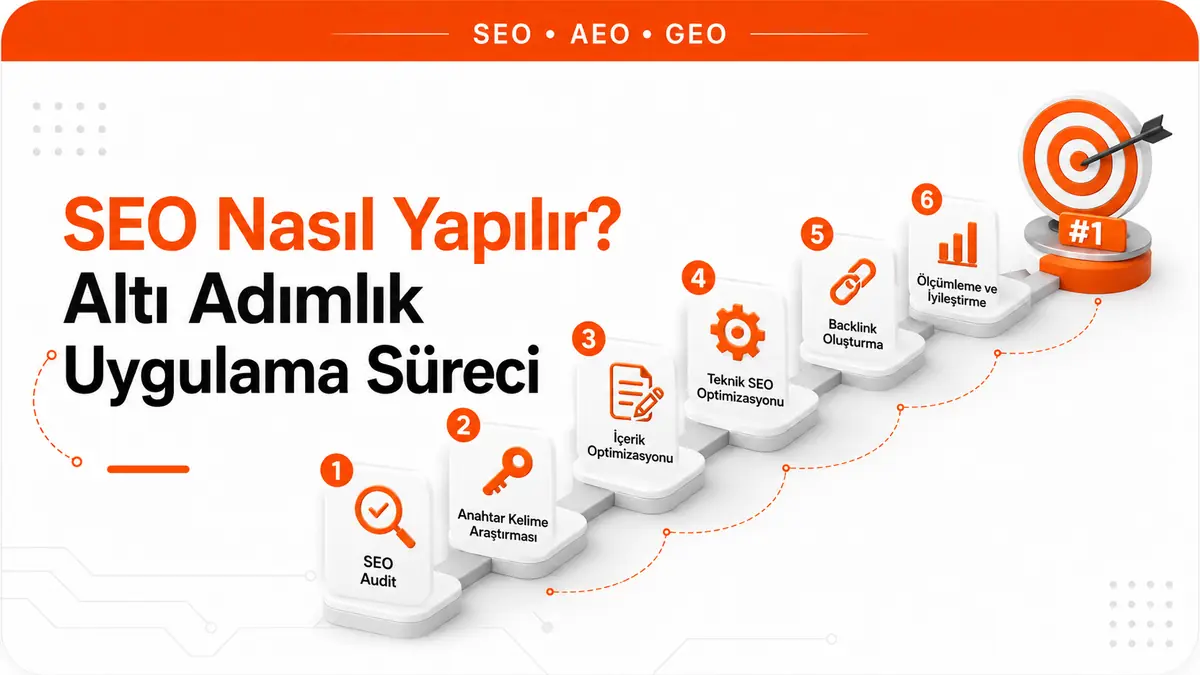
The process consists of six steps. A step doesn't count as "done" just because you worked on it; it's complete only once it has delivered its output. This distinction turns the work from a task list into a flow you can check.
- Assessment and measurement setup. Is the site indexed, which pages appear for which queries, and exactly which pages do you have? Output: a page inventory and a working measurement pipeline.
- Keyword and search intent research. Which keywords are different ways of expressing the same intent, and which genuinely need separate pages? Output: a mapping table in which each keyword is tied to a single page.
- Technical foundation. Can the target pages be found, fetched and indexed? Output: a list of target pages with no technical blockers remaining.
- On-page work and content. Does the page fully satisfy the intent it's tied to? Output: pages that fully answer their target question without outside help.
- Authority and promotion. Who besides you knows about the page, and who references it? Output: references the target pages receive from outside the site.
- Measurement and iteration. Which of the changes you made worked? Output: the priority list for the next round.
The sixth step loops back to the first. At the end of the measurement round, your inventory is updated and the process runs again from the start with new data. The steps don't carry equal weight either: Google's starter guide considers creating content people find useful more decisive than all the other recommendations in the guide combined. So the fourth step is the heaviest, but it can't aim at the right target unless the three steps before it are in place.
Step 1: Assessment and measurement setup
The first question isn't "what should I do?" but "where am I right now?" Google's own advice is likewise to check whether the site is indexed before doing anything: if you type site:yourdomain.com into the search box and get results, your site is indexed and you don't have a findability problem. If no results come up, the problem isn't with the content but at a much earlier stage, and none of the following steps will produce results until that obstacle is removed.
Search Console sits at the center of the measurement pipeline. Setup begins with ownership verification; without verification, the site's search data can't be accessed. Next, the indexing report tells you which pages Google has indexed and which ones it sees problems with. For details such as how to interpret performance data and why average position isn't your ranking, our Search Console data tracking article is a separate starting point.
In practice, the first week looks something like this:
- Ownership is verified and data starts accumulating. Data isn't backfilled, so the later you do this, the later you have a baseline to compare against.
- Pages with commercial value are listed one by one: URL, the page's goal, and the product or service that corresponds to it.
- Each page is marked as indexed or not. Pages that aren't indexed go into a separate bucket; they're the job of step three.
- The current titles and descriptions of the pages are recorded together with the queries they get impressions for. This record is the "before" snapshot for every future change.
Building this inventory by hand is possible on small sites but gets harder as the page count grows. To see titles, descriptions and on-page status in bulk, the on-page SEO analysis tool speeds up this step. The output of the step, in one sentence: you have a table in which every row corresponds to a real page, and a working measurement pipeline alongside it.
Step 2: Keyword and search intent research
The goal of keyword research isn't to produce a long list but to distribute the keywords on that list across pages. The critical distinction is this: different ways of expressing the same need belong on one page, and different needs belong on separate pages. When this distinction isn't made, the site competes with itself.
A concrete example is this article's own keyword cluster. According to estimates from Semrush's Türkiye database, monthly search volumes for these Turkish-language queries break down as follows:
| Keyword | Monthly searches (estimated) | Decision |
|---|---|---|
| seo nasıl yapılır (how to do SEO) | 390 | Main target, single page |
| seo çalışması nasıl yapılır (how to do SEO work) | 110 | Same intent, same page |
| seo adımları (SEO steps) | 20 | Same intent, same page |
| youtube seo nasıl yapılır (how to do YouTube SEO) | 210 | Different platform, separate page |
| seo uzmanı nasıl olunur (how to become an SEO specialist) | 140 | Different user, separate page |
Volume alone doesn't decide anything. The YouTube query in the table goes to a separate page even though it gets more searches than two of the same-intent variants, because the person searching for it is working on a video platform and the same text won't answer their question. The real work here isn't ranking by volume but seeing where the intent breaks.
Once the keyword list is ready, watch out for three common mistakes, which Google's own guide files under things you don't need to focus on. The keywords meta tag isn't used by Google. Repeating the same keyword and its variations over and over not only tires readers but also violates spam policies. Having keywords in the domain name or URL path has no meaningful ranking effect; the only visible difference is in breadcrumbs. These three still circulate as to-do items, and the time spent on them doesn't pay off.
The step's output is a mapping table with a single URL written next to each target keyword. If there's a keyword but no page, that row becomes a work order for step four.
Step 3: Building the technical foundation
Contrary to popular belief, the scope of the technical step isn't a long audit checklist. It solves one question: can the target page be found, fetched and indexed? Content and link work done before this question is solved can't be measured.
Google finds pages primarily by following links from pages it has already crawled. The practical consequence: a page on your site that receives no links from anywhere waits to be discovered, even if it's technically flawless. Linking a newly created page from the relevant category, menu or content page is the cheapest and most effective move in the technical step. Submitting a sitemap also helps, but Google doesn't define it as a requirement and recommends making sure people know about your site first.
When it comes to directory and URL structure, scale matters. Google describes grouping similar pages into folders as affecting crawl behavior for sites larger than a few thousand URLs, because learning how often each folder changes becomes meaningful at that scale. On a fifty-page site, a week spent restructuring URLs doesn't produce as much return as two pages written in the same time. Applying advice that doesn't fit your scale is also an ordering mistake.
The output of this step is clear: every target page in the inventory is indexed, or the reason it isn't is known. Moving on to step four before one of these holds means investing in work whose results can't be measured.
Step 4: On-page work and content
This is the center of gravity of the process. One of the strongest statements in Google's starter guide is that creating content people find compelling and useful will likely influence a site's presence in search results more than any of the other suggestions in the guide. The guide ties this to concrete qualities: the text being easy to read and well organized, the content being unique, outdated information being reviewed, and the content genuinely being written for people.
On-page work determines how this content appears in search results. The snippet in the results is generated directly from the page's own content; the meta description tag is sometimes the source of that text. A good meta description is short, unique to that page and contains the page's most important points. Using the same description on a hundred pages defeats the purpose of the field entirely.
In recent years, another layer has been added to this step: the page being not just readable but quotable. AI answers don't use a page as a whole but rather a passage they select from it. Sections that make sense on their own, answer their question directly and carry their context within them are well suited to this selection; a structure that gives the answer three paragraphs later isn't. This layer has its own working discipline and is covered separately under generative engine optimization.
The output of this step isn't a page count. The output is every target page in the inventory satisfying the intent it's tied to on its own.
Step 5: Authority and promotion
Why does the fifth step come after the fourth? Because promotion makes something that exists visible. Driving traffic to a page that isn't ready wastes that page's first impression, and there's no second chance.
Google describes promotion in terms of methods such as social media, community engagement, advertising and word of mouth, and points to word of mouth as the most lasting method. The same guide also draws the line: when promotion is overdone, people get tired of it, and some practices can be treated as attempts to manipulate search results. In other words, the risk in this step is higher than in any of the previous steps.
On the link side, which references carry value and which create risk is a separate topic, detailed in our what is a backlink article. From a process standpoint, the only rule is this: link work begins after the target page has been indexed and its content is complete.
The weight of this step has recently increased in one more respect. In a Muck Rack study examining the sources used in AI answers, roughly 84% of citations came from earned media, that is, editorial content produced by third parties. The same study also shows that platforms differ markedly from one another: one model cites sources in almost all of its answers and gives an average of five links, while another cites sources in just over half of its answers but uses an average of thirteen links when it does. This is the finding of a single study, and its scope is limited to the platforms examined. All it suggests is a direction: who talks about you outside your own site has become as much a part of visibility as what you write on it.
The output of this step isn't a link count but target pages that receive references from outside themselves.
Step 6: The measurement and iteration cycle
This step doesn't end the process; it restarts it. The biggest mistake here is questioning results too early. In Google's own words, every change takes time to be reflected in results: some changes take effect within a few hours, others take several months, and in general you should wait a few weeks before assessing whether the work has had an effect. The same source states plainly that not every change you make will have a noticeable impact on search results.
These two sentences directly determine how the process should be set up. Changes should be made in rounds rather than one at a time, you should wait a few weeks after each round, and when evaluating a round you should look not only at the pages you changed but also at the ones you didn't. If the whole site moved in the same direction, your change's share is smaller than you think; if only the pages you touched diverged, you have a real signal. This comparison invalidates most decisions made by looking at a single page.
Google doesn't recommend an aggressive checking schedule either: there's no need to log in to Search Console every day; checking once a month or after making changes to the site is enough. When a new issue arises, the system sends a notification anyway.
At the end of the round, three questions are answered: which page moved in the expected direction, which didn't, and which step was incomplete for the one that didn't? That last question sends you straight back to the relevant step, and the cycle starts again.
Typical losses when the order breaks down
The order of the steps isn't a theoretical preference. The results that come from breaking it are predictable, and most are expensive to reverse.
| Skipped step | What happens | The right way |
|---|---|---|
| Producing content without setting up measurement | Because the "before" state of the change wasn't recorded, it's never known which work paid off | Verify on day one and start accumulating data |
| Opening pages without separating intents | Your own pages suppress each other for the same query, and neither breaks through | Cluster keywords by intent and tie each cluster to a single page |
| Link work without checking indexing | The return on a reference pointing to an unindexed page can't be measured | First verify that the page is indexed |
| Promoting before the content is finished | Incoming visitors find an incomplete page, and the first impression can't be repeated | Start promotion only once the page answers its own question |
| Expecting results after a few days | A change that had started to pay off gets rolled back too early | Close the round, wait a few weeks and compare with unchanged pages |
Putting the first three months on a calendar
The order of the steps is clear, but without a schedule it stays a to-do list. The breakdown below is a reasonable starting template for a site run by a one-person team who can spare a few hours a week; page count and the site's current state will shorten or lengthen these ranges.
| Period | Focus | What you should have by the end of the period |
|---|---|---|
| Weeks 1 and 2 | Measurement setup and inventory | A verified measurement pipeline, a page list and a table with indexing status marked |
| Weeks 3 and 4 | Keyword and intent research | A table mapping keywords to pages, and a list of missing pages |
| Weeks 5 and 6 | Removing technical blockers | Target pages indexed, or the reason they aren't known |
| Weeks 7 to 10 | On-page work and content | Priority pages satisfying their own intent |
| Weeks 11 and 12 | Starting promotion and the first measurement round | First references and a report with a period-over-period comparison |
This calendar isn't a promise of results; it's a division of work. What's expected at the end of the third month isn't rankings but the first reliable data on which work paid off. From there, the process enters its second round in the same order.
Frequently Asked Questions
Can you start SEO before the site has any content?
You can, but it's limited to the first three steps. Measurement setup, keyword and intent research and the technical foundation can all be done with no content in place; in fact, doing them after publishing begins costs more. What makes no sense is allocating budget to promotion and link building when there's no content.
Can the steps be run at the same time?
Some of them can. Technical fixes and content production can proceed in parallel, because they're different people's jobs and don't wait on each other's output. There are two dependencies where order is mandatory: content production has no target until keyword mapping is finished, and promotion is wasted until the page is indexed.
If the site is going to be redesigned, where does the process start?
With the measurement and inventory step, before the design starts. Google cites a site redesign as one of the best times to bring in search support and says the earlier this is done, the better. The practical reason: if the pre-redesign URL list and performance snapshot weren't recorded, it's no longer possible to measure where a post-redesign drop came from.
Does the process ever end?
The steps end; the cycle doesn't. At the end of each round, the inventory is updated, new queries appear, competing pages change and the process runs again in the same order. The difference from the first round is this: in the second round, you have your own data showing what you did and what paid off, and decisions are made with that data rather than guesswork.