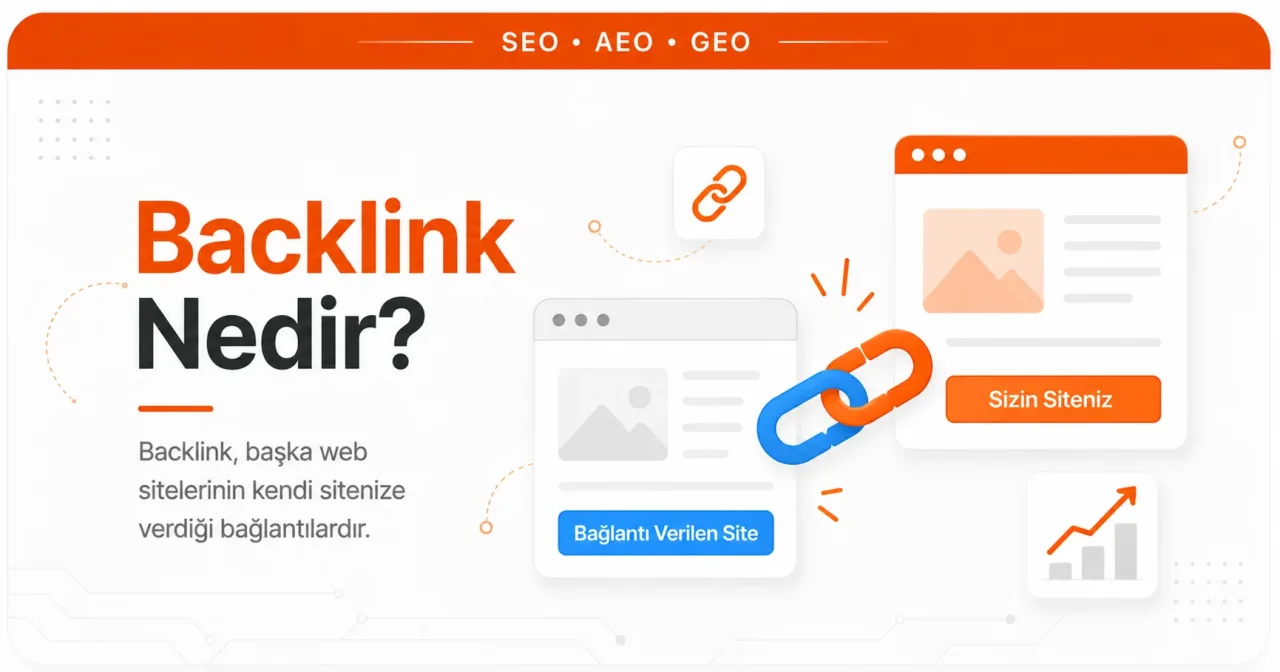
The web is built on a single move: one page sends its reader to another. Whether an author cites a source, a news site points to an organization it mentions or a forum user shares a guide that helped them, the same thing happens. A backlink is that move pointed at you: a link to your page from a page on another domain. Links you create between pages on your own site are internal links; a backlink comes from outside.
Backlinks are also called inbound links or incoming links, and all of these terms describe the same thing. From the point of view of the site giving the link, the same link is an outbound link. There is a small but decisive technical condition: Google says it can only crawl a link if it is an <a> element with an href attribute, and it generally does not parse elements that behave like links through script events as links. In other words, some of what is described as "linking" on a page is not counted as a link at all on the search engine's side.
What does a backlink do for Google?
For a search engine, a link serves two separate functions, not one. Google writes in its own guide that it uses links as a signal both to determine the relevance of pages and to find new pages to crawl.
The first function is discovery. The crawler reaches addresses it has not seen yet by following links on pages it already knows. That is why a page that has never received a link and is not in the sitemap has a much narrower path to being found.
The second function is context, and this is where most of the confusion lies. Anchor text, the visible text of the link, tells both the user and Google something about the target page. Google's guide says the words before and after the link matter too, and that attention should be paid to the whole sentence. The same guide explicitly warns against the urge to stuff every relevant keyword into anchor text, because keyword stuffing violates its spam policies.
The practical takeaway: a link is not a button that pushes rankings up on its own, but a piece of context that shows in what topic, and alongside whom, your page is mentioned. That is why the question "how many links do I have" tells you less than "what does this link present me as."
What types of backlinks are there?
Links are classified by three separate criteria, and these three distinctions do not replace one another. A link can be sponsored, in-content and an image link all at the same time.
By the attribute it carries
By adding a rel attribute to a link, the publisher declares its relationship to that link. A normal link with no attribute is commonly called dofollow, but that is not a value Google defines; it is just the name for an unqualified link.
| Value | Use recommended by Google |
|---|---|
rel="sponsored" | Links that are ads or paid placements |
rel="ugc" | Links in user-generated content such as comments and forum posts |
rel="nofollow" | When the other values don't apply and you don't want your site associated with the linked page |
Google notes that it previously recommended nofollow for paid links, that this is still an acceptable way to mark them, but that the sponsored value is preferred. Values can also be combined; rel="ugc nofollow" is a valid choice for a link in a user comment.
By how it was obtained
An earned link is one the publisher gives on its own editorial judgment. A self-placed link comes from places where you can fill in the content yourself, such as directory listings, profile pages or comment sections. A paid link is obtained in exchange for money, products or services. All three look the same in the browser but do not mean the same thing when evaluated, because only in the first did the linking party make a choice.
By its position on the page
A link given within the content, as part of a sentence explaining the topic, is a different thing from a link placed in the site's footer or template and repeated on every page. Google's examples of link spam explicitly include links widely distributed in the footers or templates of various sites. For image links, the image's alt text takes the place of anchor text, so empty alt text leaves the link without context.
Which backlinks count as valuable?
In short, value comes from fit, not quantity. A link works when it places you in a genuine context related to the topic.
A few questions determine this. Is the source's topic related to yours, or has the link landed on a page with no context at all? Is the source page actually read, meaning does it have its own search visibility and visitors? Does the link sit inside the article as part of a sentence that explains it, or is it tacked on at the end of the text? Does the anchor text say what the target page is, or is it a forced formula?
There is one more distinction that is often missed in reports: a hundred links and links from a hundred different sites do not produce the same picture. The second and third links from the same domain do not add a new source the way the first one did. How to check these criteria one by one, and when a source should be ruled out, is covered in detail in What Is a Quality Backlink.
How do you earn backlinks?
Not all methods do the same job. Some leave the content and timing of the link to you; others put the decision entirely in the other party's hands. The difference determines the balance between scale and risk.
| Method | How it works | Control | What to watch for |
|---|---|---|---|
| Real business relationships | Listings on supplier, dealer, association membership and partner pages | High | Limited in scale; the link may disappear when the relationship ends |
| Digital PR and press releases | A newsworthy announcement or dataset is sent to publishers | Medium | Optimized anchor text in press releases is among Google's spam examples |
| Guest posting | Content is written for an industry publication | Medium | Falls under policy violations when it turns into scaled production done only for links |
| Linkable assets | Original data, a calculator, a field test or a comprehensive guide is produced | Low | The investment comes first; results build over time |
| Converting unlinked mentions | Content that mentions the brand without linking is found and the publisher is asked for a link | Low | Limited by the number of existing mentions |
| Broken link building | Links pointing to a resource that no longer works are found and current content is suggested as a replacement | Low | The replacement content must be a genuine equivalent |
| Directory and organization listings | Business directories, professional chambers and official registries | High | Low-quality directories are among Google's spam examples |
| Sponsored content and advertorials | Content is published by paying the publisher | High | The advertising relationship must be marked with sponsored or nofollow |
Trying these methods one by one and tying them to a publishing calendar are different jobs. Results change when source selection, sequencing and continuity are tied to a plan; for businesses that want to outsource the process, the way we work on our backlink packages page shows how that plan is built.
Is buying backlinks a policy violation?
Most sources answer this question only halfway. Google's link spam policy lists buying or selling links for ranking purposes at the top of its violation examples. And it is not only about money: links provided in exchange for products or services, sending someone a product so they write about it and include a link, and text ads that don't block ranking credit are all on the same list.
Further down the same policy text, Google also says clearly: buying and selling links for advertising and sponsorship purposes is a normal part of the web economy, and such links do not violate its policies as long as they are qualified with a rel="nofollow" or rel="sponsored" value.
The dividing line is not the money itself but how the link is presented. Presenting a paid placement as an editorial recommendation and letting it pass ranking credit is a violation; publishing the same placement with the right attribute is advertising. That is also why using optimized anchor text in press releases, guest posts and articles distributed across other pages is singled out as a separate example in the policy text.
Two separate layers determine the outcome. Google's AI-based spam prevention system, SpamBrain, was trained to detect both sites that produce spam links and sites built to pass spam links to others, and after this training Google reported detecting 50 times more link spam sites than in the previous link spam update. The second layer is human: content found to be in violation can be subject to a manual action. A link being ignored and a site receiving a manual action are not the same thing and are evaluated separately.
How do you measure a backlink profile?
Measurement starts with two questions: who is linking to you, and what do those links look like?
The first distinction is between total link count and the number of referring domains. A single site giving you a thousand links does not produce the same picture as a thousand sites linking to you; the number of domains shows how broad the profile is. The second view is the distribution of anchor texts, because texts clustered around a single pattern don't look like a natural distribution. The third is link velocity; a sudden spike in a profile that has been inactive for a long time should have an explainable cause.
For your own site's data, the first-party source is the Links report in Search Console. When you need an outside view, for example to evaluate a source before publishing, third-party tools come in, and there is a common mistake here: authority scores such as DA, PA and DR are not the search engine's measure. Each is an estimate based on that tool's own link index and its own model, which is why different tools produce different numbers for the same site. Using these scores to compare sources with each other is reasonable; treating them as an absolute certificate of quality is misleading. For individual lookups, you can use our DA PA checker.
Which backlinks cause harm?
Harm comes from three separate places, and each has a different fix.
The first is structures you set up yourself. Google's policy text gives specific examples: generating links with automated programs or services, excessive link exchanges, low-quality directory and bookmark links, links embedded in widgets distributed across various sites, forum comments with optimized links in the signature, and low-value content produced mainly to obtain links.
The second is an attack carried out through your site. Attackers can get in through a security hole and plant hidden links on your pages; these links are usually invisible to visitors, and the site itself turns into someone else's link source. How to spot the signs and how to clean up is covered in What Is a Hacklink.
The third is links that come from outside and that you didn't create. Almost every profile has some spam links from unknown sources, and not all of them require action. When a review and a disavow file are really needed is a separate assessment; the process is explained step by step in Toxic Link Analysis and the Disavow File.
Where do backlinks stand in AI search?
Two things need to be kept apart here. On the classic search side, Google writes in its own guide that links are a signal. Source selection in AI-generated answers, however, is a different mechanism, and the available data is correlational rather than causal so far.
In an Ahrefs study covering about 75,000 brands, the correlation between AI visibility and backlinks came out at 0.218, which is weak. In the same dataset, brand mentions across the web showed a stronger relationship at 0.664, and YouTube visibility at 0.737. This is a correlation; it doesn't say which variable produces the other, and it comes from a single provider's dataset. Reading the finding as "backlinks no longer work" would also be wrong, because what was measured is visibility in AI answers, not classic rankings.
A second data point points in the same direction. In a Muck Rack analysis of more than 25 million citations, about 84 percent of citations came from sources other than the brand's own publications. In other words, the page that feeds the answers is usually not the brand's own site but a page someone else wrote.
Put together, these suggest a reasonable reading: the work done to earn a link, that is, getting genuinely mentioned in a third-party publication, feeds both surfaces at once. The link itself doesn't appear to be a strong explanatory variable on the AI side, but the mention that produces the link does. Work aimed only at link count leaves the second surface empty, and does so by choice.
Where should backlink work start?
Most projects get the order backwards. A link doesn't turn a weak page into a good one; it increases the visibility of a page that already exists. So the first step is not finding sources but making sure there is a page worth linking to.
From there, the work goes in this order: confirm that the target page is crawlable and indexable, measure the existing profile at the referring domain level, look at what kinds of sources the pages ranking for the same query get links from, rank the reachable sources by topical relevance, and tie them to a calendar.
On the measurement side, you don't look at a single number either. An increase in link count is not a result in itself; what matters is whether the linked page gains impressions and moves up for its target queries.
Frequently Asked Questions
How many backlinks does a site need?
There is no number that applies to everyone, because the need varies by query. The meaningful question is not "how many links" but "how many different domains link to the pages on the first page for this query." For a low-competition query, a few relevant sources can make a difference, while for a highly competitive query the same number changes nothing. Setting a fixed target number often does harm, because hitting that number forces you to lower source quality.
How long does it take to see the effect of a backlink?
There is no guaranteed timeline, and any figure that gives a precise duration is an estimate. Before a link can be taken into account, the source page first has to be crawled and processed; how long that takes depends on how often that page is crawled. After that, whether the effect shows up depends on the query's competition and the state of the target page itself. Isolating the share of a single link is usually not possible either, because other changes happen on the site during the same period.
Do internal links count as backlinks?
No. A backlink comes from another domain; links between your own pages are internal links. That doesn't mean internal links are unimportant: Google's guide says paying attention to internal anchor text helps both users and the search engine understand the site, and it recommends that every page you care about be linked from within your site. The two do different jobs; internal links describe the site's own structure, while backlinks bring in an outside reference.