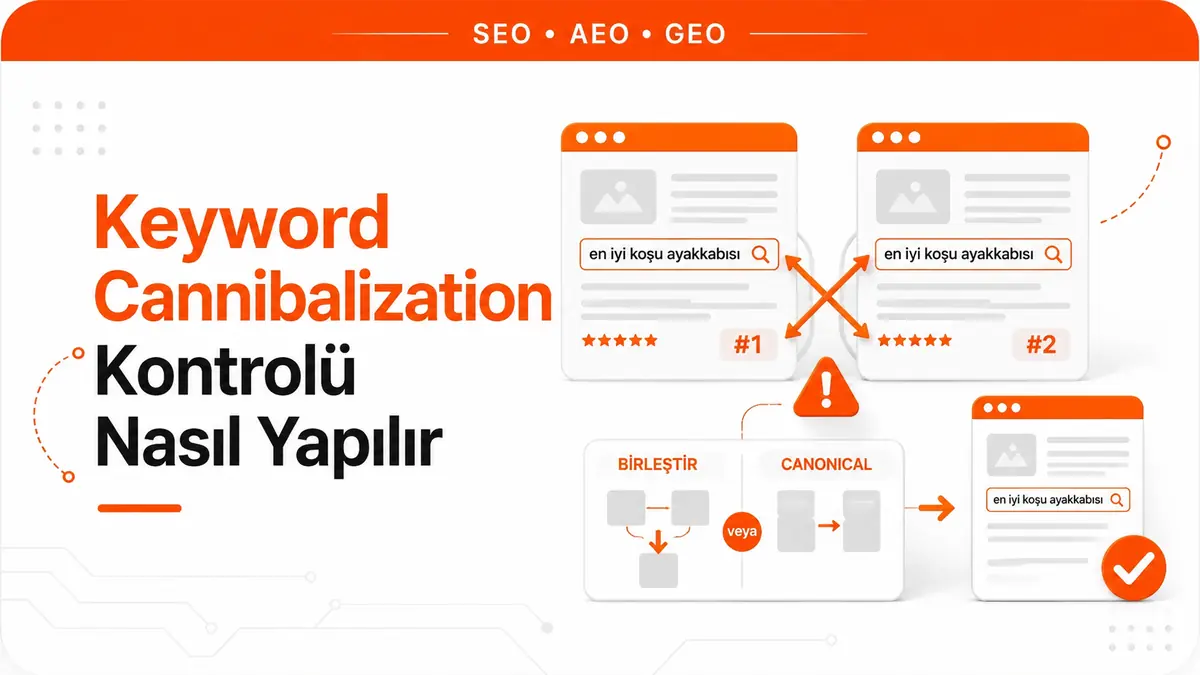
Seeing two URLs from your own site for a query is not a fault in itself. What makes it cannibalization is not two pages using the same keyword; it is both pages trying to satisfy the same search intent while Google keeps wavering over which one to show. In practice, this distinction determines the outcome: in one case, merging the pages and setting up a permanent redirect is the right move; in a similar-looking case, the same move needlessly destroys one of two results that were both working.
Google's own documentation treats these two situations as different problems. For pages that are very similar to each other, the indexing process forms a cluster and marks the most complete, most useful page in the cluster as canonical. That is a duplicate content issue, and Google does not consider having duplicate content a spam policy violation. If two pages genuinely carry different content but are candidates for the same query, this mechanism does not kick in. Most cannibalization discussions end with the wrong fix because they confuse these two situations.
When two URLs for the same query are not a problem
If you have two URLs side by side on the results page and both stay there permanently, you are not splitting the results; you are occupying them. Two of the slots for that query are yours, and a competing result cannot take them. In Search Console data, the signature of this situation looks calm: the average position of both URLs stays within its own band for weeks, impression counts are roughly stable, and the query's total clicks do not fall.
The deduplication mechanism described in Google's ranking systems guide is also part of this picture. When there are results that are very similar to each other, the system shows only the most relevant one to avoid unhelpful repetition. So if two of your pages can stay on the results page together, Google does not consider them duplicates of each other. Diagnostically, that is a free signal, and it is missed in most audits.
Base the decision to intervene not on what the results page looks like, but on the site's total performance for that query. If two URLs sit together and the query's total clicks are rising, there is no problem to solve.
The Search Console signature of real cannibalization
The primary place for diagnosis is the Search Console performance report. The right order is: apply the query filter first, then switch to the page dimension. Looking at the page list without locking onto a single query aggregates data from different queries into one table and produces a misleading picture.
Once the filter is applied, what you are looking for is not the number of URLs but how the URLs behave over time. The distinguishing signature of cannibalization is this trio:
- Impressions for the same query alternate between two URLs. One week one URL gets the impressions; the next week the other takes over.
- Neither URL settles into a consistent position band for that query. The average position lines of the two cross each other.
- The query's total clicks on the site fall compared with the period when one of the URLs was performing best on its own, or at best stay the same.
Two technical details change the outcome when reading the metrics. First, average position in the chart is the average of your site's topmost result; in a table row, it is the average of that row's URL itself. So you can see two URLs fluctuating in the table rows while the site-level chart looks fine. Second, when impressions are grouped by page, each URL gets its own impression; when grouped by property, a single impression is counted for the same results page. Mixing up these two groupings produces impression gains or losses that do not exist.
The query dimension has its own limits too. Some queries are anonymized for privacy reasons and do not appear in the report, and the system only stores the most important rows. For a low-volume query you may not see the two URLs at all. Our article on tracking Search Console data, which covers these behaviors of the performance report in more detail, is worth reading before you interpret the data.
The intent overlap test
Keyword overlap is not a diagnosis. The same phrase appearing in the title tags of two pages does not mean those pages do the same job. The real question is: what does the person searching this query expect after clicking, and do both pages meet the same expectation?
In practice, three questions separate them. Do the pages answer the same question, or does one teach the concept while the other closes the purchase decision? Do the pages address the same stage of the user journey? When a user opens both pages, do they find something new on the second, or do they read the same information in different sentences? If the answer to the third question is no, the overlap is real and intervention is needed.
This test also resolves the classic dilemma between a blog post and a service page. An informational query and a service query are different intents and are not served well on a single page. If two pages serve different intents, there is no overlap; separate the title and content focus so the distinction is visible, and add a link from the informational page to the service page. We cover how intent classification works in detail in our article on search intent alignment.
Four situations that produce false positives
Four patterns that look like cannibalization but are not come up again and again in audits.
Brand queries. For queries containing your own brand name, the homepage, a service page and the contact page can be listed together. This means the site takes up a lot of space for its brand query; there is nothing to fix.
Long-tail variation. There are dozens of variations under a broad query. If one page takes the core phrase while another takes a longer, more specific variation, these are not the same query. Switching the query filter from "contains" to the exact phrase usually simplifies the picture.
Temporary swapping. A newly published page can swap places with an existing page for a few weeks. This is the indexing process still positioning the page. Intervening without looking for a lasting signature ends with accidentally retiring the right page.
A decaying page muddying the picture. If one page's position is falling while another page rises for the same query, this may be content decay rather than cannibalization. The difference between the two diagnoses is this: in cannibalization, total impressions are preserved and split between URLs; in decay, total impressions fall. We cover this distinction separately in our article on content decay analysis.
Site patterns that create overlap structurally
Cannibalization often stems not from individual article decisions but from the URL patterns the site generates. These patterns should be shut off at the source rather than fixed one by one.
When tag and category archives have the same name, both pages present almost the same list of content. Here there really is duplicate content, and the solution is to limit tag creation or keep the archives out of the index. In e-commerce, the tension between category and product pages is different: the category targets the broad phrase, the product page targets the product-specific phrase, and a product description that heavily repeats the category phrase increases the risk. URLs that carry the year create a structural competitor with every new edition; removing the year from the URL and keeping it in the content eliminates the problem at its root. For paginated pages, the correct behavior is for each page to carry a self-referencing canonical, because pointing all paginated pages to the first page prevents the links on later pages from being evaluated.
Intervention options and what they actually change
All four main interventions are called "cannibalization fixes", but they do different things. The choice depends not on what you want to do but on which signal you have.
| Intervention | What it actually does | When it fits | Reversibility and risk |
|---|---|---|---|
| Merge and permanent redirect | Consolidates two pages into one URL. A permanent redirect is a strong signal that the target should be canonical, and the new target is shown in search results. | Both pages satisfy the same intent and their content can be meaningfully combined on one page. | Technically reversible, but if content was deleted the information loss is permanent. The highest-impact and least flexible option. |
| Retargeting | Shifts the focus of one page to a different intent. Does not touch the URL structure. | Both pages serve a legitimate purpose but overlap because both target the same intent. | Fully reversible. The slowest option to show results, because re-evaluation depends on a new crawl. |
| rel="canonical" | Declares the preferred version and consolidates signals into one URL. Google treats it as a hint, not a rule. | The two pages really are very similar, and both need to remain accessible. | Easily reversible. Silently ignored if the pages are not similar enough. |
| Internal link hierarchy fix | Makes clear which page has priority through the site's internal link structure. Does not remove any page. | The overlap is weak, both pages will be kept, and simply signaling a preference is enough. | Fully reversible and risk-free. Does not resolve a strong overlap on its own. |
| noindex | Removes the page from search results but does not consolidate its signals into another page. | The page needs to stay for users but has no business in search results. | Reversible, but its effect depends on crawling. The page must remain crawlable for the tag to be seen. |
The last row of the table points to a common mistake. Blocking a page from crawling with the robots file and also adding a noindex tag does not work, because the page has to be crawled for the tag to be read.
A decision tree from signal to intervention
The combination of signals you have determines the intervention. Work through it in this order:
- If both URLs are listed permanently and the query's total clicks are not falling, do not intervene. Record it in your measurement file as "monitoring" and close it.
- If there is swapping but the pages serve different intents, go for retargeting. Change the focus of the weaker side and leave the stronger side's focus alone.
- If there is swapping, the intents are the same and both pages have unique information, merge them and set up a permanent redirect.
- If there is swapping, the intents are the same and one of the pages really is a near-copy of the other, canonical is enough. If the pages are not similar enough, skip this step.
- If the overlap is weak and both pages are to be kept for strategic reasons, only fix the internal link hierarchy and look again in the next measurement period.
- If the page should not be in search results but must stay on the site, apply noindex and make sure the page remains crawlable.
The order itself is a safety mechanism. Working from top to bottom, the least reversible intervention only comes up after cheaper options have been ruled out.
Where the canonical tag silently fails
Thinking of the canonical tag as the general fix for cannibalization is one of the most expensive assumptions in the field. Google treats the canonical preference as a hint, not a rule, and may choose another page as canonical. The important point is that this is not random: for a page to be considered a copy of another page, it has to resemble it. If two pages genuinely carry different content, a canonical tag pointing from one to the other will never be accepted.
The implementation is added to the head section of the weaker page:
<link rel="canonical" href="https://example.com/technical-seo-audit" />Verify whether the tag is accepted instead of assuming it. In Search Console, the URL Inspection tool shows the canonical you declared and the canonical Google selected separately. If they differ, the tag is not working, and since the two pages really are different, you need to move to another intervention.
The ways of declaring a canonical preference differ in strength. Redirects and rel="canonical" annotations are strong signals; inclusion in a sitemap is a weak signal. These methods are not mutually exclusive; used together, they increase the likelihood that the preferred URL is chosen.
The order of merging and the irreversible step
Merging consists of four steps, and the order is not negotiable.
- Decide which page stays. The decision is based on which page has the better position, more clicks and a stronger external link profile in Search Console data with the query filter applied.
- Move the unique information from the page being closed to the page that stays. If this step is skipped, the redirect does not bring back the lost information.
- Set up a permanent redirect from the closing URL to the remaining URL. A server-side 301 or 308 response is the clearest signal that the target should be canonical. If a temporary redirect is used, the source page continues to be shown in search results.
- Update the site's internal links to point to the new target. This step prevents redirect chains and unnecessary crawl load.
The second step is the only irreversible one. A redirect can be removed and internal links can be changed again, but a deleted section is gone until it is put back live. Saving the full text of the page being closed somewhere before you start is the cheapest precaution that reduces this risk to zero.
Which metric shows the result of the intervention?
Choosing the wrong metric can make an intervention that worked look like a failure. Looking only at the remaining URL's average position is prone to this mistake, because the position value in the chart is the average of your site's topmost result and already looks optimistic when there are two URLs.
Set up measurement at the query level. For the query you intervened on, look at three things: the query's total clicks, the query's total impressions and the number of URLs listed for that query. In a successful intervention, the number of URLs drops to one, impressions are at least preserved and clicks rise. Clicks falling while impressions hold steady suggests the wrong page was chosen as the winner, and in that case you should review the content focus.
The only certain point about timing is this: the result depends on Google recrawling both the old and new URLs, and that does not happen instantly. Seeing fluctuation during this period does not mean the intervention was wrong. Spread the evaluation across two consecutive periods rather than a single measurement window.
A plan that stops overlap before it happens
Fixing cannibalization is always more expensive than preventing it, because fixing requires closing a page or changing its focus. Prevention, by contrast, is just a single pre-publication check.
The mechanism that works is this: record the primary intent each page targets in one place, and before opening a new content brief, check that record for a page targeting the same intent. The record works when it is kept as a list of intents rather than a list of keywords, because what creates overlap is intent, not keywords. We cover how to set up this record in our article on topical map planning, and how to pin down a single page's intent at the article level in our article on writing SEO-friendly content.
Reducing duplicate content has a second benefit on the crawling side. Many URLs carrying the same information cause crawl resources to be spent on copies instead of new and updated pages. On large sites, this is a sufficient reason on its own, independent of cannibalization.
Frequently Asked Questions
Is cannibalization a Google penalty?
No. Having duplicate or near-duplicate content on a site is not a spam policy violation. Its effect shows up not as a penalty but as signals and clicks being spread out and crawl resources being used inefficiently.
Does the same phrase appearing in the title tags of two pages create cannibalization?
Not on its own. The same phrase can naturally appear in two titles serving two different intents. The problem is not that the words in the titles are the same, but that the pages meet the same expectation after the click.
Is it better to delete or redirect the page being closed?
If the page receives external links or still gets traffic from search results, a permanent redirect is preferred, because the signals are consolidated in the target. If the page has never received links and has no traffic, the redirect contributes little, but setting one up does no harm either.
How often should a small site check for cannibalization?
Tie it to events rather than a calendar. Run the check when new content is published, when the URL structure changes and when an existing page is significantly expanded. Outside these three events, regular scanning rarely produces new findings on small sites.
What do you do if three or more URLs appear for the same query?
Do not tackle them all at once. First lock in the URL with the most clicks for the query as the page that stays, then run the rest through the decision tree one by one. A bulk intervention makes it impossible to measure which change produced which result.