Three links to the same page say three different things
Imagine the following three sentences appear in a piece of text, and assume all three link to exactly the same URL:
- For detailed information on the topic, click here.
- Seobaz has put together a detailed guide on this.
- The whole topic is covered in the anchor text diversity guide.
For a reader, the difference between them is a difference in style. For a search engine parsing the link, the difference is a difference in information. The first says nothing about the target page, the second says who the page belongs to but not what it is about, and the third says what the page covers. Same href, three different descriptions.
Anchor text, also called link text, is exactly this visible text: the words in the clickable part of a link. Google's own definition is simple: link text is the visible text of a link, and it tells people and Google something about the page you are linking to. Google uses links both to discover new pages and as a signal for deciding how relevant pages are, and anchor text is the readable face of that signal.
So anchor text is not decoration; it is the label you attach to every link you give. And a site's anchor text profile is really the sum of how dozens of different people linking to that site describe it.
Where does Google read anchor text from?
The answer is narrower than you might expect. Google can generally crawl a link only if it is an <a> HTML element with an href attribute. Other formats that behave like links but do not use the <a href> structure are mostly not parsed. So a <div> made clickable with JavaScript may be a link for the user, but not for the crawler.
This basic rule has three practical extensions:
- In image links, alt text takes the place of anchor text. If you use an image as a link, Google uses the
altattribute of theimgelement as the anchor text. An image link with an emptyaltis an unlabeled link. - In empty links,
titleserves as a fallback. If an<a>element is empty for some reason, Google can use thetitleattribute as anchor text. This is not a preference; it is recovery behavior. - If anchor text is inserted with JavaScript, it must appear in the rendered HTML. In that case Google recommends checking with the URL Inspection Tool.
The first fix that follows from this comes before word choice on most sites: before trying to improve anchor text, make sure the link is technically readable.
Types of anchor text and the signal each one carries
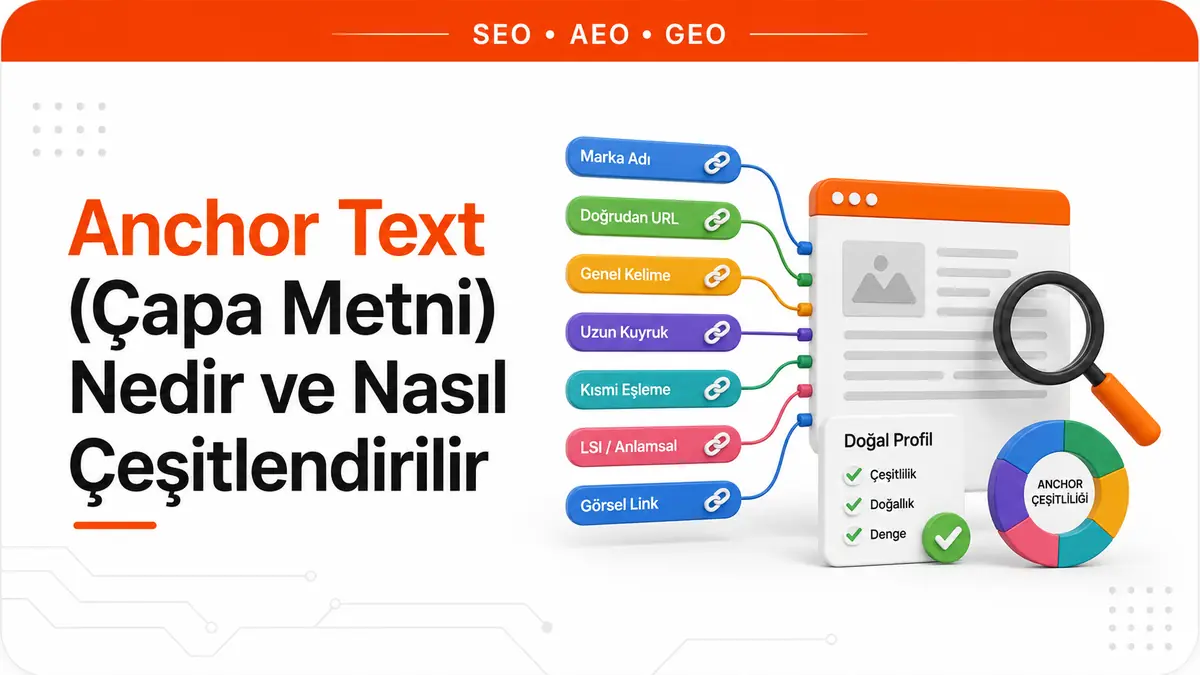
The types are not categories that are processed differently at a technical level. There is no "exact match anchor" class in Google's documentation. These labels are vocabulary the industry came up with so that link profiles can be analyzed and discussed. It is useful because it makes it easier to tell what an anchor text is saying. It does harm when it is mistaken for a rule.
| Type | Example | What it says about the target page | Where it naturally appears |
|---|---|---|---|
| Exact match | backlink packages | States the page's topic using the exact target keyword | Rarely. People write sentences, not keyword lists |
| Partial match | affordable backlink solutions | States the topic, but in the writer's own words | Often. The writer referring to the topic in their own language |
| Brand | Seobaz | Says who the page belongs to, not what it is about | Very often. The reflex of citing a source |
| Brand plus topic | Seobaz's backlink guide | States both the source and the topic | Often. The typical form of editorial citations |
| Naked URL | seobaz.com/blog | States the address, says nothing in human language | Often. Forums, reference lists, automatic quotes |
| Generic | click here, read more | Says nothing | Very often. Interface and navigation text |
| Descriptive phrase | in the section explaining why anchor text carries context | Says which of the page's questions the link leads to | Often. Natural in-content citations |
| Image alt text | alt="backlink profile distribution diagram" | States the topic of the image and the target | Moderately. Citations of diagrams and charts |
Reading the table from right to left is more instructive. The right-hand column explains why a given type is abundant on a site. If brand anchor text is abundant, the reason is social, not technical: people have referred to you by name. This distinction is the foundation of the entire section that follows.
Google's description of good anchor text and its one-sentence test
Google's official recommendation is clear and narrow in scope: good anchor text is descriptive, reasonably concise, and relevant both to the page it is on and to the page it links to. It gives the link context and sets the right expectations for the reader.
The same document lists bad examples too, and they all share the same flaw: being too generic. Patterns like "click here", "read more", "our website" and "we have an article" carry nothing about where the link goes.
In the same place, Google offers a very practical test: read only the anchor text, out of context, and check whether it is specific enough to make sense on its own. This test is the cheapest quality check you can apply while writing, and it requires no percentage calculations.
One detail of the description is often overlooked: anchor text is expected to be relevant not only to the page it points to but also to the page it is on. In other words, link text is evaluated not in isolation but together with the sentence it sits in. Beyond that, no official source gives a measurable coefficient along the lines of "the text around a link carries this much weight". It says context matters; it does not say how much. That gap also shows where most claims on this subject run out.
Why aren't percentage recipes a rule?
The most widely circulated statements on this topic are numerical: 80 percent of the profile should be branded, exact match should not exceed 5 percent, naked URLs should sit in the 10 to 15 percent band. These figures spread quickly because they look precise and actionable.
No official document published by Google includes a target distribution percentage of anchor text types for a profile. No such threshold appears in the link best practices document, the spam policies or the starter guide. What exists on the official side is a qualitative recommendation about the readability of individual links.
So where do the numbers come from? Two places. First, from crawling the link profiles of strong sites and averaging their type ratios. Second, from imitating competitor profiles. Both are observations, both are descriptive, and both contain the same logical error.
To see the error, it is enough to go back to the table. A site with a large number of brand anchors does not have that profile "because it produced brand anchors". The profile formed because people referred to that site by name. So an 80 percent brand ratio is not a practice on that site but a result of recognition. When you turn the measurement into a target, you end up trying to produce the result, not the cause. Writing your brand name eighty times in placements you paid for is not the same as eighty people writing it of their own accord, and it does not produce the same signal.
The second problem is that the ratio is blind to subject matter. It is natural for an e-commerce site to be referred to by product name, for a news source to be quoted with a naked URL, and for a documentation site to be referred to with descriptive phrases. Imposing the same percentage on all three means distorting the natural profile of all three. Observing the real profile of your niche is both more accurate and easier than trying to fit a universal ratio.
This does not mean you should never look at the distribution. Distribution is a good diagnostic tool. It is a bad target. The difference is best shown by where risk is actually defined.
What does Google actually state as a rule?
In the spam policies, link spam is defined as the practice of creating links to or from a site primarily for the purpose of manipulating rankings. Anchor text is mentioned directly among the listed examples, and the sentence it appears in matters: advertorials or native advertising published for payment are a policy violation if they contain links that pass ranking credit, as are articles, guest posts or press releases distributed across other sites that contain links with optimized anchor text. To make this concrete, Google gives an example of a text with phrases like "wedding", "best ring", "flowers" and "wedding dress" sprinkled through it as links. Keyword-rich links embedded in widgets and distributed across many sites fall under the same heading.
The point to note is this: the variable the policy defines is not a percentage but the nature and purpose of the placement. Whether a link sits in a paid article or an editorial citation, whether it passes ranking credit, whether it is part of a distributed template. Anchor text appears here not as an offense in itself but as a marker that gives away the purpose of a paid placement.
This has a direct practical consequence. Switching the anchor text in a paid placement to your brand name does not make the placement policy-compliant. What makes it compliant is marking the link with rel="sponsored". Google recommends this value for ads and paid placements; for user-generated content it recommends rel="ugc"; nofollow is still an acceptable annotation, but sponsored is preferred for paid placements. Correctly labeling where each link comes from matters more than adjusting anchor text ratios. The question of where placements come from is covered separately under the criteria that actually make a backlink high quality.
Neutralization, not penalty
The motivation behind percentage recipes is usually fear: if I cross the threshold, I'll get penalized. This fear is a holdover from how the mechanism used to work.
Google has publicly stated that it now uses SpamBrain, its AI-based spam prevention system, to fight link spam. The key word in the announcement is "nullify": the impact of unnatural links on search results is removed. The system can detect both sites buying links and sites used to pass links outward, and the credit those links pass disappears.
This distinction changes the strategy. The common scenario is no longer "I crossed the threshold and got penalized" but "the link was never counted". In other words, what happens to a manipulative placement is usually not a drop but nothing at all: money is spent, the link goes live, it shows up in the profile report, and nothing happens.
A percentage recipe offers no protection against this kind of failure, because the problem is not what the anchor text says but how the link was obtained. For an editorially earned link, the anchor text ratio is not a problem in the first place. For a link set up for manipulation, switching the anchor text to your brand does not make it valuable; it only makes it worthless in a less conspicuous way. How links are earned is covered in detail in the article explaining the fundamentals of backlinks.
How does natural diversity actually come about?
The distinguishing feature of a natural anchor text profile is not its type ratios but multiple authorship. When ten different people link to a page, ten different phrasings appear, because everyone refers to the topic in their own words. Some write your brand name, some copy the title, some paste the URL, some say "according to this study", and some use a phrase you never targeted.
The distinguishing feature of an artificial profile is the opposite: being written by a single hand. Repetition of the same pattern, type ratios spread at regular intervals, variations that all come back to the same three words. A profile usually looks fake not because "the exact match ratio is high" but because the whole profile looks like it came from one person's keyword list.
The upshot is reassuring: you cannot control anchor text on earned links anyway, and you don't have to. Diversity is a by-product of earning links from diverse sources. The areas you can control are narrow, and the work in that narrow area is clear: mark placements correctly, write anchor text that reads well, and don't repeat the same phrase in series. For teams that want to build this discipline into planned placements, the working model on our backlink packages page is designed around this framework.
On internal links, you have full control
The most productive part of the anchor text discussion is the part talked about least. On links within your own site, you decide 100 percent of the anchor text. There is no guesswork, ratio or risk calculation here; there is only writing discipline.
Google's description can be applied directly to internal links. Menu and navigation links stay short and consistent, while in-content links say which of the target page's questions they lead to. Writing "the items checked in a technical SEO audit" instead of "more details" turns the same link into one that carries information.
There are two typical internal linking mistakes. The first is linking to the same target page from everywhere on the site with exactly the same keyword. This is monotonous for the reader and squeezes that page into a single word. The second is giving the same anchor text to different pages. This is more harmful, because it becomes unclear which of the two pages corresponds to that description. Neither is a matter of penalties; both are ambiguity you create with your own hands.
How to read your profile without looking at percentages
Asking four questions tells you more than looking at a distribution table. You can apply them in order:
- Out-of-context reading. List your anchor texts and read them one by one. The ones where you can't tell which page they lead to are the ones to fix. This is Google's own test, and it applies directly to internal links.
- Repetition test. How many different sources have used the same phrase? The same sentence repeating across many different sites is a sign of a distributed template or a campaign run by a single hand. What you are looking at here is not a ratio but the repetition itself.
- Source type test. Look at the nature of the placement the link comes from: editorial citation, paid article, distributed press release or user comment. This is the variable the policy defines, and paid ones need to be marked correctly.
- Author test. Look at the whole list and ask: do these phrases look like they were written by different people, or did they come from a single keyword list? If it is the latter, the problem is not the distribution but the method of earning links.
These four questions give you something a ratio table never can: which fixes are in your hands. You cannot fix the percentage, because the people linking to you decide it. You can fix readability, annotation and repetition.
Frequently Asked Questions
Does using brand anchor text in a paid article remove the risk?
No. The problem defined in the spam policies is the paid placement that passes ranking credit itself; anchor text is a marker that shows the purpose of that placement. Using a brand phrase does not make the placement editorial. The compliant solution is to mark the link with rel="sponsored".
Does giving the same anchor text to more than one page cause problems?
Not in the sense of a penalty, but in the sense of clarity. When you link the same description to two different pages, it becomes unclear which page corresponds to that description. Since internal links are entirely under your control, giving each important page its own distinctive description is the cleanest solution.
Do I need to clean up exact match anchors built in the past?
It is not an automatic requirement. Because the current approach to link spam is to nullify the effect of unnatural links, much of the credit from manipulative placements may already be going uncounted. The disavow tool is not a broom for sweeping cleanups; it is meant to be used narrowly and carefully. First look at where the links come from; don't delete the whole list to hit a ratio target.
If anchor text is added with JavaScript, does Google see it?
Only if the text is present in the rendered HTML. For pages that insert anchor text with JavaScript, Google recommends using the URL Inspection Tool to confirm that the text appears in the rendered HTML. The link also needs to be an <a> element with an href attribute; other elements made clickable are generally not parsed as links.