Picture two links. Both come from sites with the same authority score, both carry the same anchor text, and in your link tool's dashboard they show up as two identical rows. The first sits in the middle of a relevant guide; the author placed it to cite a source for readers, the page appears in search results and real readers visit the site every month. The second sits inside a paid article, next to links from seven unrelated industries on the same page, and the page has never made it into Google's index. The difference doesn't show up in the tool's dashboard, but these two are not the same thing.
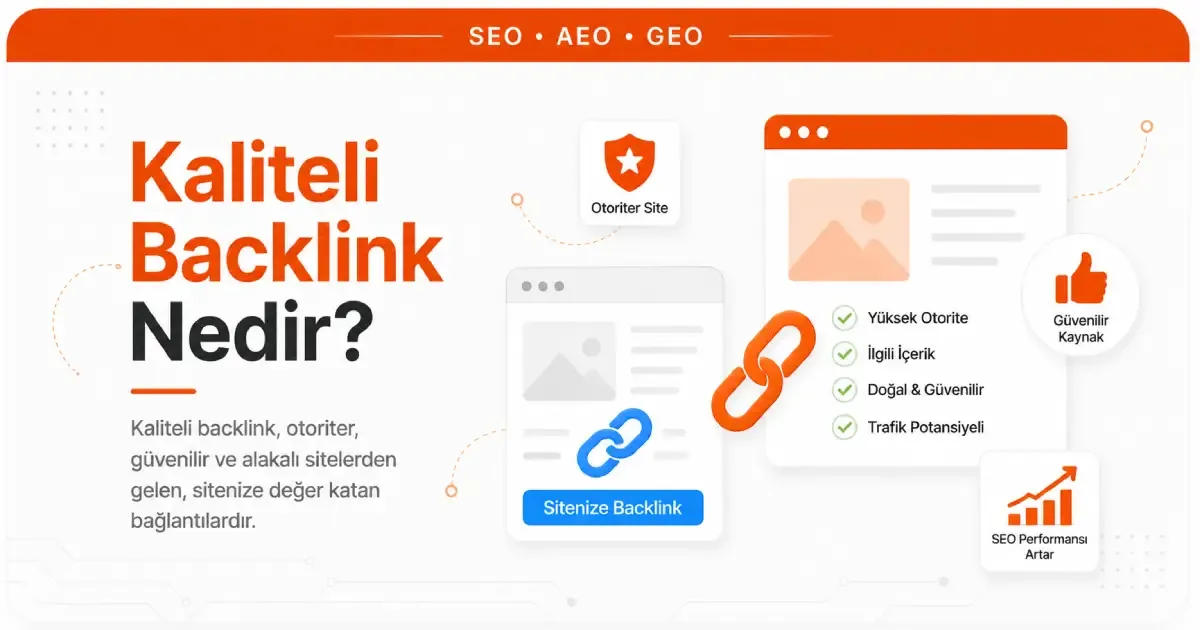
A quality backlink is a link given through an editorial decision on a relevant page that people actually read. The question what is a backlink explains how a link works; quality asks something else entirely: what does this link say about the page that gives it?
A valuable link and a safe link are not the same question
Most debates about backlink quality mix two separate questions under one heading. The first is the question of value: does this link give the target page anything? The second is the question of risk: is this link part of a pattern that Google's spam policies count as a violation? A link can produce no value at all and still be completely risk-free. Another link can seem to work in the short term and still count as a policy violation.
The risk side is not open to interpretation, because it is written in Google's spam policies. Buying or selling links to influence rankings, getting articles with links published in exchange for money or products, and having links that pass ranking value in content published for payment are listed among the examples of link spam. The value side, on the other hand, is not written in any policy text. You can only read it from the source itself, through signals visible from the outside.
Which signals show that a link is valuable?
Quality cannot be reduced to a single measure, but it is not scattered either. Four signals that an outsider can observe carry most of the decision.
Relevance: which topic is the link sitting in?
Relevance is the closeness between the topic of the source page and the topic of the target page, and it is read at two levels: the site's overall topical scope and the topic of the single article the link sits in. The two count separately. A review of accounting software published on a general technology site is relevant at the article level, even if the whole site is not devoted to accounting.
Relevance does not require the exact same niche; neighboring topics also create natural context. For e-commerce software, content on logistics, entrepreneurship and payment systems is a reasonable neighborhood. The pattern to rule out is a single article linking side by side to industries that have nothing to do with each other. A page like that is not really about a topic at all.
Real traffic: is the search engine already rewarding the site?
Organic traffic is the most honest data you can observe from the outside about how a search engine views the source site. If a site receives regular search traffic, it produces content that Google already considers worth ranking. Authority scores can be pushed up with link volume; search traffic can only be earned with content that genuinely ranks, which is why it is much harder to fake.
Looking at the curve is more informative than a single monthly figure. A traffic graph that falls off a cliff within a few months shows that the site has run into a problem. Getting a link from there before the cause of that problem is clear means entering a neighborhood whose story you don't know.
The second benefit of a source with traffic is completely independent of rankings: a link on a page that has readers sends real visitors to the target page. Even if the ranking side doesn't work at all, this referral traffic is a measurable gain, and it is left out of most evaluations.
Editorial decision: who decided to place the link?
An editorial link is a link that an author or editor places because they think it will be useful to their readers. The opposite is when the link exists before the content: first the target URL and anchor text are decided, then the article that will carry that link is written. In the second case, it usually becomes clear within a few paragraphs that the article exists for the link, not for the reader.
The practical test is this: if this link were removed from the text, would the rest of the article still stand as a meaningful and complete piece? If the answer is no, the page's reason for existing is the link itself.
Position and neighborhood: where on the page is the link?
Two links on the same site mean different things depending on their position on the page. A link sitting in the body text, in the natural flow of a sentence, is tied to that sentence's claim. A link in the footer, sidebar or author box that repeats across every page of the site is tied not to a single editorial decision but to a template; it was set up once and then forgotten.
The neighborhood carries just as much information. How many external links a page gives and where they go tells you that page's linking policy. An article that links to a few selected sources and an article that links to thirty different industries are not the same kind of page.
What DA and DR should a site have?
This question has no numerical answer, and the reason is often skipped: these scores do not belong to Google. Moz's Domain Authority, Ahrefs' Domain Rating and similar values are prediction models these companies produce from the link data their own crawlers see. Each sees a different link universe, updates its own formula periodically and can produce different numbers for the same site. There is no metric by these names in Google's ranking system.
This does not mean the scores are useless. They just need to be used for what they are: scores are a quick pre-screening tool that helps separate the candidates worth looking at from among hundreds. They are not a decision tool. In addition, most of these scores use a logarithmic scale, so going from 20 to 30 is not the same size of difference as going from 60 to 70. A gap of a few points between two sites tells you nothing on its own.
Scores are most misleading when read in isolation from traffic. A site with a high score but almost zero search traffic is typically a site that has inflated its score with link volume. By the same logic, a site with a medium score but a steady readership is often the better source. You can check a candidate's DA and PA for free; read the resulting number as an estimate, not as proof, and always evaluate it alongside traffic data.
Does a nofollow attribute mean the link is low quality?
No. These attributes declare a relationship, not quality. Google's own documentation defines the three values as follows: sponsored is for links that are ads or paid placements, ugc is recommended for links in user-generated content such as comments and forum posts, and nofollow is used when neither of the other two values fits and the site does not want to be associated with the page it links to. Links carrying these values are generally not followed.
In practice, this means that even if a tagged link carries no ranking signal, it can still produce value in terms of referral traffic, brand visibility and getting the content into circulation. The reverse is also true. Leaving a paid placement unmarked does not make that link more valuable; it only means the publisher is declaring the wrong relationship to Google.
The point most often negotiated with publishers is whether the link will be left untagged. From a quality evaluation standpoint, the correct reading is not to treat the attribute as a quality indicator on its own: an untagged link on a weak page is still weak, and the presence of an attribute does not make a strong page worthless.
Does a link from a paid placement count as quality?
Google's spam policies draw a clear line here. Buying or selling links for ranking purposes, giving money or products in exchange for links, and having links that pass ranking value in articles published for payment all count as link spam. The path the policy points to is not giving up on paid placements but declaring the relationship correctly: a paid placement is marked with sponsored.
This does not mean paid placements are useless; it means expectations need to be set correctly. A correctly marked paid placement works for brand visibility, referral traffic and getting the content read. A plan built on the promise of passing ranking value, however, directly contradicts the policy. The extreme end of this contradiction is the hacklink scheme, where the link is placed without the site owner's knowledge: there is neither an editorial decision nor a lasting placement there.
How is AI search changing backlink quality?
In classic search, links continue to be an input to ranking systems. When AI answers select sources, however, links seem to carry a different weight. Ahrefs' study of about 75,000 brands found a correlation of 0.664 between a brand's visibility in AI answers and its mentions across the web, while the correlation with backlink count was only 0.218. This is a correlation study: it does not show which factor causes the other, only which measures move together.
The practical consequence for quality evaluation is this: measuring a source only by the ranking value it will pass is increasingly an incomplete reading. A publication that is actually read and that also mentions the brand without a link may be doing work beyond the value you measure on the ranking side. This does not make the link unimportant; it means that when choosing sources, you also need to consider the site's readership and whether it mentions the brand name in a natural context.
How do you vet a source before publication?
The checks save time when done in order, because the first steps eliminate the most candidates:
- Examine the site's organic traffic curve over recent months. If there is a sharp drop, don't proceed until the cause is clear.
- Check whether the section where the article will be published is in Google's index. A link on a page that isn't indexed does nothing on the ranking side.
- Read a few of the site's recent articles. Whether they were written for readers or to carry links becomes clear within a few paragraphs.
- In a sample article, look at how many external links are given per page and which industries they go to.
- Agree with the publisher that the link will be placed in the body text, inside a natural sentence; an author box or end-of-list placement is something different.
- Choose the anchor text by looking at the distribution in your existing link profile. Repeating the same anchor over and over does not produce a natural pattern.
Few sources pass all six steps, and that is normal. Quality evaluation is not a scoring exercise but an elimination process: the earlier and stricter the elimination, the higher the average value of the links that accumulate in your profile. If you prefer to work with a ready-made pool of publications, you can review the options on the backlink packages page.
Frequently Asked Questions
Are a few strong links better than many average links?
The two cannot be compared on the same scale, because they carry different risks. Many average links may not cause harm individually, but collectively they produce a recognizable pattern, and when that pattern becomes entrenched it causes problems on the policy side. Links from a small number of sources that are genuinely read do not produce such a pattern. The right question is not how many links there are but what the profile says when viewed from the outside.
Can a low-quality link harm my site?
On its own it usually does no harm; it simply has no effect, because Google largely ignores links it finds worthless. The risk does not appear in a single link but in a profile that grows into a pattern: repeated links spread across a site and heavy association with spam networks can lead to enforcement. For suspicious links that accumulate outside your control, Google has a link disavow mechanism, but it is a last resort, not a first one.
Does a source's quality change over time?
It does. A site can change hands, its editorial direction can drift, its traffic can drop or it can start focusing on selling links. A source choice that is right today may not mean the same thing a few years from now. That is why quality evaluation is not a one-off purchasing decision but ongoing work that requires rereading the profile periodically.