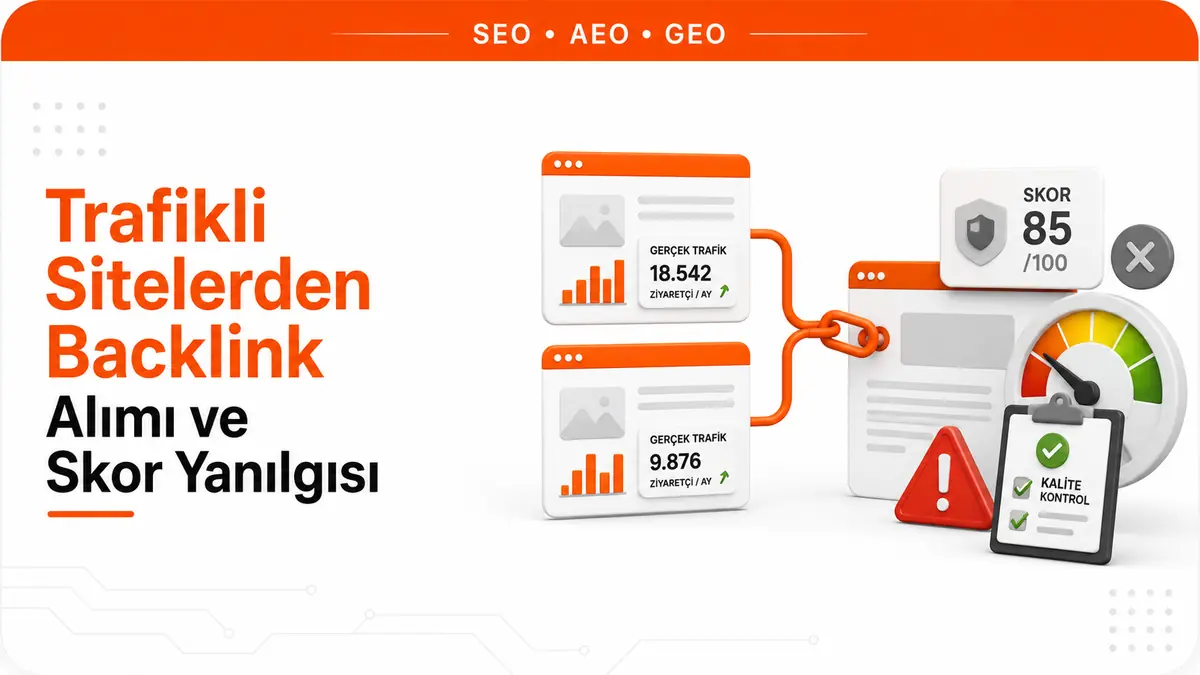
You have a budget for one placement and two options in front of you. The first has an authority score of 58 and organic traffic close to zero. The second has a score of 31 and gets around 4,000 organic visitors a month, and those visitors come from queries related to your industry. On the vendor's list, the first is more expensive and looks stronger on paper.
The right choice is the second, and the reason isn't a matter of preference: the two numbers measure different things. An authority score is a piece of software's estimate of what Google thinks about a site. Organic traffic is a record of what Google actually does with that site. If a site gets organic traffic, Google is genuinely ranking its pages for real queries.
A score is an estimate, traffic is an observation
Scores like Domain Authority and Domain Rating are not Google products. Each one is calculated from the link graph that the tool behind the metric collects with its own crawler, and it answers the question "how well is this site likely to rank?" with an estimate between 0 and 100. The model's input is mostly links: how many places link to the site and how good those links are.
There's an important limit hidden in this definition. The score measures the links pointing to a site; it doesn't measure whether Google gives those links any credit. When Google devalues a site, the site's link graph stays exactly where it was, and so does its score. For the score to drop, the site has to lose its links; losing Google's trust isn't enough.
Organic traffic fills exactly this gap. If a page gets organic traffic, it has appeared for a query and been clicked, and all of that happened as a direct result of Google's ranking decision. Traffic isn't a claim about the site; it's the externally visible trace of how Google behaves toward it. When evaluating a backlink, making this distinction comes before every other criterion.
Why a high score and zero traffic show up on the same site
This combination isn't a rare accident; it's a predictable outcome. A domain may have collected a large number of links over the years without ever gaining real readers. When a powerful expired domain is bought and relaunched, its old links keep showing up in measurement tools, but from Google's perspective it's now a different site. Networks of sites linking to each other produce the same effect: the graph inflates, the rankings don't come.
The commercial side of this is simple. A score is an appearance you can buy; traffic can't be produced as cheaply. Pointing links at a site is relatively easy; getting that site's articles to rank for real queries is hard. That's why inflated metrics are the most common form of misrepresentation in sales lists, and they usually come with the highest price tag. The same distinction sits at the heart of the debate over what makes a quality backlink.
How to verify a site's real traffic
The traffic figure tools give you is also an estimate, so making a decision from a single number just repeats the first mistake with a different number. What matters here isn't the absolute figure but consistency and direction.
- The direction of the traffic curve. Is the chart for the last year stable or rising, or did it drop at some point and never recover? A sharp, lasting drop can indicate that the site lost value in an algorithm update.
- The queries traffic comes from. If almost all visits come from the site's own brand name, the site doesn't rank for queries related to its topic. The signal you're looking for is traffic from on-topic queries.
- Testing articles one by one. Take the titles of three of the site's latest articles and search for them. A publication that can't make the first page even for its own headline has no value to pass on to you.
- Publishing pattern. If nearly all the content on the site is sponsored articles that link out, it isn't a publication but a link warehouse. On publications with real readers, content without outbound links is the majority.
- Index status. If the site's pages don't appear in search results at all, there's no channel for that link to pass through, whatever the traffic estimate says.
Running the same checks on the publications your industry competitors get links from reveals which sites are actually read. Competitor traffic analysis is the practical way to see this list in bulk instead of scanning it by hand one site at a time.
How Google views paid links
No set of selection criteria is complete without this question. Google's spam policies define links built to manipulate rankings as link spam and spell out the scope clearly: buying links or posts containing links for money, exchanging goods or services for links, and using ranking-passing links or optimized anchor text in advertorial content published for payment. Guest posts and press releases are explicitly counted within this definition. For sites that violate the policy, the result is ranking lower in results or not appearing at all; detection is done both by automated systems and, where needed, by manual review.
It's worth paying attention to what exactly is prohibited. The target isn't the commercial relationship itself but disguising that relationship behind a link that passes ranking value. In the same documentation, Google also describes the legitimate route: links that are advertisements or paid placements are marked with rel="sponsored". rel="nofollow" is still acceptable markup, but sponsored is preferred for paid links. Properly marked sponsored content is not a policy violation.
The practical takeaway: a placement whose entire value depends on transferred ranking credit is fragile by definition. The model that holds up is a placement built on the publication's own editorial value and real readership. That kind of placement keeps working however the link is marked.
The second and third returns of a high-traffic placement
Appearing in a publication with traffic doesn't produce just one gain. Along with the link come two more things: real visitors who read the article, and one more mention of your brand name on the web. On a site with no traffic, neither of these happens, and all that's left is the weakest link in the chain.
The weight of these three can now be measured. In an Ahrefs analysis covering 75,000 brands, the variable with the strongest relationship to brand visibility in AI answers was the number of times the brand was mentioned across the web (Spearman correlation 0.664). In the same analysis, the correlation for backlink count was only 0.218. This is a correlation study and doesn't prove causation, but it shows that mentions are a signal to take at least as seriously as links.
An independent measurement points the same way. In a Muck Rack study that examined more than 25 million links in ChatGPT, Claude and Gemini answers across 17 industries, 84% of cited sources were earned media. The share of paid and advertorial content among citations was measured at 0.3%. This data doesn't guarantee a placement's return; it shows the composition of the citation pool. And what it shows is clear: a publication that is genuinely read and newsworthy and a placement that looks purely paid don't sit in the same category in the eyes of these systems.
Is traffic alone enough?
No. Traffic is the first filter, not the final decision. Some placements are useless despite having traffic, and if they aren't separated out, the score trap is simply replaced by a traffic trap.
- Topic mismatch. A celebrity gossip site with 100,000 visitors a month isn't the right context for an industrial product page. There are readers, but they aren't your readers.
- Source of traffic. If all visits come from social media or from a single viral piece, you've learned nothing about the site's search visibility.
- Where the link sits on the page. A link inside the body text, in a sentence related to the topic, isn't the same as a link in the footer or sidebar. The latter isn't read, so it doesn't bring visitors either.
- Density of sponsored content. A site with real traffic that publishes forty sponsored articles a month is a link warehouse with readers. It passes the traffic test but fails the editorial test.
- The state of your own site. If your target page isn't indexed or isn't technically accessible, even the best placement doesn't connect to anything.
What each site profile means
| Site profile | What it actually indicates | Decision |
|---|---|---|
| High score, near-zero organic traffic | Inflated link graph; Google doesn't rank the site's pages | Don't buy |
| High score, sharply dropped traffic | The site used to rank but lost value at some point | Don't buy until you understand the cause of the drop |
| Medium score, steady on-topic traffic | Google regularly ranks the site for relevant queries | First choice |
| Low score, small but growing traffic | A new, rising publication | Reasonable; worth trying at low cost |
| High traffic, off-topic publication | Readers, but no context | Low priority |
| Has traffic, most content is sponsored | Commercial publishing pattern, weak editorial value | Limited value; use sparingly |
Who it makes sense for, and who it doesn't
Appearing in high-traffic publications makes sense for businesses that want brand awareness alongside search visibility and can sustain the effort over time. In highly competitive industries, content production alone often isn't enough to close the visibility gap; outside context helps close it.
On the other hand, in three situations this budget goes to the wrong place. On a technically broken site whose pages aren't indexed, external links are wasted; your own site has to be crawlable first. If there's no real page on your site for the target keyword, the link has nowhere to connect. And if you expect permanent rankings from a one-off spend, the expectation is flawed from the start, because a link profile gains meaning by accumulating over time.
On the cost side, the trade-off is clear. The number of publications with real traffic is limited, which is why they're expensive. With the same budget you choose between appearing on ten sites with impressive-looking metrics or on two or three publications that are actually read. The second is the right choice, because the output of the first is usually zero, and ten times zero is still zero.
Paid placement isn't the only route either. Publishing original data, an industry calculation or a genuinely useful tool on your own site attracts free, editorial links over time. This route is slower, but its return on the mentions side is stronger, and the two approaches deliver results when run together. In our backlink packages, site selection follows this order: first the publication's real organic traffic, then the other metrics and topical fit.
Frequently Asked Questions
How high should the authority score be?
Giving a fixed threshold would be misleading, because the score itself is an estimate and every tool produces a different number. The question that works is this: do this site's pages rank for queries related to its topic? If the answer is yes, whether the score is 30 or 60 is secondary. If the answer is no, a score of 70 doesn't change anything.
How long does a link from a high-traffic site take to have an effect?
No exact timeframe can be given, and you should be cautious of any source that gives one; crawling of the page, evaluation of the link and the competitive landscape all vary. On the other hand, appearing in a high-traffic publication has one return that isn't delayed: real visitors start arriving the moment the article goes live, and that part doesn't wait for the ranking calendar.
Does a link marked as sponsored have any value?
It doesn't pass ranking value, because that's exactly the purpose of the markup. But the value a link produces isn't limited to ranking credit. A marked link still brings visitors, puts the brand name into circulation and leaves a mention in the text that AI systems read. The correlation data shows this second group shouldn't be underestimated.