You added an FAQ section to the page, wrote the JSON-LD markup, and the validation tool reported no errors. Then you waited for that expandable question box to appear in search results. It didn't. Weeks went by, and it still didn't.
The problem is not your markup. Google has removed the FAQ rich result entirely. Today, adding FAQPage schema to a page does not produce an expandable question and answer box in search results, whatever your site is about.
The rich result disappeared in two stages
FAQ stands for "frequently asked questions" (in Turkish, sıkça sorulan sorular, or SSS for short). FAQPage is the name of the Schema.org type that defines these question and answer pairs in a machine-readable way. For a long time this type had a tangible payoff: question blocks that expanded and collapsed beneath your search result.
That payoff did not vanish all at once but in two steps. In August 2023, Google announced that it would show FAQ rich results only for "well-known, authoritative government and health websites", and that for all other sites the result would no longer be shown regularly. In the same announcement, it wrote that there was no need to rush to remove the markup: unused structured data does not cause problems for Search, but it has no visible effect either.
The second step was more definitive. As of May 7, 2026, the feature stopped appearing in Google Search altogether. Google then also took down its FAQ rich result documentation, giving as its reason that the feature is no longer shown in search results. In other words, the exception granted to government and health sites has ended too.
FAQPage is not on the supported types list, but Q&A is. That is not a backup plan
Google's list of the structured data features it supports in Search today includes Article, Breadcrumb, Event, Product, Recipe, Video and similar types. FAQ or FAQPage is not on it. The type that is on the list, and that causes confusion because of the similar name, is Q&A, meaning QAPage.
For many site owners who lost the FAQ rich result, the first reflex has been to switch their markup to QAPage. That is not a solution; it is a direct violation of the rules. Google's eligibility requirement for QAPage is clear: the page must consist of a single question and the answers to that question, and users must be able to submit their own answers to the page. Forum pages and product support pages where users can write answers fit this description.
Google also lists inappropriate uses explicitly. An FAQ page written by the site itself, where users cannot submit alternative answers, is not a QAPage. Pages containing more than one question per page are not QAPages either. In short, marking up a classic FAQ section as QAPage does not bring back a lost feature; it leaves behind markup that violates the structured data rules.
Should you remove the schema from your pages?
Short answer: you don't have to, but if you keep it, your reason should not be "maybe it will come back one day". Google's own wording settles it: unused structured data does not cause problems for Search, but it has no visible effect either. So this is not a risk decision but a maintenance decision.
In practice, there are four situations and four different right answers:
| Situation on the page | Right decision |
|---|---|
| The schema matches the visible FAQ section on the page exactly | Leave it. It carries no burden beyond maintenance. |
| A plugin or theme generates schema for questions that are not on the page | Fix it or turn it off. The rule that structured data must match visible content applies regardless of rich results. |
| There is no visible FAQ section on the page, only markup | Remove it. It gives nothing to either readers or engines. |
| The schema was added solely to win the FAQ box | Delete the markup or leave it, but drop the expectation. That box is no longer produced. |
The worry that deleting structured data will cause a ranking loss is also unfounded. Since unused markup has no visible effect, removing it should not be expected to have a visible effect either.
What happened to your old FAQ data in Search Console?
In Search Console, "FAQ rich results" collected impressions and clicks for years as a search appearance type. That dimension is now among the deprecated fields. In bulk data export, the field remains in the schema, but its value comes back empty for recent dates.
This has two concrete consequences on the reporting side. First, if you have a dashboard comparing year over year by search appearance, you will see a sharp drop there; that drop is not a traffic loss but a measurement category being retired. Second, automated reports and alerts tied to this dimension no longer produce meaningful signals and need to be removed. Historical data is not deleted; new data simply stops arriving.
Does adding schema increase AI citations?
After the FAQ rich result was shut down, the most frequently repeated justification became: "It may not work in the SERP, but it helps with AI." There is a study that measured this claim, and its result does not support that justification.
Between August 2025 and March 2026, Ahrefs tracked 1,885 pages that added JSON-LD markup, matched them with roughly 4,000 control pages and measured the change in citations over a 30-day window after the addition. In Google AI Overviews, pages that added markup declined by 4.6% relative to the control group, a difference too consistent to be explained by chance. The increases of 2.4% in AI Mode and 2.2% in ChatGPT were too small to distinguish from noise.
Reading this result as "schema lowers citations" would be wrong, and the study itself does not say so. The researchers spell out the limitations clearly: the sample was drawn from pages that were already heavily cited, so what was measured is that schema added nothing to pages that were already visible, not whether it makes an invisible page visible. Schema types (Article, FAQ, Product, HowTo, Organization) were pooled together, so the effect of FAQPage on its own was not isolated. On top of that, adding schema often coincides with content updates and technical fixes, which makes establishing causation impossible.
The reasonable conclusion is this: structured data has not been shown to be a measurable lever for AI visibility. The center of gravity of generative engine optimization lies not in markup but in the content itself.
The schema is gone, the visible FAQ section remains
The only thing left standing in this whole picture is the question and answer text actually written on your page. Both search engines and answer engines process the readable text of the page. An answer buried inside the schema but not visible on the page is of no use to readers, and it can't be cited as a passage.
The value of a visible FAQ section never really came from the box anyway. A question and answer block turns information buried in the middle of a long article into a short answer that stands on its own. This format makes the job easier both for readers scanning the page and for systems trying to extract an answer from a source. Writing content that gets cited in AI answers rests on exactly this logic.
What makes a visible FAQ section useful
A three-question filler section tacked onto the bottom of a page never worked, not even when the box existed. Whether the section produces value depends on a few concrete decisions.
- The questions must be real. The source is not the sales brochure but the Search Console queries report, on-site search logs, questions sent to the support team and objections that come up repeatedly in sales calls.
- The answer must stand on its own. Let the first sentence answer the question and the reasoning come after. An answer that starts with "as we explained above" means nothing when lifted out of context.
- It should not repeat the body. Rewriting a question already answered in the article in the FAQ section makes the page longer without adding information. The section should cover follow-up questions that have no natural place in the main text.
- If you use an accordion, the text must be in the HTML. An answer sitting in a collapsed panel must be present in the source code. Answers fetched later on click may not be readable; being visually collapsed is not the problem, being absent from the page is.
- The number of questions should be set by the content. If the page really has three follow-up questions, write three. Inventing questions to fill a fixed quota weakens the section.
If you keep the JSON-LD, keep it correct
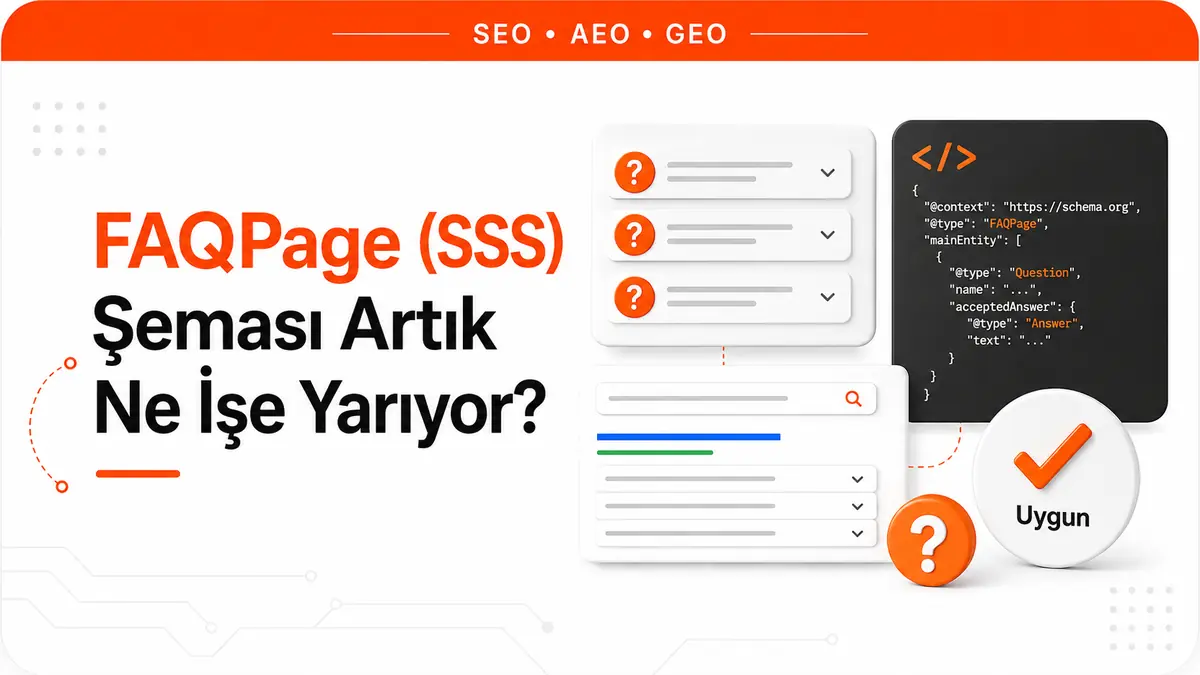
If you choose to keep the markup, its structure is: a mainEntity array under the FAQPage type, Question objects inside the array, and the answer text in each question's acceptedAnswer field.
{
  "@context": "https://schema.org",
  "@type": "FAQPage",
  "mainEntity": [
    {
      "@type": "Question",
      "name": "Do I need to remove FAQPage schema from my page?",
      "acceptedAnswer": {
        "@type": "Answer",
        "text": "It is not required. Unused structured data does not cause problems for search, but it has no visible effect either. The decision depends on whether the markup matches the visible FAQ section on the page."
      }
    }
  ]
}
The only critical rule here is that the questions and answers in the schema must be visible on the page. This rule is not a rich result requirement but a general rule of structured data; it remains valid even though the feature has been shut down. If your plugin outputs questions that are not on the page, the markup is wrong.
The role of the validation tool has changed too. Since FAQPage is no longer among the supported features, the tool should not be expected to report your markup as a rich result candidate. Today you use the Rich Results Test not to hunt for a feature but to see that the structured data on the page parses correctly and genuinely represents the page.
Do not build a strategy around a single rich result type
FAQ is not the only feature to be shut down. How-to rich results were also removed, first on mobile and then on desktop, and the type was retired completely. Google has also taken down the documentation for types such as course info, estimated salary, learning video, special announcement and vehicle listing, because these results are no longer shown in Search.
The practical meaning of this trend is that the visual output a markup type produces today is not a permanent asset. Structured data should be built not as a visibility trick that leaves nothing behind when it disappears, but as a layer that accurately describes to machines the information the page already carries. Built this way, when a feature is shut down, all you lose is a box, not the value of your content.
Frequently Asked Questions
I still see expandable question blocks in search results. Who is showing them?
The blocks you see are not generated from pages' FAQPage markup. Question blocks created by Google's own systems and a rich result generated from a page's structured data are different things. Seeing question boxes in results does not mean your markup is working.
My plugin keeps outputting FAQ schema automatically. Should I turn it off urgently?
It is not urgent. The criterion is whether the markup produced matches the visible content on the page. If the plugin only marks up questions that are already written on the page, you can leave it. If it generates questions from a template that are not on the page, turn it off; this is no longer about a rich result you might lose but about incorrect structured data.
Should I remove the FAQ section from the page as well?
No. What was removed was the visual payoff of the markup in search results, not the value of the section itself. A section that addresses real follow-up questions with short, self-contained answers helps readers make a decision without leaving the page and gives the content passages that can be cited on their own. What should go are the filler questions.