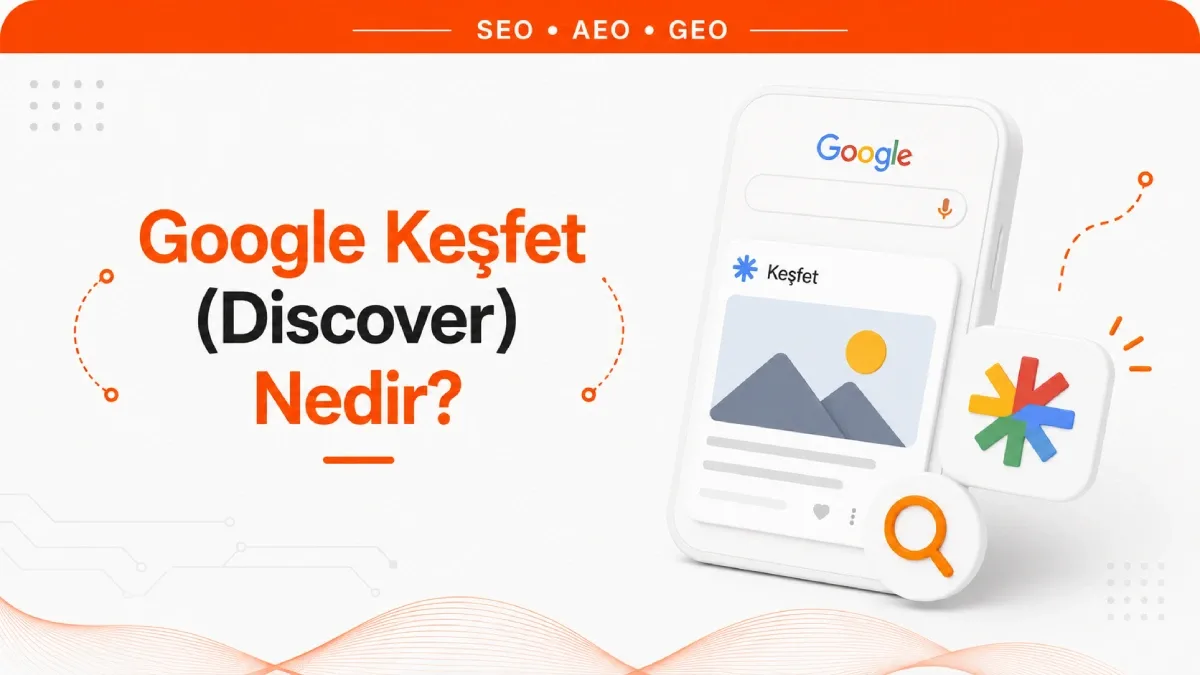
Google Discover is a personalized feed that runs within Google Search and shows users content without them searching. In classic search, the user types a query and gets a list of results. In Discover, there is no query: Google brings content it selects based on the user's interests to their phone screen as cards with large images. The content doesn't wait for the user to search for it; it reaches them first. That is why, for site owners, Discover is a second source of traffic, independent of search.
The feed lives only on mobile surfaces: it appears in the Google app, on the home screen of some Android phones and on Chrome's mobile new tab page. The feature got its current name in 2018: Google renamed what had until then been called Feed to Discover, and at the time of the announcement said the feed reached 800 million users a month. In the Turkish interface it is called Keşfet; Discover and Keşfet are names for the same feature in two languages.
What signals does the feed run on?
The feed runs not on queries but on user signals. According to Google's official documentation, Discover selects content based on the user's Web & App Activity (the search and browsing history stored in the account). The topics a user follows, the sites they visit and their search habits form an interest profile; the feed ranks content that matches this profile. Users can also follow topics manually or hide cards they aren't interested in.
On the content side, selection balances freshness and staying power. Fresh content dominates the feed, but Google can also show older content if it matches the user's interests. What decides it is not the publication date but the value the content holds for that particular user.
How is it different from Google Search?
The two channels use the same index but work on different logic. In search, demand starts with the user; in Discover, Google makes the offer. This difference changes everything from content strategy to traffic expectations. The table below puts the two channels side by side:
| Criterion | Google Search | Google Discover |
|---|---|---|
| Trigger | A query the user types | The user's interest profile |
| Intent | The answer to a specific question | Browsing and discovery without a query |
| Ranking basis | Query-to-page match | Interest-to-content match |
| Nature of traffic | Relatively stable and predictable | Volatile, driven by spikes and drops |
| Appearance | A list of blue links and rich elements | Content cards with large images |
The practical consequence: search traffic is something you target, while Discover traffic is something you earn. Ranking a page at the top for a particular keyword is work you can plan; getting the same page into the feed is an outcome that depends on content quality and user interest.
Where does Discover appear?
The feed can be accessed from three main surfaces. A user who opens the Google app sees Discover cards directly below the search box. On many Android phones, swiping left from the home screen brings up the same feed. In the mobile version of Chrome, the new tab page lists these cards below the address bar.
There is no Discover feed on desktop; the feature is built around mobile usage habits. This means Discover traffic consists almost entirely of mobile visitors: page speed, mobile friendliness and image quality carry extra weight in this channel.
How does content get into the feed?
The entry requirement is surprisingly simple: Google's documentation states that any content that is indexed and complies with content policies is automatically eligible for Discover. No special tag, application or structured data is required. Being in the index is enough for a site to be a candidate.
Eligibility and visibility, however, are separate things. The same documentation says clearly that being eligible doesn't guarantee being shown. Appearing in the feed is not a ranking race but a selection process: content is shown when it matches the profile of the relevant audience. That is why the work of "getting into Discover" is not a technical activation step but producing content worth selecting. The measurable rules for producing it are the subject of the next section.
What are the content and image rules?
Google officially lists the practices that increase the likelihood of standing out in the feed. The main criteria are:
- Use large images: images should be at least 1,200 pixels wide and served with the max-image-preview:large setting (a robots directive that allows large previews) or with AMP (accelerated mobile pages technology).
- Mark up the image: specify the page's representative image with the og:image meta tag or schema.org markup.
- Capture the essence in the title: the page title should capture the essence of the content, not create a curiosity gap.
- Avoid clickbait: Google keeps clickbait titles that drive engagement by playing on morbid curiosity, outrage or similar emotions out of the feed.
- Offer unique value: content that tells a story well or provides information not found elsewhere is prioritized in the feed.
The common denominator of this list is trust. Discover is a feed that arrives uninvited; Google can only keep extending that invitation with content that doesn't mislead. The quality principles that apply to citable content in AI-assisted search work here too; we cover the rules on that side in detail in our guide to content that gets cited by AI.
Why is Discover traffic so volatile?
The volatility is not a bug; it is by design. Google's official documentation states that Discover traffic is less predictable than keyword-based search visits and should be thought of as supplemental traffic. A piece of content can reach millions of users through the feed and bring heavy traffic for days, and then its impressions can drop close to zero.
The main reason is that the feed depends on user interest. Interest profiles change constantly: users turn to new topics, old interests fade, the news agenda shifts. Unlike search traffic, which rests on steady keyword demand, Discover impressions stand on this shifting ground. The healthy strategy is to plan Discover as a bonus channel, not a main channel: when it comes, it adds growth; when it goes, it doesn't create a crisis.
How do you track performance in Search Console?
Discover performance is measured in Search Console. If your site's content appears in the feed and the data exceeds a minimum impressions threshold, a separate Discover performance report appears in Search Console. The report lists impressions, clicks and CTR (click-through rate) for the last 16 months, and it also covers traffic from the Chrome surface.
Keeping the report separate is deliberate: Discover data isn't mixed in with search performance. This lets you see, on its own, which content made it into the feed and which types of images and titles drove clicks. If you don't see a Discover report, the site hasn't entered the feed at all; this isn't a penalty, the site simply hasn't been selected yet.
Can you rely on Discover traffic?
The assessment comes down to three findings. First, Discover is a real and large channel: it brings a query-free, image-driven and entirely mobile audience to your site. Second, the key to entry is technical but limited: getting indexed and meeting the image rules makes you a candidate but doesn't guarantee visibility. Third, this traffic is structurally volatile; in Google's own words, it should be planned as supplemental traffic.
The right positioning is this: search traffic is the business's main artery, while Discover is a strong but irregular supporting channel. A site that wants lasting visibility first earns rankings for the keywords people search for, then builds the pattern of high-quality, image-rich content that Discover rewards. Visibility on AI-assisted search surfaces is now part of this plan too; our AI visibility service measures and manages how your brand appears on these surfaces.
Google may update Discover's interface and rules; follow Google's official documentation for the current criteria.
Frequently Asked Questions
How is Discover content selected?
The user's interest profile determines the selection. Using the Web & App Activity data in the account, Google identifies the topics a user is interested in and places content matching those topics in the feed. On the content side, freshness, image quality and how trustworthy the title is all play a role. The same piece of content may make it into one user's feed and never appear in another's.
How do you turn Google Discover on or off?
The feed is managed from the Google app's settings. Within the app, users can turn the Discover feed on or off or edit their interests. The feed on the Android home screen can also be removed from the phone's settings. Turning it off only hides the feed on that device; it doesn't affect whether sites appear in Discover.
Do you need a special tag to appear in Discover?
No. No special tag, application or structured data is required. Every page that is indexed by Google and complies with content policies is automatically a candidate. What increases the chance of appearing is not a technical activation step but large images, honest titles and high-quality content that matches user interests.
Are Discover, Google Feed and Keşfet the same thing?
Yes, they are names for the same feature. Google offers this feed globally under the name Discover; in the Turkish interface, the same area appears as Keşfet. Before 2018, the feature was called Google Feed. You may come across all three names in different sources, but they all describe the same personalized content feed.
Can older content appear in Discover?
Yes. Although fresh content dominates the feed, Google can show useful content that matches a user's interests even if it was published long ago. The deciding factor is not freshness but the value the content holds for that user. That is why evergreen guides with lasting value can make it into the feed even years later.