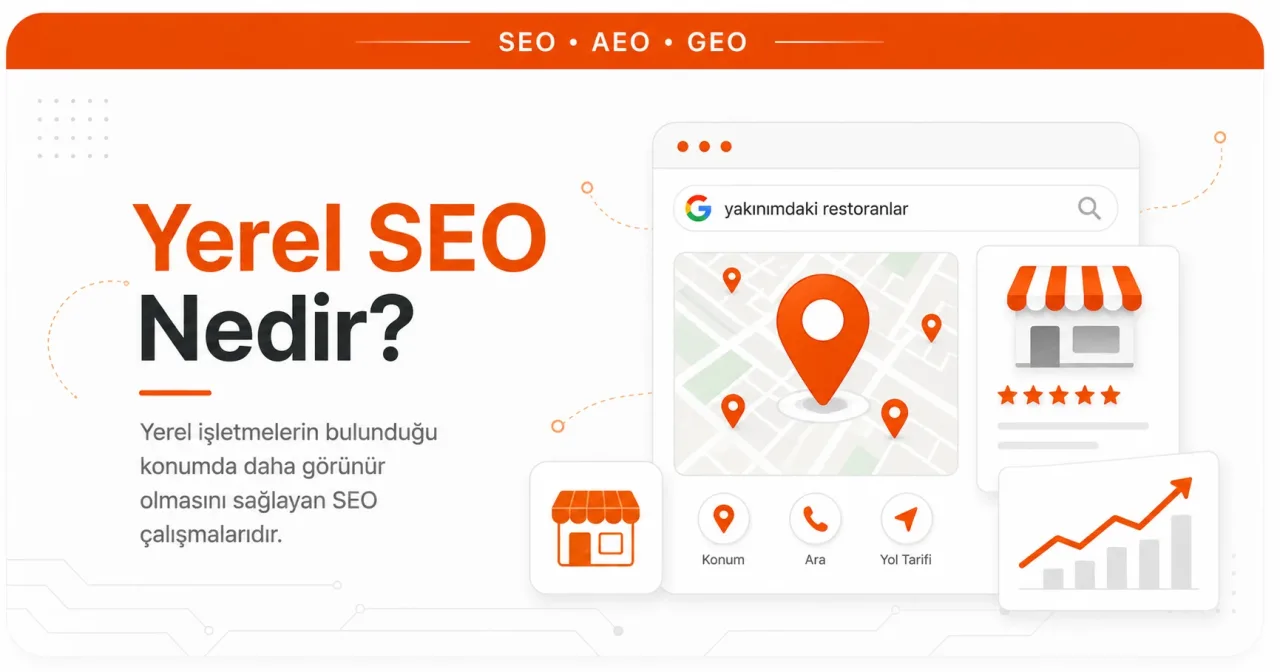
When someone types "dentist near me" into their phone, the first thing on the screen is not blue links. At the top there is a small map, and below it a few business cards showing the rating, the number of reviews, how many minutes away the business is and whether it is open. The cards have call and directions buttons. Some users make their decision right here without scrolling down at all; the classic results list starts below this block.
Local SEO is the full set of work that makes a business findable both in this block and in the classic results for searches with local intent. It is called local SEO in English-language sources (and sometimes "lokal SEO" in Turkish). Google's own definition sets the boundary of the work: when a user searches for a business or place near where they are, they see local results on Google Maps and in Search. So there is not a single list but two different result surfaces working side by side on the same screen.
Why do local results work separately from classic results?
The two lists are fed from different sources. The short business list that comes with the map is generated from Google Business Profile records. The classic list below it is made up of web pages. In the industry, the area containing the map and the business cards below it is called the local pack; usually three businesses are listed there, and you switch to Maps for more.
In practice, this distinction means that your site ranking first in the classic results does not guarantee that your business listing will appear in the map block, and vice versa. Two separate evaluations run for the same query: one ranks the page, the other ranks the business listing.
Local intent shows up in two ways. The first is the user typing a city or district name. The second is no place name being typed at all; in that case Google adds the location itself. Google's definition of distance says this explicitly: if the customer doesn't share their location, Google uses what it knows about the customer's location. So a query doesn't need to contain "near me" to be interpreted locally.
Which signals does Google use to determine local rankings?
Google answers this question in its own help documentation. Local results are based mainly on three factors: relevance, distance and prominence. The same page includes one more warning: there is no way to request or pay for a better local ranking on Google. That sentence is the clearest yardstick you have when evaluating a local SEO proposal.
| Signal | Google's definition | The business's control |
|---|---|---|
| Relevance | How well a Business Profile matches what the user is searching for | High. Category, service description and completeness of information are directly in your hands |
| Distance | How far each business is from the customer who is searching | Next to none. Apart from the decision about location and service area, there is nothing to adjust |
| Prominence | How well known the business is | Medium term. It builds up through the number of sites that share the business's link and the accumulation of reviews |
Google explains the prominence item in a little more detail: it depends on information such as the number of websites that link to your business and the number of reviews you have received, and more reviews and positive ratings can contribute to local ranking. The wording here deserves attention. Google says they can contribute; it does not give a guarantee, and it does not define review count as a ranking switch on its own.
Which of these three signals can you actually work on?
Distance is calculated relative to the searcher. There is no distance setting you can change on your page, your profile or your server. So one of the three signals is fixed from the start, and all the work concentrates on the remaining two.
Relevance is the side that moves quickly. When a wrong category choice, an incomplete service list or empty fields are fixed, the profile starts matching more queries. Prominence, on the other hand, is cumulative; the places where the business's name appears online and its review history build up over time and cannot be set up in a single step.
This distribution has two concrete implications for planning. First, aiming to win the map block for searches made from a point where the business is physically far away is not realistic; at that point there are closer businesses offering the same service. Second, the way to capture demand from distant areas is not the map block but the classic organic results, because distance is not a constraint of the same weight there. A healthy local SEO plan targets these two surfaces separately.
What is the difference between local SEO and classic SEO?
Classic SEO is concerned with ranking a web page. Local SEO adds a second entity: the business listing. Because the thing being ranked changes, the evaluation criteria change too. On the classic side, the discussion is about content, technical accessibility and external links. On the local side, relevance, distance and prominence come on top of these.
The second difference is the verification step. You don't need anyone's permission to publish a web page, but for a Business Profile to be shown with confidence in search results, the business must be verified. Google describes this step as a process that confirms you are authorized to represent the business and increases the likelihood of being shown in search results.
The third difference concerns expectations. Local SEO does not replace classic SEO. A business card appearing in the map block gives the user an address, a rating and a phone number; the answers to questions about price, references, scope and trust are still on the website. The profile listing makes the first contact, and the site completes the decision.
Which businesses need local SEO?
Google's eligibility rule provides the answer: the business must have a physical location that customers can visit or must serve customers at their location. This definition covers two models.
- Business with a physical location: a clinic, restaurant, store or service point that receives customers at its own address.
- Service-area business: a business that visits customers or makes deliveries and does not serve customers at its own address. In this model, the address is removed from the profile and only the service area is entered.
- Hybrid business: a business that both serves customers at its address and visits them. The address and service area can be entered together.
The cases that fall outside eligibility are also clear. A place without permanent signage is not eligible to be shown as a storefront and should be listed as a service-area business. A business that does not operate at a rented mailing address, in other words a virtual office, is not eligible to create a profile. PO box addresses at post offices are not accepted either.
For an e-commerce site that sells entirely through shipping and never has physical contact with customers, or for a software business serving the whole country remotely, the local block is not the right target. For these businesses, traffic is won in the classic results.
City size also affects the decision. Because distance is calculated relative to the searcher, a single address does not carry the same advantage in searches made from every part of a large city. In cities with many districts, the work goes down to the district level and location pages on the site come into play; we detail how competition at this scale is handled on our Istanbul SEO agency page.
What does local SEO work consist of?
The list below is the basic skeleton of a local SEO project. The order is not random: each step builds on the previous one.
- Setting up and verifying the profile. The carrier of local visibility is the Google Business Profile, and the profile itself is free. Because setup, verification and the fields in the profile are a separate topic, we explain them step by step in the Google Business Profile article.
- Entering complete information. Google says businesses with complete and accurate information are more likely to be shown in local results. The full address, opening hours including special days, the correct business category and attributes such as parking or Wi-Fi fall under this. Retail businesses in eligible countries can also show in-store products on the profile.
- NAP consistency. The business name, address and phone number need to appear in the same form on the site, the profile and directories. Different spellings make the same business look like different listings. Details are in the NAP information article.
- Visibility on Maps and review management. Replying to reviews shows that you value feedback; positive reviews and helpful replies can help the business stand out. We cover how visibility in map results works in the Google Maps SEO article.
- Location work on the site. Content for the areas served, contact information placed on the site in a readable form and business information marked up with structured data are part of this step. This is the layer that keeps you visible in the classic results even when the local block is lost.
- Measurement. The profile performance report shows how many searches came through the business name and how many through the service name; Search Console provides the location queries on the site side. Unless the two sources are read together, you cannot see what local SEO has changed.
How long does local SEO take to deliver results?
Google does not give an official timeframe, and producing estimates to fill this gap would be wrong. However, the structure of the signals points to two different speeds. Correcting profile information affects relevance, and these changes pay off relatively quickly. Prominence, by contrast, takes time because it builds up through mentions and reviews.
There is also an expectation to rule out from the start. Since there is no way to request or pay for a local ranking on Google, a proposal that claims to guarantee a ranking within a fixed period is making a promise with nothing behind it. What you buy in local SEO is not a ranking but the correct setup of the signals that determine ranking.
The most common local SEO mistakes
- Adding keywords and a city to the business name. Google wants the name to reflect the real-world name, and it states explicitly that adding unnecessary information to the business name is not allowed and may lead to the profile being suspended.
- Creating more than one profile for the same business. The rule is one profile per business. Multiple profiles can cause problems with how information is displayed on Maps and in Search.
- Using an ineligible address. Virtual office addresses where the business does not operate and PO boxes are not accepted for a profile.
- Buying reviews or collecting reviews with incentives. Reviews and ratings published in exchange for payment violate Google's contribution policies. The policy also prohibits offering incentives such as discounts or free products in exchange for reviews and asking customers specifically to write positive reviews.
- Setting up the profile and neglecting the site. The profile makes the first contact, but the purchase decision often matures on the site. When the site side is not worked on, local visibility turns into clicks but not into customers.
Frequently Asked Questions
Does a Google Business Profile cost money?
No. Google states on its own product page that businesses with a physical store or a service area can create a Business Profile for free. Any fee paid is not for the profile itself but for the service of setting it up and managing it.
Can a business that doesn't want to share its address appear in local search?
Yes. Businesses that don't serve customers at their own address, but visit them or make deliveries, are listed as service-area businesses. In this model, the address is removed from the profile and only the areas served are entered.
Does creating a second profile for the same business increase visibility?
No. Google asks that only one profile be created per business. Instead of multiplying visibility, a second listing can cause problems with how information is shown on Maps and in Search.
Is local SEO just Maps work?
No. The map and business cards are one surface of visibility; the second surface is the classic results list sitting below them for the same query. Because the answers to the user's questions about price and scope are there, the two surfaces are worked on together.