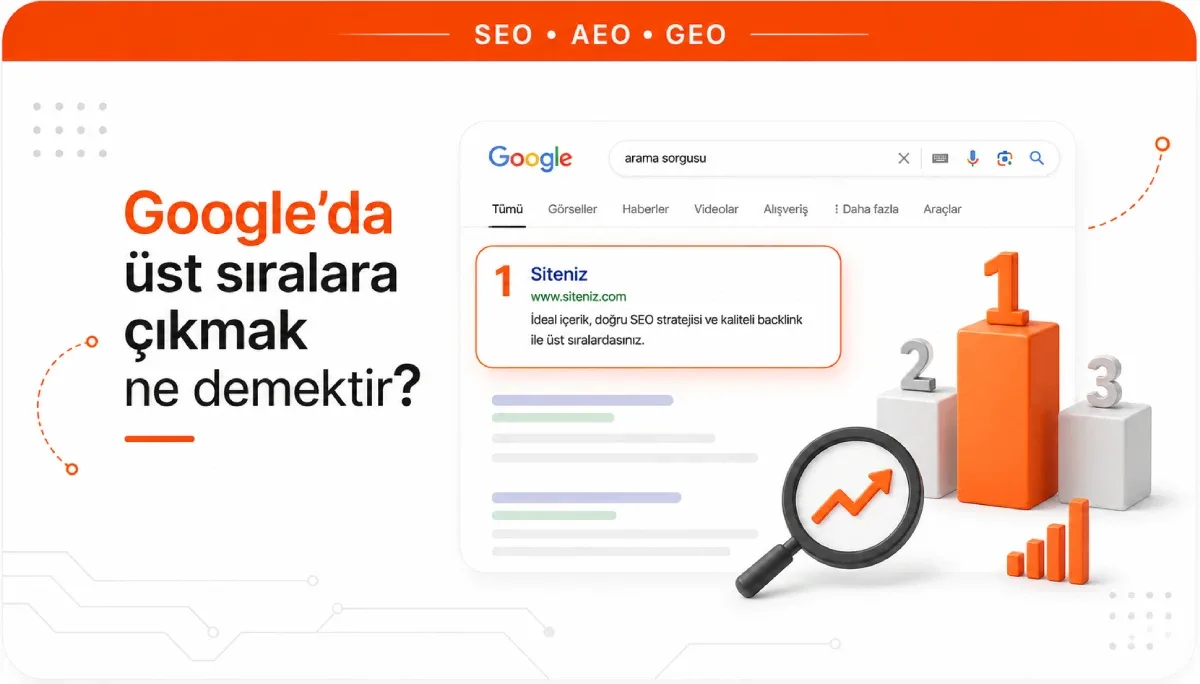
Same search on two phones, two different number ones
Imagine two people at the same table taking out their phones and searching for the same keyword at the same moment. Most of the time they won't see the same list. The site at the top for one is third for the other; for one, a map box fills the first screen, while for the other the text results start right at the top. Both are seeing a real result, because there is no single ranking list that everyone sees at the same time.
Ranking at the top of Google is not a permanent property of a site; it is the result a specific query produces in a specific context. The word "context" is doing real work here: when building results, Google takes into account the user's location, language, device type, their recent searches in that session and whether they clicked a result and came back. All of these variables are on the user's side and outside the site owner's control.
The practical consequence ends most debates before they start. A page sitting at number one in the agency's screenshot may be fourth on the client's phone in another city. Neither is lying. They are simply using the wrong unit of measurement.
Is the ranking you see personalized?
Personalization is the most exaggerated explanation for differences in results. Google's own explanation is more measured: personalization does not affect all results; some results are personalized while others are not. When it does have an effect, it does not always change the order of individual results; sometimes it changes the order of blocks on the page. If your search history leans toward video content, video results may move above web links.
You can check this instead of guessing. At the bottom of the results page there is a note stating whether results for that query were personalized, along with a link that opens the non-personalized version of the same query. When you click the link, the list often doesn't change. Google spells out what this means: if the two lists look the same, the effect of personalization on that query was not big enough to move the results.
So the position you see when you search for your own site from the browser you use every day is not a measurement but a single sample. Checking the non-personalized version before concluding that your ranking has dropped heads off most needless panic at the very first step.
The top position for which query? Branded, generic and local
Asking about a top ranking means nothing unless you say which query you mean. The same site's position on the same day tells a completely different story depending on the type of query.
| Query type | Example | How much a top position tells you |
|---|---|---|
| Branded query | The company's own name | Almost nothing. Being at the top for your own name is expected and does not prove any work was done |
| Generic commercial query | The name of the product or service, price and comparison questions | This is where the real information is. People who don't know you come from these queries, and this is where the competition is |
| Local query | "Near me" searches or searches that include a city name | A separate surface. Map results are ranked by different criteria than the classic list |
Local results need to be treated separately, because Google says it bases map results mainly on three criteria: relevance, distance and prominence. Distance is, by definition, calculated relative to the searcher. That is why, in a local query, the idea of a number one position depends on where the user is standing at that moment, and two customers in two different districts may see two different businesses at the top. Google makes one more point clear on the same page: a better local ranking cannot be requested or bought.
If you are curious about what happens before ranking (how a page is first discovered, then indexed, and only then ranked), the basic framework is in the What is SEO article. This article covers the last link in that chain.
What does average position in Search Console tell you, and what doesn't it?
Search Console data is a more reliable way to learn your rankings than checking in a browser. The average position number there, however, does not measure what most people think it does.
Google calculates this value as follows: if a query returns more than one link to your site, only the position of the topmost link is recorded for that query. These values are then averaged across queries. Google's own example is easy to follow: if the first query returns your site at positions 2, 4 and 6, the position for that query counts as 2; if the second query returns it at positions 3, 5 and 9, the position counts as 3; the average of the two is 2.5.
The truly critical rule comes next. For a position to be recorded, the link must receive an impression, meaning it must actually be seen by the user. If your result is on the third page and the user only looked at the first page, no position is recorded for that search at all. If you see a dash instead of a position in the report, the meaning is clear: the user never saw your site for that query. If the same page received ten impressions on desktop and none on mobile, you will see a number for desktop and a dash for mobile.
Put these two rules together and here is what average position really is: an average calculated only from searches where someone actually saw you. An improvement in the number does not always mean you moved up. The average also improves when you stop appearing for queries where you showed up deep in the results. The opposite happens too: when you start appearing for a new and difficult set of queries, your average position falls while your traffic grows.
That is why the question "what position am I in?" has no single correct answer. The question you can actually answer is: for which query, on which device, in which location and seen by how many people?
What now sits above the classic number one?
The results page is no longer just a single ranked list. Above the classic list there may be an answer layer that summarizes the topic and contains source links. Google calls this AI Overviews. It describes the feature as an overview with links to supporting web sources and says it is designed to appear for queries where users can get more out of Search.
The way this layer is measured shows clearly why the idea of a top ranking needs to be redefined. In Search Console, an AI Overview has a single position in the search results, and all the links inside it are assigned the same position. A click on a link inside it counts as a click, but an impression only counts if the link is scrolled into view or the section is expanded.
In practice, this means that when a page appears as a source within the answer, it does not count as ranking first in the classic list, but in the searcher's eyes it is often higher than the number one position. It is possible to be a source in the answer layer and to hold a good position in the classic list for the same query, and each has to be earned separately.
Two kinds of claims need to be kept apart here. The idea that AI summaries send visits to a more diverse set of sites, and that clicks from these pages are higher quality, is Google's own assessment; it should not be presented as a finding verified by independent measurement. The part that is measurable and indisputable is the mechanism: the answer layer sits above the classic list and increases the likelihood that the user leaves without needing a link. How pages get selected as sources in this layer is the subject of the What is GEO article.
Why shouldn't a guaranteed number one ranking be taken seriously?
Google leaves no room for guesswork on this. In its guide to hiring an SEO, it says not to work with anyone who guarantees that their changes will take you to the number one position in search results, and to find someone else. Its starter guide states plainly that there is no secret that will automatically rank your site first.
This is not a matter of corporate policy; it follows from how the system works. If the result changes with the query, location, language, device and moment, then what is being guaranteed is not a fixed thing. No one can make promises about where the user searches from or on which device.
In practice, there are three ways to make such a guarantee technically true but useless:
- The guaranteed keyword is one that nobody actually searches for. Ranking first for an unsearched keyword is easy and brings nothing.
- The guaranteed keyword is actually your brand name. You are already at the top there.
- The guarantee is defined as the first page, but which city, which device and which language is never specified. A promise with no stated measurement conditions gets measured after the fact from wherever looks best.
What can be promised is different: the scope of the work, the deliverables, the data source used for measurement and a realistic estimate of improvement. The same Google guide says an SEO audit should provide exactly this, namely a realistic estimate of improvement and the amount of work required. A warning in that section of the guide is also useful in practice: during the audit stage, give read-only access in Search Console, not write access.
Is there a fee for ranking at the top?
This is the most searched question in this cluster, and the answer is clear: you cannot pay Google for organic rankings. Ads are a separate surface: they carry a "Sponsored" label and are kept apart from organic results, and advertising does not change organic rankings. A better position cannot be bought in local results either.
So what you pay for is not a placement fee to Google but the work of earning the ranking: content, technical fixes, authority building and measurement setup. The variables that determine the cost of this work are well known:
- The competition level of the target queries. A high-volume commercial keyword and a narrow long-tail query are not the same job.
- The site's starting point. A site that is indexed and has commercial pages is not the same workload as one built from scratch.
- The number of target queries. There is a serious difference in scope between a single keyword and an entire category.
- Geographic and language scope. A single city, a whole country and multilingual targets produce different volumes of work.
If you want to see concretely how the scope of a project is defined and what is delivered, the SEO packages page shows these scope distinctions.
How do you set a realistic top ranking goal?
Writing a goal as a position number means making a promise that cannot be measured. A measurable goal is built not around a position number but around conditions, and it includes these elements:
- Which queries. Non-branded queries with commercial value are chosen; the brand keyword does not count as a success metric.
- Which geography and language. Nationwide or a single city, and which language users search in.
- Which device. Mobile and desktop results behave differently and are tracked separately.
- Which data source it is measured with. Impression and click data, not a look in the browser.
- Which business outcome. Not position, but qualified clicks and the form submissions, calls or sales that follow.
- When it will be evaluated. The evaluation date is set at the start, not renegotiated every week.
Expectations about timing can also rest on documented sources. Google says a change can be reflected in results sometimes within a few hours and sometimes after a few months, that you usually need to wait a few weeks to assess the impact of a piece of work and that not every change will produce a noticeable effect. These three points keep both camps in check: those who expect results in a week and those who count every change as a win.
This article covered what a top ranking is and what it is not. The work that gets you there (the sequence from query selection to content and technical execution) is laid out step by step in the How to do SEO article.
One last point: a top ranking set as a goal is a number whose measurement is open to debate and which, once reached, says nothing on its own. What matters is appearing in front of someone who doesn't know you for the query they will use to find you, and looking good enough to be clicked when you do. The position number is an indicator of that, not the thing itself.
Frequently Asked Questions
I see my site in first place when I search for it, but my client doesn't. Why?
The most likely reasons are differences in location, language and device; these are the context signals Google takes into account when building the result. The second reason is personalization. If you are checking from a browser you often use to visit your own site, the list you see is not representative. You can compare the two using the non-personalized version link at the bottom of the results page.
Does getting onto the first page bring traffic?
Getting there is not enough on its own; you need to be seen. Search Console only records a position if the link received an impression, meaning the user actually saw it. A result near the bottom of the page produces neither an impression nor a click if the user doesn't scroll that far. On top of that, when there is an answer layer above the list, the user may leave without clicking any link.
Is ranking at the top of Google Maps the same as ranking at the top organically?
It is not the same. Map results are ranked by relevance, distance and prominence, and because distance is calculated relative to the searcher, the result changes with the user's location. It is possible to rank well in the organic list and not appear in map results at all, and vice versa.
Did my ranking drop, or did the results page change?
You tell these two apart with different data. If your impressions and position stay stable while your clicks drop, it is probably not your ranking that changed but the layout of the results page above you. If your position value is falling and impressions are falling too, the problem is on the ranking side. Measuring with impression and click data for the same set of queries, rather than a single browser view, makes this distinction possible.