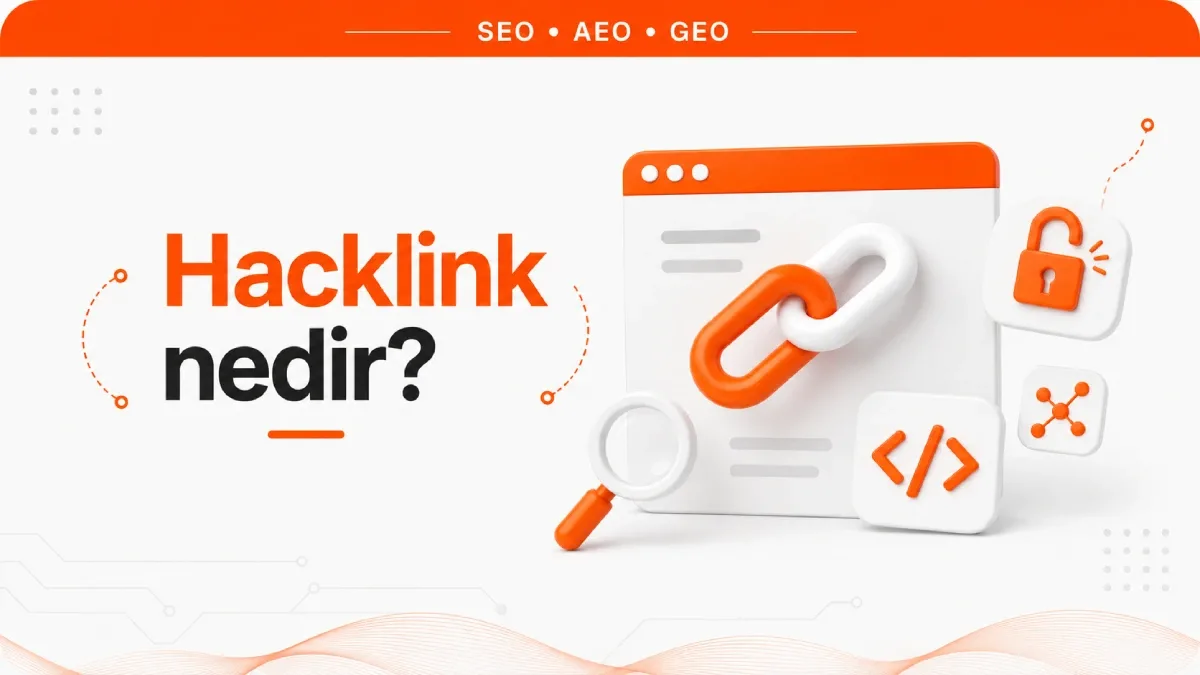
A hacklink is a backlink (an inbound link) that is secretly planted on a website after someone breaks into it without the owner's permission. The attacker gains access to a site with a security vulnerability and hides a link pointing to their own target site in the page code. The site owner is usually unaware of it; the link can sit in an invisible area for months. The term combines the English words "hack" (unauthorized access) and "link".
Google treats these artificial links as link spam and subjects them to heavy penalties. SpamBrain, Google's AI-based spam prevention system, caught 5 times as many spam sites as in 2021 and 200 times as many as when it first launched. The company also reported that more than 99% of search visits were spam-free (Google's 2022 webspam report). In other words, while a hacklink may look like a short-term win, it is built on a loophole that keeps getting smaller.
This guide explains what a hacklink is, exactly what harm it does to a site, how to spot it and how to clean it up. It also clarifies the difference between this black-hat method and safe link building. The two do not lead to the same outcome; they lead to completely opposite ones.
How are these hidden links planted?
The starting point of the attack is always a security vulnerability. The attacker gets into the site through an outdated theme, an old plugin or a weak admin password. On widely used systems such as WordPress, attackers scan for known vulnerabilities and get in as soon as they find a vulnerable site. That is why a hacklink is a security breach problem before it is a link problem.
Once access is gained, the link is placed somewhere out of sight. The most common hiding techniques are:
- Areas that are invisible on screen: the text color is set to match the background, or the link is pushed off-screen.
- Template areas repeated on every page, such as the site's footer or sidebar.
- Hidden content blocks added directly to the database; they do not appear in the admin panel.
- Newly created fake pages secretly pushed into the index.
These links are usually planted in bulk rather than one at a time. A single hacked site can contain links to dozens of different targets. Because the attacker sells the same access to multiple buyers, the host site suffers more damage and the spam network grows.
What is the difference between a hacklink and a safe backlink?
The two concepts look similar on the surface, because both are links from one site to another. The difference lies in how the link was created and how Google sees it. The gap is as wide as the one between an invited guest and a burglar. The table below puts the two methods side by side:
| Criterion | Hacklink | Safe backlink |
|---|---|---|
| How it is created | Unauthorized access, hidden placement | Editorial decision or mutual consent |
| Site owner's awareness | None | Yes |
| Google's assessment | Link spam, a violation | Natural signal |
| Effect on the host site | Security breach and penalty risk | No harm |
| Durability | Deleted once noticed; the penalty remains | Long-term value |
The critical point is this: the method is risky both for the site receiving the link and for the site hosting it. The host site has to deal with a security breach and the threat of a penalty. The receiving site may seem to win in the short term, but it becomes dependent on a link that is not permanent and carries a violation signal. Lasting authority is built only with high-quality backlinks; we cover what that means in a separate guide.
How does a hacklink harm my site?
The harm this kind of link causes is not one-dimensional; it hits security, rankings and reputation at the same time. For the host site, the most concrete dangers are:
- Manual action penalty: Google can apply a manual action (a decision by a human reviewer) to a site that hosts link spam. Rankings drop, and the issue is reported in Search Console.
- Algorithmic loss of value: Google's systems that target link spam algorithmically lower trust in pages carrying spam signals; no separate warning is sent.
- Security warning: a hacked site may be flagged with the label "This site may be hacked". This label is visible in search results and destroys click-through.
- Loss of reputation: if a visitor encounters a malicious redirect, their trust in the brand is shaken; in some cases, browsers block access to the site entirely.
For the party buying the link, the picture is even more fragile. A hacklink is not permanent: when the owner notices the breach and deletes the link, the link you gained disappears overnight. In the December 2022 link spam update, Google trained SpamBrain specifically to catch sites of this kind, meaning sites that buy spam links and sites that pass them on. So the money paid buys a result that is both risky and temporary.
Does Google penalize these links?
Yes, Google explicitly prohibits this practice. Google Search's spam policies define artificial links created to influence search rankings as link spam. The same policy explicitly lists adding hidden links, placing hidden text and distributing links through hacked content as violations.
Enforcement comes in two forms. The first is a manual action: reviewers detect the violation, a penalty is applied to the site and the issue is reported in Search Console. The second is algorithmic loss of value; systems such as SpamBrain ignore these links or lower their trustworthiness. Google's official advice is clear: harmful links should be found and removed, and if they cannot be removed, they should be reported to Google with a disavow file.
How do you detect a hidden link?
The first rule of detection is regularity: this check is not a one-off but an ongoing task. Because the attacker tries to stay hidden, the symptoms are often not visible on the surface. The following methods expose hidden links:
- In Search Console, watch for unexpected pages being indexed or a sudden rise in links; unfamiliar sites in your link profile are the first sign.
- Scan the page source for unusual outbound links; look especially at the footer, the sidebar and hidden areas at the bottom of the page.
- Search for your own site by its domain name and check whether unexpected topics (for example, keywords from unrelated industries) show up.
- Review server files and the database by their last modified dates; unexpected edits point to a breach.
These checks require knowing your existing link profile. A site owner who does not know what a healthy profile looks like will not notice a harmful link that has slipped in either. Our guide What is a backlink? lays the groundwork you need for this detection.
How do you clean up a harmful link?
Cleanup works on two layers: first close the vulnerability, then remove the link. Simply deleting the link is not enough; as long as the way in remains open, the attacker will come back. Follow these steps in order:
- Close the security vulnerability: update the theme, plugins and core software, and change all admin passwords.
- Completely remove the hidden link and any malicious code left by the attacker from the site code and the database.
- Remove the fake pages the attacker created and request their removal from the index.
- If you received a security warning, request a reconsideration from Google after the cleanup.
- For harmful links that cannot be removed, prepare a disavow file and submit it to Google.
Monitoring after cleanup is essential. A site that has been hacked once can become a target again when a vulnerability reappears. That is why security updates and link profile checks should be built into a monthly routine; a one-off intervention does not provide a lasting fix.
What should you do to build links safely?
The right path is to earn authority, not steal it. A hacklink is a shortcut that invites penalties; sustainable rankings are built with clean, editorial links. Safe link building rests on three principles:
- Links come from relevant sites with real traffic; relevance and authority are sought together.
- Every link carries editorial value: the content is actually read, and the link sits naturally within it.
- The link profile is diverse and balanced; the goal is natural growth spread over time rather than a sudden pile of links.
Seobaz's backlink packages are built within exactly this safe framework: from authoritative sites with real traffic, inside editorial content, with no penalty risk. The foundation of this approach is building lasting, transparent authority instead of the fake gains a hacklink offers.
The verdict on hacklinks
A hacklink is a form of link spam that exploits a site's authority without permission and that Google explicitly prohibits. It brings a security breach, ranking drops and loss of reputation to the host site, and a temporary, penalty-prone result to the party buying the link. Both sides lose; the only winner is the attacker.
Protection comes down to two things: security and transparency. Regular updates and audits keep the site closed to attacks, and link authority is built through real, editorial work rather than hidden methods. As Google's spam prevention systems get stronger every year, the lifespan of hidden methods is getting shorter; lasting rankings come from the patience of clean link building.
This content is for informational purposes. If you detect a suspicious link or a security breach on your site, verify the current status in Search Console and carry out the necessary technical work with a qualified specialist.
Frequently Asked Questions
Are hacklinks legal?
Because a hacklink involves unauthorized access to a site, it is a violation both legally and under search engine rules. Breaking into a system without permission falls under computer crime, and Google treats it as link spam and penalizes it. In other words, a hacklink is neither a legal nor a sustainable method; the price of short-term gain is lasting risk.
Is it safe to buy hacklinks?
Buying hacklinks is not safe. The link you buy sits on someone else's hacked site and is deleted when the site owner notices the breach. Google can also penalize the site relying on that kind of link under its link spam enforcement. The money you pay buys a result that is both temporary and risky; it provides no lasting value.
How can I tell if my site has a hacklink?
The first sign is a sudden increase in links from sites you don't recognize in Search Console, or unexpected pages being indexed. Search for your site by its domain name and pay attention if unrelated topics come up. Regularly checking hidden areas in the page source and the last modified dates of server files also exposes hidden links.
Is a hacklink penalty permanent?
The penalty is not permanent, but it does not lift on its own either. First, close the security vulnerability and completely clean up the hidden links and malicious code. If you received a manual action, request a reconsideration from Google after the cleanup. If the process is handled correctly, rankings recover over time; if it is neglected, the decline continues.
Are a hacklink and a backlink the same thing?
No, they are complete opposites. A backlink is a natural link created with the consent of both parties or by editorial decision, and it adds value to the site. A hacklink is a hidden link placed through unauthorized access and counts as a violation. One builds authority; the other puts both the host site and the receiving site at risk of a penalty.